In October, in New York state, biologists from the US Fish and Wildlife Service captured a bright yellow-orange burbot (Lota lota), instead of the usual patchy greenish-brown. The most likely cause is xanthochromism, a rare genetic condition that suppresses normal pigmentation and allows yellow tones to prevail.
An eel-looking fish, with a single barbel under the chin and bright yellow coloring. This is how the specimen presented itself burbot (scientific name lota lota and burbot in English) captured by the team Aquatic Invasive Species Survey of the Lower Great Lakes Fish and Wildlife Conservation Office during a routine monitoring in the Port of Oswego, Sul Lake Ontario in New York state. The program, designed to find invasive species, instead found a rare native species for that stretch of lake (it is also the first burbot ever recorded in a scientific survey in that port) and with a color which, according to the body, is due to the xanthochromism or xanthochromiaa genetic condition that is observed much less often in fish than albinism and melanism.
As the FishBase platform explains, the burbot is the only member of the Lotidae family (relatives of cod) to live in fresh watercan reach 152 centimetres in length, although it usually stops around 40. It is active above all at dusk and at night, prefers cold and deep waters and reproduces in mid-winter, under 6°C: groups of up to 20 individuals intertwine on the bottom forming a sort of ball. The species also lives in Italywhere it is native only in the Po basin and large pre-Alpine lakes. The typical color is greyish, light brown or tobacco, with dark spots on the body, head and fins, perfect camouflage for the seabed.
The color of the fish depends on the chromatophores (specialized cells that contain pigments): i melanophores they are loaded with dark melanin, the xanthophores contain yellow and orange pigments. In the normal livery these layers overlap like colors mixed together on a palette. In xanthochromism, explains the USFWS, a genetic mutation suppresses normal pigmentation and yellow-orange remains the only one to express itself.
The result is a fish without camouflagemuch more visible to predators. This is also why similar individuals are rarely observed: few reach adulthood. It must be said, however, that for the Oswego specimen the diagnosis is not yet confirmed. USGS biologists found him in poor health, and sent him to Cornell University College of Veterinary Medicine for analyses. The results could also say something about the health of a population that is already very small in Lake Ontario.
Burbot is not the only fish “colored by mistake”. In 2024, off the Caribbean coast of Costa Rica, fishermen caught and then released one orange nurse shark about 2 meters long, with white eyes. The study published on Marine Biodiversity talks about xanthochromism combined with albinisma case never before documented in this species.
Also in Costa Rica, a small bottom fish from the stingray family, Urotrygon asteriaswith a partly yellow body was captured twice after some time during monitoring.
Finally, in the Gulf of Mexico, a female stuff it (Centropomus undecimalis) 77 centimeters long was found orange instead of grey: it is the first case of its kind recorded in that area. In all these cases the authors cite diet and pollution among the possible causes, in addition to genetics, but for now they remain hypotheses.
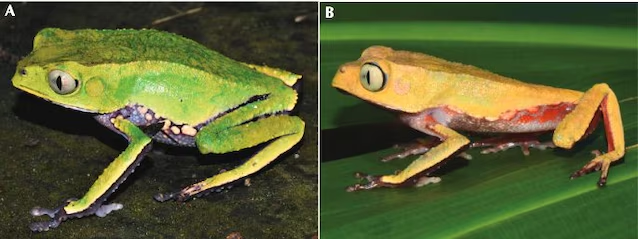
The misplaced yellow also appears out of water. One has been described in the Amazon tree frog (Phyllomedusa vaillantii) yellow instead of green.
In the United States, every now and then someone photographs a cardinal (Cardinalis cardinalis) yellow instead of the usual fiery red. Here, however, the mechanism is different. The red of the cardinal comes from a enzyme that turns yellow pigments taken in food red. If the enzyme doesn’t work, the feathers remain yellow. According to Audubon it happens to less than one cardinal in a million.
Yellow is just one of the anomalous colors observed in nature. The blue lobsters they have an excessive amount of a protein in their shell that turns the red pigment blue. Even rarer are lobsters split in half, with one side of one color and the other of another: according to the Lobster Institute of the University of Maine there is about one every 50 million.
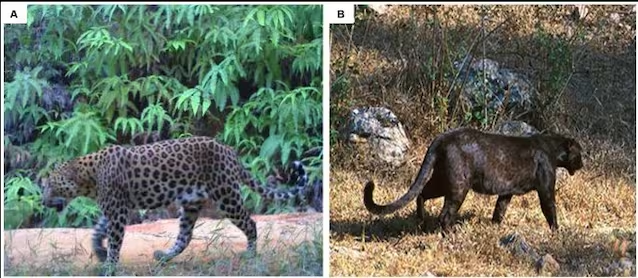
At the other extreme is the melanismi.e. excess dark pigment. “Black panthers,” as explained on PLoS One, are leopards with a mutation that makes them almost entirely black. On the Malay peninsula this variant has become almost the norm: in camera traps the 94% some photos of leopards depict black individuals.
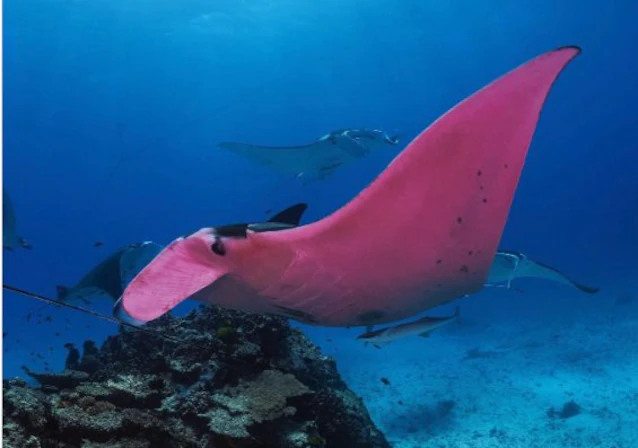
Finally there is Inspector Clouseauthe only one known pink manta raywhich owes its name to the famous character of the “Pink Panther” and swims in the Great Barrier Reef. The analyzes have excluded infections and diet, and researchers think of a mutation that reduces melanin, but for now it remains a hypothesis.