All responses to those who do not understand why the school calendar must change
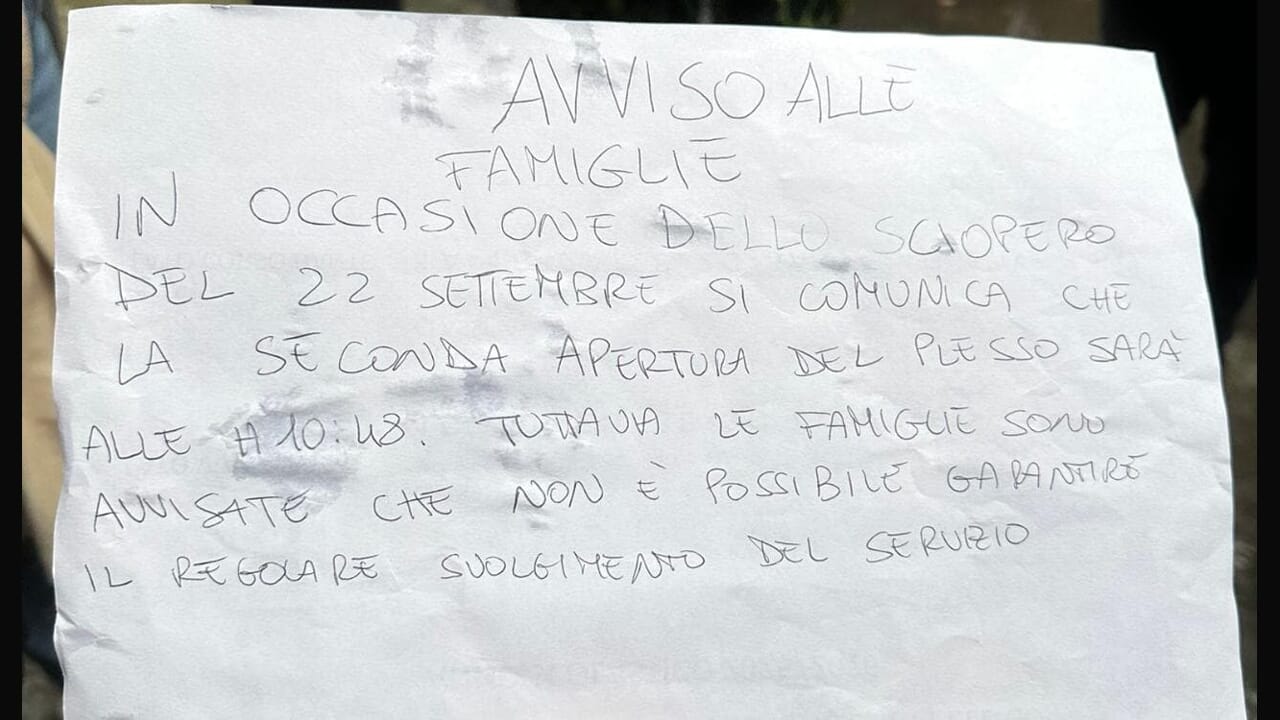
Today, Monday 22 September, there is a large national strike for Gaza. We are not here to discuss the reasons for the strike, we would miss it. In fact, however, today’s strike means that even this week the parents of children and teenagers under the age of 14 (the minimum age to be able to leave a child alone at home, as long as it is mature and that he has the opportunity to quickly contact an adult) will not be able to count, in the vast majority of cases, on a complete week of school. For those who attend elementary or middle schools that are seat of seat, the last week of “normal” time dates back to May 26-30.
Then there was the early closure to June 5 to be able to set up the seats for referendum and administrative. Since that day, families with children whose parents both work (not to mention mono-genientary families …) have had several options: leave their children to their grandparents, but only if the grandparents are retired, physically and mentally capable, willing to look after children and residents at a distance that can be traveled daily; Send the children to some summer center, which (except for the school ones who include reductions to those who have low Isee and submit the demand promptly) generally cost no less than 100 euros per week per child; Working from home trying to manage their children at the same time, but only for those who can work remotely or in smartworking; Ruaching the children, as if they were incandescent spheres, between permits, leave and days of holidays, which will inevitably be able to erode the days of family holidays.
Family holidays that arrived, in most cases, in August: two weeks, four weeks, four for the luckiest, and we arrived in some way in September. A couple of weeks of grandparents / summer center / smartworking with cartoon background / days of leave or holidays, and the school has finally started. Of course, still with the “provisional” reduced time, which in many cases lasted until Friday 19 due to the difficulty of finding all the teachers necessary to ensure the full time. And today, as mentioned, strike, so we apologize if there will run away some typo but we are writing this article while our seven -year -old daughter chooses what to watch on TV while playing with dolls, colors and cars and asks questions and requests to the rhythm of one per minute.
Of course there are exceptions, in wealth and poverty: there are families in which the salary of a single parent is enough to take forward safely, and perhaps also to pay babysitters that follow the little ones all day; And there are families not very different from those of our parents and grandparents when they were in school age, that is, families in which, even if the revenues are not particularly substantial, immense sacrifices are made and in some way you can live in four or five with a thousand and something euro of salary.
For the rest of us parents, however, the situation is the one described before: the last week of normal school was at the end of May, the next one will be in early October, and between one and the other we had to find extemporaneous, lucky or expensive solutions.
A year and a summer ago we have already written about how the Italian school calendar must necessarily be subjected to a serious reform, to meet the needs of a company enormously different from what was in Italy when school calendars were evidently carved on immutable stone tables: when, that is, in most families the women made housewives and children were often used to give a hand in agricultural work, or were left at home, At ten, perhaps by entrusting them with the youngest brothers and sisters, without risking, in addition to their safety, also the arrival of social workers or law enforcement agencies that take away the little ones to the parents.
That article had unleashed over one hundred comments, many of whom are written by people who objectted the thesis we set about a necessary reform of school calendars. And then we use this opportunity to respond to those objections, which in many cases are the same that are moved every time some parent asks for reforms or solutions in this regard.
“You can’t go to school when it’s very hot”
A typical objection to those who ask to reform the school calendars is the “climatic” calendars. In summer it is hot, even very hot, and you can’t stay in the classroom when there are 35 degrees.
It could be replied that those who make the high school exams must attend school even until mid -July and beyond, and there are no news of mass fainting during written or oral tests.
It could be replied that non -teaching school staff (secretariat, operators) goes safely and regularly at work in July, and also in this case there is no news of school dependent fallen en masse for too hot, nor do we believe that working in the heat is much easier than studying in the heat.
However, these answers do not hit the point. Because the climatic objection starts from an assumption: that we live in a country so about the gas barrel that they cannot even think of installing air conditioners in schools. As if to say: schools are dilapidated and we cannot do anything to improve them. The State, the Regions and the Municipalities can spend millions if not billions of euros for bridges, military investments, bonuses of all kinds and for useful bodies only to place friends of friends in the board of directors, but to think of installing cooling systems in those buildings where for decades there have been the radiators not, isn’t it really possible? Or maybe yes, if there is a political will?
“And should teachers give up their holidays?”
We are not part of those who believe in the metropolitan legend according to which teachers from June to September are with the belly in the air as they take their salary and look at the others who continue to work. This is not the case: the teachers also work when the school is closed, not “only” for the end of the cycle exams, but also for ballots, meetings, repair exams and so on.
So no, we don’t demand at all that teachers work more hours for the same salary. Above all considered how little Italian teachers gain. But perhaps, similarly to what has been said before, it is not so unthinkable to ask one of the richest states in the world to hire other teachers, and also to raise the salaries of one of the most important professional categories for the progress of a company. Again, provided that there is the political will to invest in school.
“Have you always done so, why don’t you feel good about it now?”
Then there are those who underline that the situation has always been the same and yet generations and generations of students and related families have made it. Except that, in the meantime, the cost of living has increased much more than salaries. To give some examples, even single -income families once managed to buy a house with mortgages of a few years, today families with two incomes make mortgages of twenty or thirty years so as not to risk ending up the air in the first unexpected disbursement. And then, we reiterate, once they took their children to work in the fields or left them alone at home when they had just learned to read and write. Today, simply, it cannot be.
“So how do foreign families who make the most children than us?”
Here too, we do not believe in the “easy” response, not to say discriminatory, according to which immigrant families are on average more numerous because they live on subsidies and state aid, if not expedients to the limit of legality if not exactly beyond.
An objection that does not take into account, first of all, of the extreme difficulty with which bonuses and subsidies for families with children is accessed. Often you have to be black belt of bureaucracy to extricate yourself between rules, quibbles, stakes, modules, documents and requirements. And sometimes even the familiarity with the language of the public administration is not enough, as demonstrated, just to give an example, a recent bonus made available to the Piedmont Region whose ceiling has been exhausted within a few seconds from the so -called “click day” set to request it.
The answer to the question “How come immigrants make more children than Italians?” It is, roughly, the same that can be given to the question “Why did we do more children when we were the poorer?”. We can speak of cultural differences, of greater propensity for sacrifice, also wanting to lower the consequences (do you want to call it ignorance? Call it ignorance if you like), but the fact is this: to make more children than the average are usually, in Italy and a little around the world, or the poorest or most rich families.
“School is not a parking lot”
This is the most frequent reaction to those who ask to change school calendars stopped in sixty or more years ago. “School is not a parking lot” We are told with Sarcasmo. And it’s true, school is not a parking lot, but in this case there are various possible answers.
It can be replied to this objection by emphasizing how Italy is the European country with the longest summer school closure, while in other countries, while maintaining more or less the same number of lessons of lessons, the holidays are more distributed during the school year, without having to force parents to rush for three months, if not four, to the constant search for solutions that do not fail the family budget. How do you say? Is it less hot in other European countries than with us? Please reread the response to the above climate object.
Alternatively, you can answer that what we ask for is not a parking lot. We do not want, that is, only a place to download children at 8 to take them back to 16 or 17, but we would like a school that finds public solutions, within everyone’s reach, to form our children also in June and September, also with systems other than the classic frontal lesson. How do you say? Are there no money for teachers in June and September? Please reread the response to the objection “Mica teachers can work more for the same salary”.
Finally, you can point out that not even parents’ work is a pastime that can be stopped as and when you want, especially not for three months in a row. And therefore we come to the conclusion.
“Have you wanted your children? Now manage them” “Ok, but pay for pensions alone”
So here we are, to respond to those who accuse us of not having reflected properly before putting the world of children who now do not know how to manage. A sort of family re -edition of “Did you want the bicycle? And now I pedal”.
Well, perhaps it is necessary to underline a couple of things, a politics and an economic one. Why, in the election campaign, every party and every leader repeats phrases such as “young people are our future”, “we have to support families”, “we must encourage Italians to make more children” to contrast “the demographic winter” and then there is never a minister, if not a president of the Council, that once in the government we say “we move from words to the facts” and put hand to a school system stopped in the 1960s? Why is the much talked about support for families regularly translates into new bonuses or tax reliefs for those who make children, for those who send them to the summer center, for the purchase of books or other cultural initiatives and never in a serious change project for our schools? Maybe because it’s easier, for sure not because you like to go on families in this way.
So, to those who accuse us of poor responsibility and excessive reliance on the state in the management of our families and related budgets, perhaps we should answer something like: “You don’t want to pay one more than your taxes to contribute to support to families with children? Very well, then why when they grow up, our children should pay with their taxes and their contributions even just a penny of your pensions?”.
Now sorry, but we have to go to prepare lunch for our children left at home.
