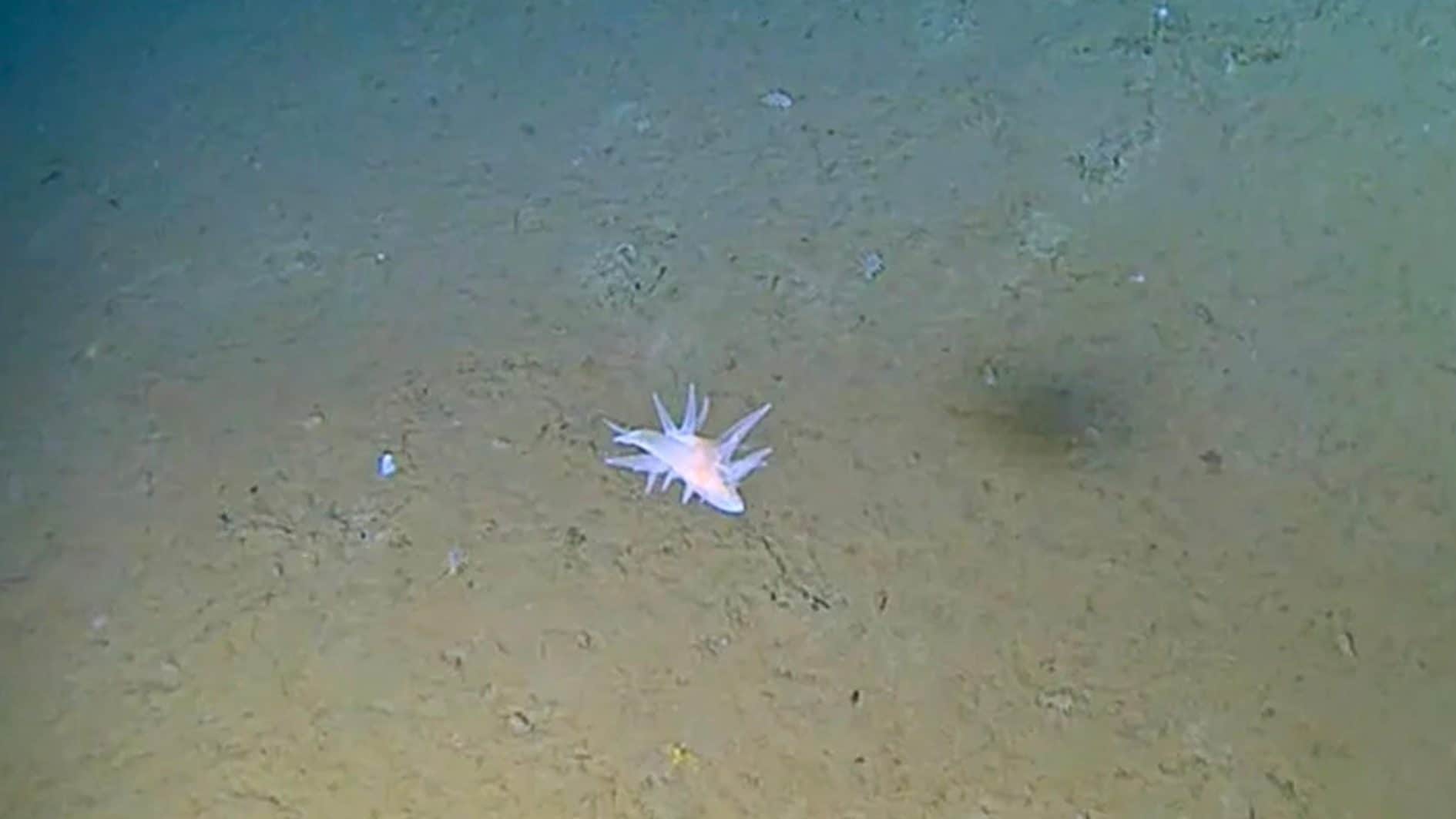
Almost 10 km deep in the ocean trenches of Ryūkyū and of Izu-Ogasawara A small whitish marine animal was spotted moving slowly in the darkness off the coast of Japan. The shape resembles a snail or sea cucumber but does not correspond to any known species. Experts around the world have looked at it and come to the same conclusion: they don’t know what it is. Science has tentatively classified it as Animalia incerta sedis – literally, “animal of uncertain position” – the formula by which biology admits that it does not have an answer. The finding is one of the most surprising elements of a large study published in the Biodiversity Data Journalwhich documented for the first time in a systematic and visual way the biodiversity of the abyssal areas of the was from Japan in the northwestern Pacific Ocean, among 4,534 and 9,775 meters deep. Research has documented in total at least 108 distinct groups of organisms (morphotaxa).
The unclassified marine animal discovered in the depths of Japan
At the center of AJ Jamieson’s study is the creature imaged twice at depths up to 9,137 meters. As you can see in the video, it is a slow-moving organism, with a whitish body, appendages that resemble antennas and bilateral symmetry. Initially it made people think that it was a nudibranchone of the most widespread marine molluscs in the ocean such as Dirona albolineata. However, specimens of this species have been recorded at a maximum depth of approx 4,000 metersthis creature was more than twice that depth.
As the researchers report on the study, other experts consulted noted that the appendices they appeared too rigid to belong to a nudibranch, while some hypothesized that they had mollusc characteristics without however managing to go any further. After consultations with taxonomists from around the world, the animal remains, for now, without a name and without a family. The designation Animalia incerta sedis it is reserved for organisms that cannot be assigned even to a known Phylum.
The study on biodiversity in the Pacific ocean trenches
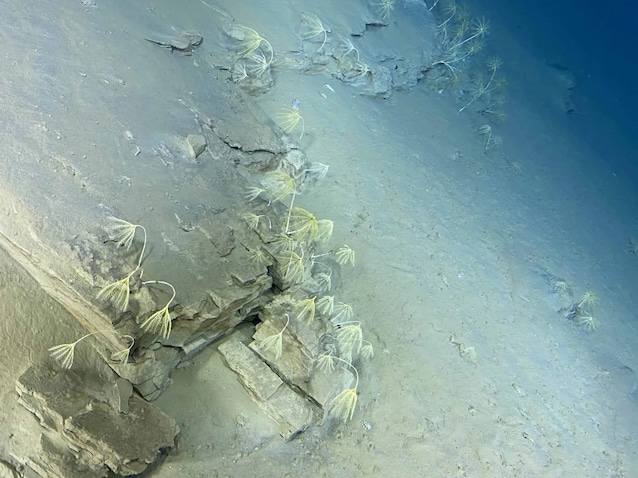
In addition to the encounter with the mysterious creature, the expedition mapped great biodiversity in the deepest areas of the Pacific. At 9,137 meters deep they were discovered “crinoid meadows” composed of over 1,500 “sea lilies” anchored to the rocks.
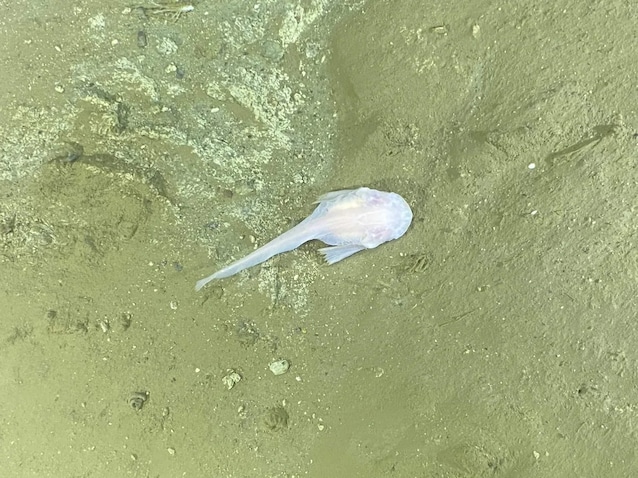
Between 9,568 and 9,744 meters some carnivorous sponges (family Cladorhizidae), capable of actively capturing small crustaceans with adhesive or hooked structures. The landers imaged a bony fish (Pseudoliparis sp.) with a gelatinous body and no functional eyes while feeding on well 8,336 metersa record for vertebrates.
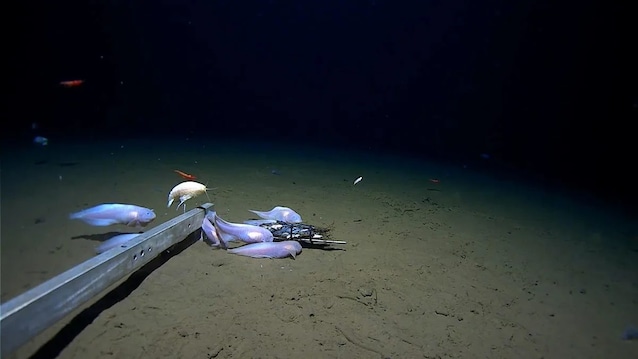
Finally, in all the pits studied the presence ofAlicella giganteaa “scavenger” crustacean that feeds on carcasses and is widespread throughout the planet. It is the largest amphipod in the world with some individuals reaching up to 34 centimeters in length.
A two-month expedition into the depths
The exploration took place in 2022over the course of about two months, aboard the DSSV Pressure Drop, a vessel equipped for diving in very deep waters. The team was made up of researchers from Minderoo-UWA Deep-Sea Research Centre of the University of Western Australia and the Tokyo University of Marine Science and Technology.
The abyssal trenches have been explored for decades with trawling and physical samplingwhich collect organisms but damage them irreparably and do not return any information on their behavior or ecological context. In this expedition it was instead chosen to use manned submarines and lander with decoy in free fall to attract and recapture species that feed on carcasses. “This combination has allowed us to create the most comprehensive visual baseline available to date for the abyssal and hadal megafauna of the Pacific Northwest,” the study authors notified.
Among the images of the seabed, the researchers also documented the presence of debris of human originprobably transported downwards by sliding processes along the slopes of the pit.
