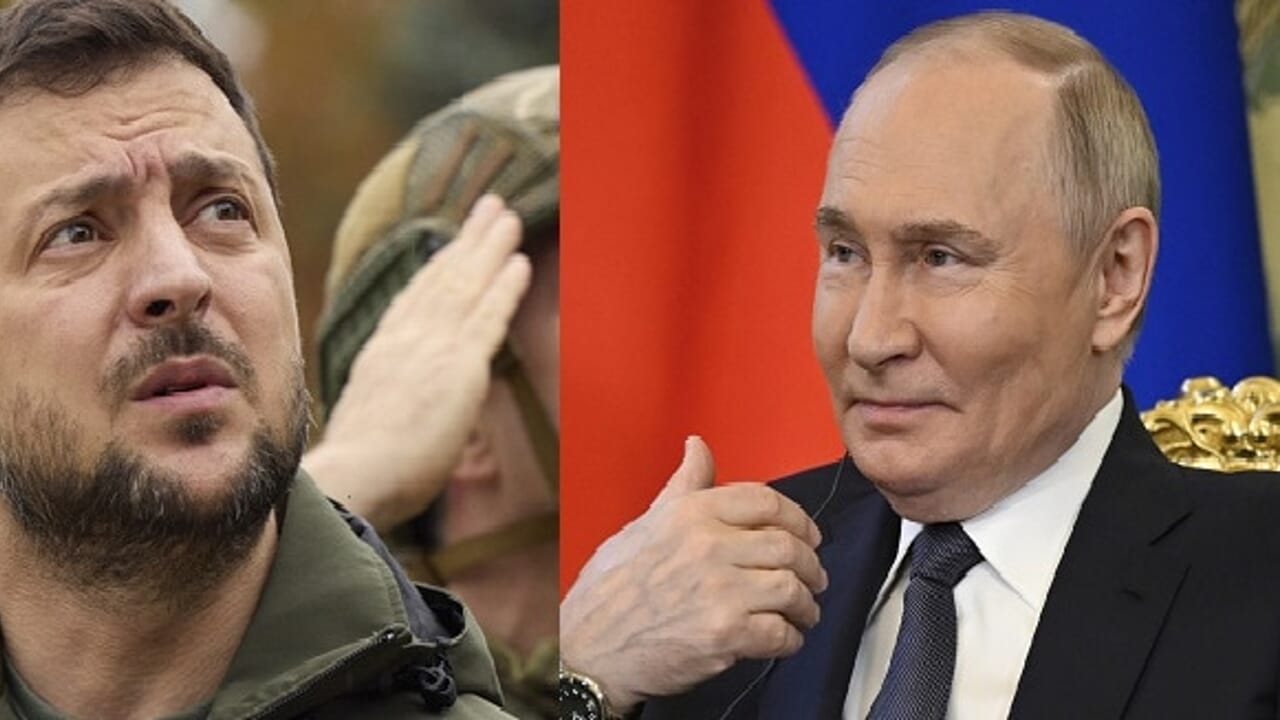
And we are the tired ones
Four years after the start of the large-scale invasion of Ukraine – as the Ukrainians want Putin’s second offensive to be defined, after the first which consolidated his aims on Crimea -, February 24 has stopped being a simple war anniversary to become a barometer of the resistance of European democracies. But also of our attention.
After four years of long conflict, after having learned the names of cities and rivers of a geography unknown to most, after the activation of the aid machine (not only military) to collectively respond to fear and impotence, the feverish exceptionality has transformed into daily routine. Four years later, we return to talking about Ukraine only when the smoke from the fires darkens the sky of Kiev, when drones enter citizens’ homes, instantly pulverizing everything inside, including those who live there, or when the leader of the ultimatums (read: Donald Trump) threatens the Russian president and then takes a step back. The daily life of the Ukrainian resistance has become background noise to which public opinion seems to have become accustomed. And it is into this habit that Russian propaganda has crept in, capable of reshaping the facts and orienting the way in which the war is described. A story that has become less unbearable and more negligible. A story that raises several questions.
European disengagement: an unimaginable idea
Looking back, the question is no longer just “what happened”, but what would have happened if Europe had chosen the path of disengagement. Without Western logistical support and intelligence, Ukraine’s resistance would have been short-lived. In a few weeks, we would have witnessed the establishment of a pro-Russian regime in Kiev, with all due respect to the 20 thousand demonstrators who took to the Maidan square in 2014 to demand a European future. Ukraine would thus have become a puppet state in the hands of Putin, which would have seen the Russian borders extended for thousands of kilometers and in direct contact with those of Poland, Slovakia, Hungary and Romania. The domino effect on the Baltic countries would have been immediate: Estonia, Latvia and Lithuania would live under the constant threat of “special operations” for the protection of Russian-speaking minorities and to counter the alleged expansion of NATO.
In short, the absence of a cohesive European response would have sent a green light to Putin’s revanchism. And then we would have witnessed the yoke of economic leverage: without the forced separation from Russian gas and oil, Europe would today be totally dependent on Moscow’s energy supplies. But also isolated: with Atlantic loyalty betrayed and ignored with Trump’s return to the White House, the European chancelleries would have (had?) their sides exposed to military actions and Russian manipulation of the internal political debate, which feeds sovereignism. But fortunately this did not happen. At least for now. Because Putin’s designs are clear. This is demonstrated by how the war continued without a hitch. What we left behind was the year of the US president who was supposed to bring peace to Ukraine. Yet, in 2025 the conflict has become more lethal: at least 2,919 Ukrainian civilians have been killed, adding to the 17,775 wounded in the open source project’s gruesome accounting Conflict intelligence team (CIT), increasing compared to 2024.
Ukrainian (or European?) fatigue
Ukraine is exhausted. For much of the four years since the Russian invasion, the capital has tried to maintain a semblance of normality, with theatres, schools, transport and services running regularly, while the rail network has become a symbol of national resilience. But repeated Russian attacks on energy infrastructure, which left the population for weeks without electricity and heating, have made normal daily life increasingly difficult: today it is almost impossible to forget the war even for just a few minutes. Because we don’t stop counting the victims and the displaced: since the beginning of the war over four million Ukrainians, mostly women and children, have left the country. Tens of millions have been called upon to support the national war effort, while just as many live under Russian occupation in areas undergoing a process of ethnic replacement.
It has been going on for so long that the war itself has changed: it began with bombers and tanks, today it is fought mainly with drones, whose technology continues to evolve, forcing military personnel to undergo continuous training and retraining. Ukrainians have learned to organize their lives in the perspective of a war destined to last forever. Yet, the tired ones seem like us Europeans.
And so, even European aid is no longer interpreted as a reactive response, but read as a long-term strategy. From the outbreak of the conflict in 2022 to today, the European Union has mobilized a record amount of 194.9 billion euros. A sum that guaranteed the survival of the Ukrainian state and the defense of Europe. Nonetheless, Brussels and European leaders were not considered “worthy” of participating in the US-Russia peace talks.
Over the past four years, Russia has faced internal tensions that could have weakened its political stability, but President Vladimir Putin has quelled them, allocating around 40% of the budget to defense and transforming the economy into a war machine with an expansion of military-industrial production. But despite efforts, Moscow failed to subjugate Ukraine. What was supposed to be a flash conflict turned into a war of attrition, a technological laboratory and the routine of survival, while the perception of the war in Europe also went from urgency to daily normality. For this reason, more than four years after the start of the conflict, it is necessary to reject the narrative of a “distant” war, which does not concern us, and remember how life under bombings and aerial sirens and the drone of drones in Kiev, Kharkiv and Kherson could one day become reality for us too.
