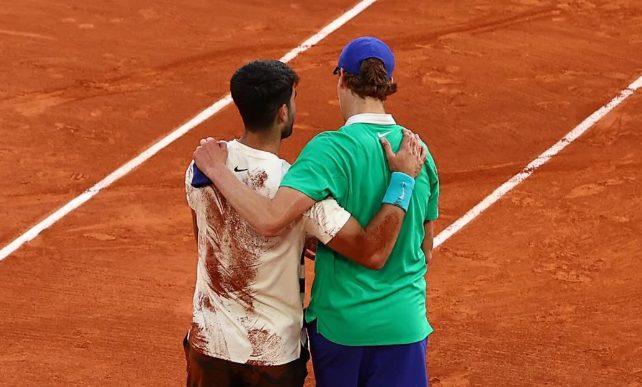
The words of the tennis legend have caused quite a bit of controversy, Roger Federerduring an interview on the podcast Served by Andy Roddick. The Swiss, who has been retired for three years now, speaking about the Sinner-Alcaraz duopoly that is dominating world tennis, offered his point of view on the uniformity of play and results that tennis seems to experience today. The former world number one defined the playing surfaces “all the same” so as to flatten the level and bring out the strongest. Playing surfaces (clay, grass, synthetic turf, hard courts) influence the game depending on their specific characteristics which may or may not meet the preferences of individual tennis players.
According to Federer (the thesis has also been supported by the current world No. 3, the German Sascha Zverev) the fact that the surfaces are “the same and tend to be slower than in the past” disadvantages the weaker playerbecause he is forced to hit extraordinary shots to beat the two dominators of the circuit. But is it really like that? Are the Tour surfaces really the same and slower? According to the Court Pace Indexa scientific parameter, the surfaces are no longer “slower” compared to the past, but it is true that they are “uniforming”.
What are CPR and CPI
The CPR (Court Pace Rating) measures the effect that the surface has on the tennis ball, considering the friction coefficient and the vertical return of the ball. It is detected through a test that uses a ball-shooting machine and a tool called Sestée. CPR is used to classify fields into 5 categories established by the ITF (the International Tennis Federation).
- slow fields (less than 29)
- medium-slow fields (between 30 and 34)
- medium fields (between 35 and 39)
- medium-fast courts (between 40 and 44)
- fast fields (greater than 45)
The CPI (Court Pace Index), however, is a completely independent measurement that derives from the data collected by Hawk-Eye (the “Hawk’s Eye”) through the triangulation camera system. It shows the actual speed of the courts measured during real matches and is an average calculated over seven days of a tournament. The CPI must be collected during the tournament and not before. The formula used to calculate the CPI is: CPI = 100(1-μ) + 150(0.81-e), where “μ” is the coefficient of friction and “e” represents the coefficient of restitution.
In summary, the CPR represents a surface classification carried out by the ITF, while the CPI represents a measurement of the actual speed of the pitches during matches. These are real tests, carried out during the tournament, in game conditions, and not in a laboratory like CPR. The results aren’t too different, but it’s worth remembering the difference.
Do tennis court surfaces become uniform, as Federer claims?
Returning to the starting thesis, Federer maintains that today all the players on the circuit “play in a similar way because the tournament directors have allowed the speed of the ball and the speed of the court to tend to be the same every week and this is why you can go from victory at Roland Garros to Wimbledon to the US Open and always play in the same way”. Is it really like that?
We have analyzed the official data provided by the Courtspeed portal in collaboration with ATP. Very interesting for the purposes of our research comparison between 2017 and 2024 of all the courses of the Masters 1000 as well as that of the ATP Finals which took place in London in 2017 and in Turin in 2024. We would also like to remind you that Monte Carlo, Madrid and Rome take place on clay, Paris-Bercy and the Finals on indoor hard courts, while all the others take place on outdoor hard courts.
The fact that immediately catches the eye is thegeneralized increase in field speed: we passed from an average of 32.1 in 2017 to 36.4 in 2025. The clay courts are all close to the medium-slow classification, while three have reached the “medium-fast” category (Cincinnati-Shanghai-Paris Bercy) compared to only Shanghai in 2017. The case of Shanghai is emblematic to explain how not only the surface, but also the type of ball and above all the atmospheric conditions are decisive: the 2025 edition, in fact, was characterized by record heat and humidity (often above 30° and 90%) which have drastically lowered the CPI of the Chinese court from an average value always above 40 in the last ten years to 32.8, as well as creating quite a few problems for the players, who are more committed to “surviving” than playing a tennis match in the absence of rules on extreme heat.
On the topic of speed, Federer’s statement is therefore denied by science. As regards the uniformity of surfaces, however, the Swiss is right. There difference between minimum and maximum value has narrowed in eight years: from 22 to 18.5 and, as already noted, clay courts, generally faster than in the recent past, are a cause of this. Although the specialists (turf players, indoor and outdoor hard court players) resist, the adaptation to the surfaces and the cyclical change from one to another are easier than in the era of the 20-time Slam champion.
