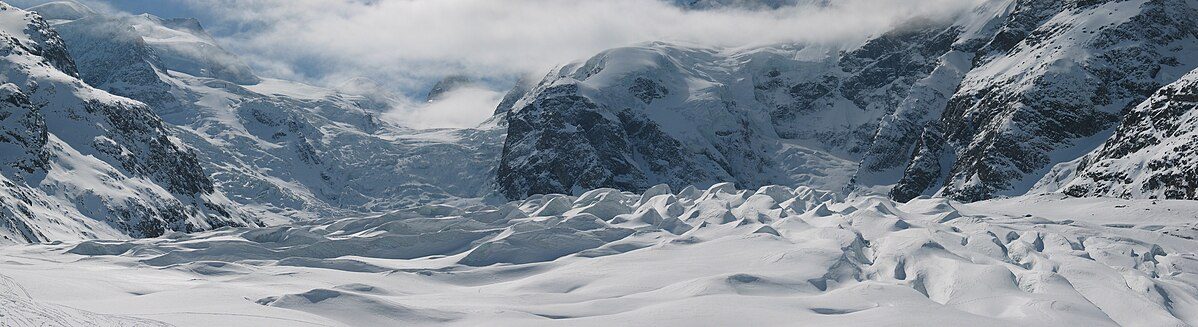
During the last Ice agestarted 110,000 years ago, the temperatures in Europe descended until they reach 9-11 ° C. THE’Homo sapiens He survived living in caves, where he warmed up with fire, but also building refuges with mammoth bones, hunting giant animals and feeding on vegetables. Communities developed complex ritescult of the dead and art forms, were then the migrations to the south who allowed them to adapt to the climatepreparing the man to great agriculture revolution.
What is a glacial era
When we talk about “ice age” We do not refer to a single event, but to very long periods in which the earth has seen a drastic drop of temperatures. This led to enormous geological changes and had a direct impact on life on the planet. Scholars have identified Eight large glacial periodsof which four main in the Pleistocene (between 2 million and 10 thousand years ago). The last is the Würm glaciationstarted about 110 thousand years ago: the coldest moment was between 25 and 19 thousand years ago, when Homo Sapiens already populated most of the earth.
In Europe, medium temperatures oscillated between 9 and 11 ° C. To survive, our ancestors took refuge in the rocks, they isolated The caves with animal skins and used the fire to warm up. When the ice retired, they moved south, building Huts with mammoth bones and finding new adaptation strategies.
The survival of Homo Sapiens during the glacial era
During the last glacial periodthe man cohabited on earth together with ice, snow and animals that, today, seem to us mythological: mammothbears and lions of the caves, but also wolves, bisons, gluttony – a small bear, now extinct – and many others including, according to a study, also the tiger with saber teeth. Among the impervious climatic conditions and the quality of the predators with whom to live, Homo Sapiens had to refine his own cognitive and social skills.
Survival was therefore mainly based on hunting of terrestrial animals, but also fish such as salmon and seafood. Thanks to the remains of Tartaro found on the teeth – just as happened for the populations of ancient Egypt, who in fact used rudimentary toothbrushes – we know that the man during the glaciation also fed on seeds and vegetable foodsbut they scarce when the cold returned to cover the earth.
Despite the difficulties, Homo Sapiens already developed one then structured community life. The rock paintings tell us about rituals related to the supernatural and very refined funerary practices. An example is the burial of the “Red Madam”found in Spain: covered with ocher and flowers, testifies to a strong respect for the deceased and an important role in the community. The burials show complete families (men, women, children), a sign that the family It was already a central unit. Some clues suggest that the rituals were accompanied by Dance and musicinvolving the entire tribe.
Migration during the glacial era
The genetic finds of the “red lady” show bonds with populations much further north, in Belgium: proof that the men of the glacial era they moved to adapt to climate change. A study on fossil teeth revealed that migrations were intense between 47,000 and 28,000 years ago, and then decrease when the cold made movements more difficult. During travel, the tribes built curtains with giant bones and animal skins, similar to the tepee of Native Americans. The women they were considered precious for the survival of the tribesso much so that some research hypothesize possible “exchanges” between groups to maintain the birth rate.
The last glacial era was not only a period of frost and difficulty: it was a real “evolutionary gym”. Pushed Homo Sapiens a strengthen cooperationdevelop new survival techniques and refine culture.
When the ice retired definitively, humanity was ready to make a huge jump: The birth of agriculture And the revolution that would change our history forever. Our ancestors, therefore, not only survived during the last glacial era, but also “exploited” the opportunity in their favor, implementing their organization, daily life, rituality and techniques of survival.
