In the Campi Flegrei seismicity is decreasing: the latest weekly bulletin of the INGV Vesuvian Observatory (relating to the week from 19 to 25 January) reported 24 earthquake shocks Of magnitude maximum 1.7 (down from 44 earthquakes the previous week) and a ground uplift due to bradyseism which, after a period of increase, returned stable to a value of 15 millimeters per month.
The geochemical parameters also confirm the warming trend already known, with the temperature of the fumarole in the crater of Solfatara which stands at approx 173°C. Among other things, a recent INGV study confirmed that the current conditions of the caldera exclude an imminent volcanic eruption.
24 earthquakes: only one shock with a magnitude greater than 1.0
Between 19 and 25 January 2026 they were located at the Campi Flegreithe 24 earthquakes: the maximum magnitude recorded was modest, equal to 1.7recorded on January 21. Among other things, only one shock had a magnitude greater than 1.0 and therefore to the limit of the perceptible for the local population.
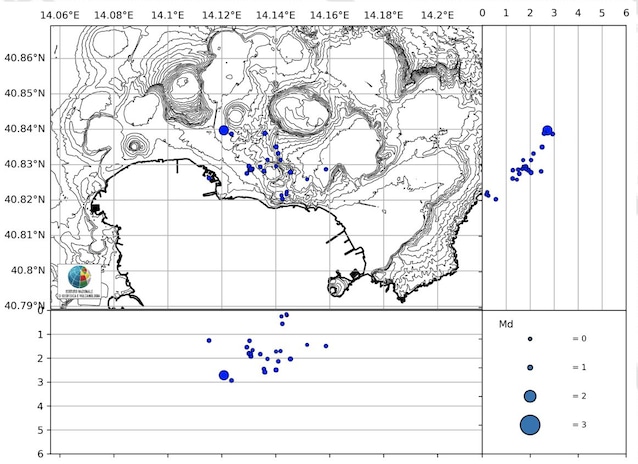
INGV did not detect any seismic swarm, while the depth average of the shocks was relatively lowaround 2.7 km. This happens because in the Phlegraean area the seismicity is due to bradyseism: in other words, i earthquakes they are not caused by the activation of faults, but by soil rise.
Bradyseism: soil lifting still at 15 mm per month
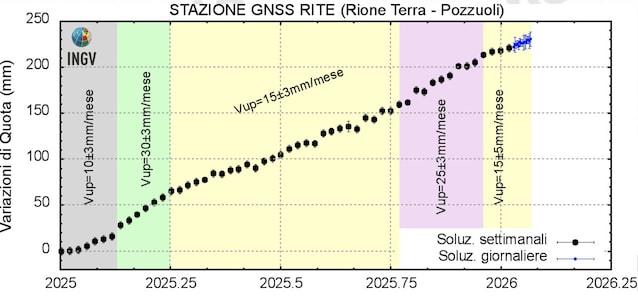
According to INGV data, starting from mid-December the average monthly rate of ground uplift has settled back to values equal to 15 ± 3 mm per monthbucking the trend after a 2-month period – officially starting on 10 October 2025 – in which bradyseism had increased to 25±3 mm/month.
The cumulative effect of this speed brought the total lift recorded at the Rione Terra GNSS station (RITE) to approximately 23 cm from January 2025.
From the point of view of geochemistry, however, i parameters they are confirmed in line with the already known increasing trends, both in terms of gas flows emitted and in terms of temperature of the fumaroles. In the last week, in particular, the temperature in the Pisciarelli fumarole showed an average value of ~95 °C, while at the main fumarole (BG) in the Solfatara crater an average value of around 173 °C was confirmed.
The INGV weekly bulletin in summary
The INGV, in its latest weekly bulletin on the Campi Flegrei, therefore reported:
- Seismicity: decreasing again, with 24 localized earthquakes of maximum magnitude 1.7 and only 1 shock of Md>1.0.
- Bradyseism: Soil heave rate decreasing to 15 ± 3 mm/month with total heave from January 2025 to 23 cm.
- Temperatures: the fumarole in the Solfatara crater is confirmed at high values (~173°C).
