
In English, “To Feel Blue“It is a common way to say that one feels sad or melancholy. Not surprisingly the one that is passed off as the alleged” saddest day of the year “, in January, is called” Blue Monday “. But what does the blue color have to do with sadness or melancholy? The association is born in theAncient Greecewith the theory of moods and the black bile, then it is colored with dark tones in the Middle Ages and becomes common language in English with “Blue Devils“. Between music, art and psychology, blue has continued to evoke solitude, introspection and poisoning, transforming itself into a universal symbol of melancholy.
Why the color of sadness is blue
To really understand why in English the blue color expresses melancholy, we must go back over 2000 years, in the medicine of ancient Greece of Hippocrates. There the Theory of the four moodsa medical-philosophical system according to which the human body was regulated by four fluids: Blood, phlegm, yellow bile and black bile. Each of these was associated with a natural element (air, water, fire, earth) and certain physical and emotional characteristics, therefore the imbalance of these moods involved the patient’s malaise. The excess of black bile It gave rise to the melancholy temperament: a thoughtful, introverted individual, inclined to sadness and contemplation.
In medieval and Renaissance thought, qualities cold and dry of the black bile were often represented visually With dark, deep colors, including dark blue. And therefore, over time, this color is increasingly associated to melancholy, passive, meditative inner states.
“Blue Devils” and the blues
One of the first signs of the association between blue and sadness in the English language appears in the seventeenth century, with the idiomatic expression “to have the blue devils“which indicated a state of deep anguish, often accompanied by hallucinations and visual delusionswho could hit those who crossed alcohol abstinence crisis. The “blue devils” were therefore A metaphor for discomfortof the inner shadows, of the ghosts of the mind. At the time the adjective “Blue” was also one Slang for “Drunk”and the laws that prohibited the consumption of alcohol on Sunday were called “Blue Laws“.
At the end of the 1700s, in the American taverns, a slow type of dance called “Blues“, In which the step and the music reflected a melancholy mood, full of deducted and intimate emotions.
After the American Secession War (1861–1865), the expressions “TO BLUE” or “To have the blues” they spread further to describe a melancholy or sad moodnow detached from the reference to alcohol. It is in this context that the term began to circulate within the African American community of the South of the United States, where he became synonymous with a particular emotional sensitivity and an individual and collective response to pain. It was only at the beginning of the 20th centuryhowever, that the abstract meaning of “blues” merged definitively with the musical one. It was not uncommon to hear that a musician “sang the blues” for get rid of of their inner demons. The Blues feeling – The emotion – was considered more important than the technique itself. In this sense, the blues became a real form of emotional therapy, A way to exorcise one’s “devils” through singing and sound.
Blue in art and visual culture
Even in visual art, blue has often expressed melancholy and introspection. Among the numerous examples, just think of “Blue Period” by Pablo Picasso (1901–1904), during which the artist painted almost exclusively in blue and gray tones, often representing poor, marginalized, suffering subjects.
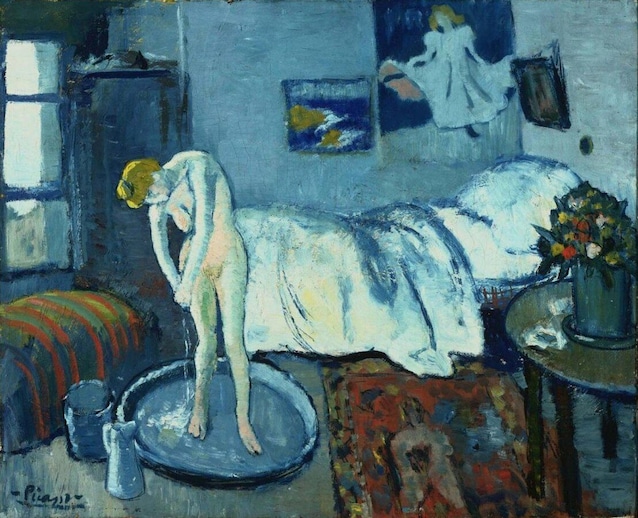
This color has been used in the history of art to evoke detachment, sacredness, mystery, but also loneliness and reflection. Today color psychology tells us that blue is perceived as calming, reliable, coldbut also detached and melancholy. In therapeutic environments it is used for sparklebut its “cold emotional” component is often evoked in advertising, art and narrative to represent introspection, isolation, meditation.
