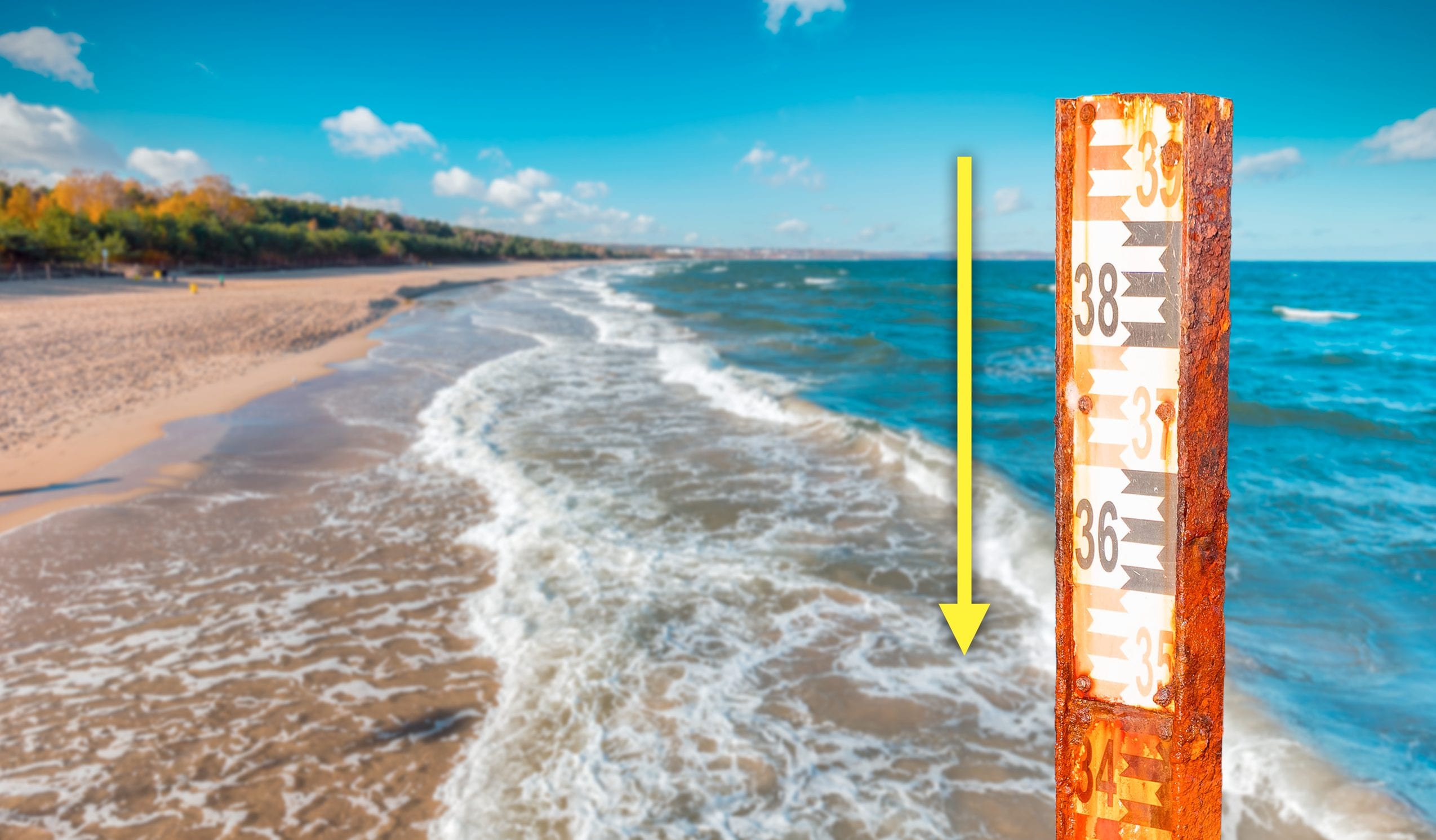
In the last two months the water level of Baltic Sea has reached an all-time low, going down 67 cm compared to the average of the last 140 years, which correspond to one loss of 275 km3 of water. The main culprits for this phenomenon, which appears to be in contradiction with the current widespread increase in sea levels due to global warming, are the strong and prolonged winds coming from the east which pushed water masses out of the basin through the Denmark Strait towards the North Sea. Their origin is linked to awave of frost which in turn is linked to climate change in progress.
The causes of the lowering of the level of the Baltic Sea
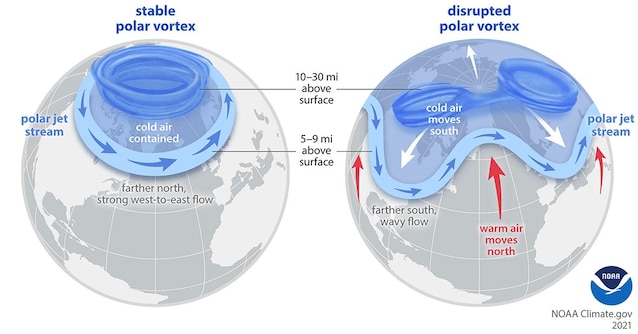
Researchers at the Leibniz Institute for Baltic Sea Research Warnemünde (IOW) constantly monitor the level of the Baltic Sea which, since records began in 1886, has reached lowest value in February this year. In over 140 years of measurements, a value almost as low (more than 60 cm below the average) has only been detected five other times, the last of which was in 1980. The phenomenon is linked to persistent easterly winds which pushed large amounts of water out of the Baltic Sea into the North Sea. At the origin there is theweakening and fragmentation of the polar vortexa vast area of low pressure consisting of strong air currents and located at medium to high altitudes, mainly in the stratosphere, above the Arctic region. This vortex is present especially in winter and holds the polar cold at altitude, preventing it from reaching lower latitudes. However, the current warming of the stratosphere above the Arctic has resulted in the so-called “open refrigerator effect“: that is, it caused the polar vortex to rupture, causing the freezing polar air to rush towards lower latitudes, just like the cold air that reaches our feet when we open the door of a refrigerator. This situation shows how the climate change manifest not only as heat waves, but also as waves of frost.
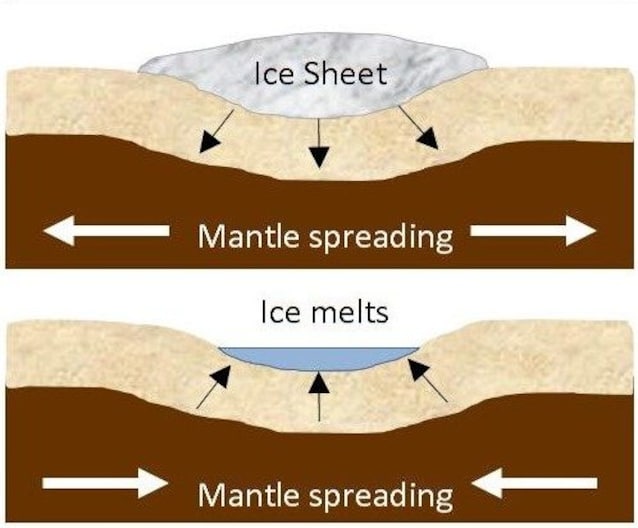
Another cause that contributes to the lowering of the level of the Baltic Sea is the so-called “isostatic adjustment”, a vertical movement of the earth’s crust that allows it to reach equilibrium by floating above the mantle. Towards the end of the last glaciationabout 20,000 years agothe ice covering the Scandinavian peninsula has begun to melt. As a result, the weight they exerted on the crust decreased, which thus began to rise (and is continuing to do so), causing a local lowering of sea level.
The consequences of the lowering of the Baltic Sea level
When a sea basin is shallow, it suffers more from the consequences of global warming. Its waters they heat up more and high temperatures favor proliferation of cyanobacterialinked to a large supply of fertilizers (nitrates and phosphates) from rivers. These determine a decrease in oxygen in the deep layers which persists for years or decades, taking it away from marine organisms whose survival is thus put at risk. This situation could improve if the easterly winds are replaced by in the coming weeks westerly winds sustained, which would push North Sea water into the Baltic Sea. This is rich in salts and being cold it can absorb more oxygen than hot one. Its contribution would therefore be very important because it could mitigate the temperature of the warm waters of the Baltic and bring benefits to the species that live there.
