Why multiplying by zero is zero? Intuitively we can see it in different ways, but there are also explanations based on mathematical rules. Let’s see a concrete explanation and a mathematical one based on the distributive property and on the fact that zero is the only one neutral element of the sum.
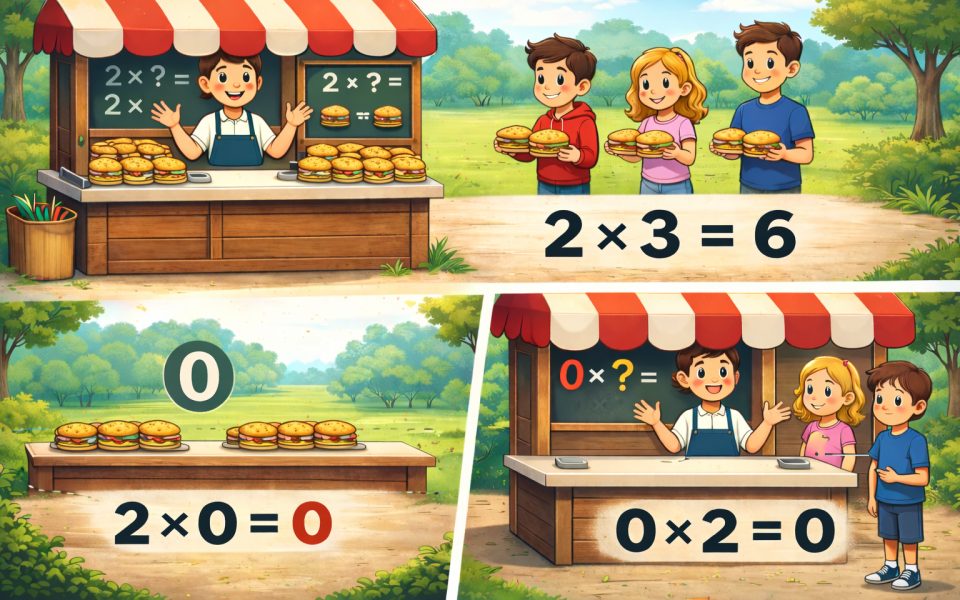
Multiplication is an operation that can be seen concretely in different ways and each of them provides us with an intuitive explanation of why multiplying by zero gives the result zero. For example, we can see this operation from the point of view of a stand that distributes sandwiches.
Examples and explanation
Let’s imagine we have a stand that distributes 2 sandwiches for each person who shows upand let’s imagine that 3 people show up: we will have to distribute 2 sandwiches ×3 people, i.e. 2×3. From a practical point of view we can do this by giving 2 sandwiches to the 1st person, then 2 sandwiches to the 2nd person and 2 sandwiches to the 3rd person: in total we have distributed 2+2+2=6 sandwiches and this way of interpreting multiplication can be described as repeated sum.
Now let’s imagine that no one shows up at our banquet if we try to distribute 2 sandwiches to each of the 0 people who showed up (which corresponds to calculating 2×0) we are unable to distribute any sandwich, the action of distributing is not actually performed, and we can conclude that 2×0=0.
Finally, let’s imagine that 2 people show up but that in total there are 0 sandwiches left: in this case we distribute 0 sandwiches to each of the 2 people, i.e. 0+0=0 sandwiches, therefore also 0×2=0.
The mathematical answer
Practical examples like this are welcome in mathematics, if they help understanding, but are we sure that things will work well even by changing the type of practical example? To avoid this danger, mathematicians look for explanations that are based on facts or mathematical ruleswhich are independent of the particular concrete interpretation. In our case, to explain why a number multiplied by zero is zero, we can get by using two mathematical notions:
- zero is the neutral element of additionso 3+0=3, 5+0=5, n+0=nthat is, adding zero to any number the result will be the number itself and this only works with zero.
- there distributive property of multiplication versus addition tells us that A×(B+C)=A×B+A×Cfor example 2×(3+4)=2×3+2×4
Starting from these notions, let’s imagine that we don’t know the result of 3×0 and we want to find out something about its value, we can try to see what happens by changing the cards on the table a bit, as follows:
- since 0+0=0, then calculating 3×0 is the same as calculating 3×(0+0)
- for the distributive property calculating 3×(0+0) gives the same result as calculating 3×0+3×0
- therefore 3×0=3×(0+0)=3×0+3×0, i.e. 3×0+3×0 gives the same result as 3×0, they are the same number.
We have therefore discovered that if we add 3×0 to itself the result is 3×0 again, in other words when we add 3×0 to 3×0 it leaves it unchanged just as if 3×0 were the neutral element of the sum, but we know there is only one neutral element for the sum, that is the number 0, consequently the result of 3×0 must necessarily be 0.
