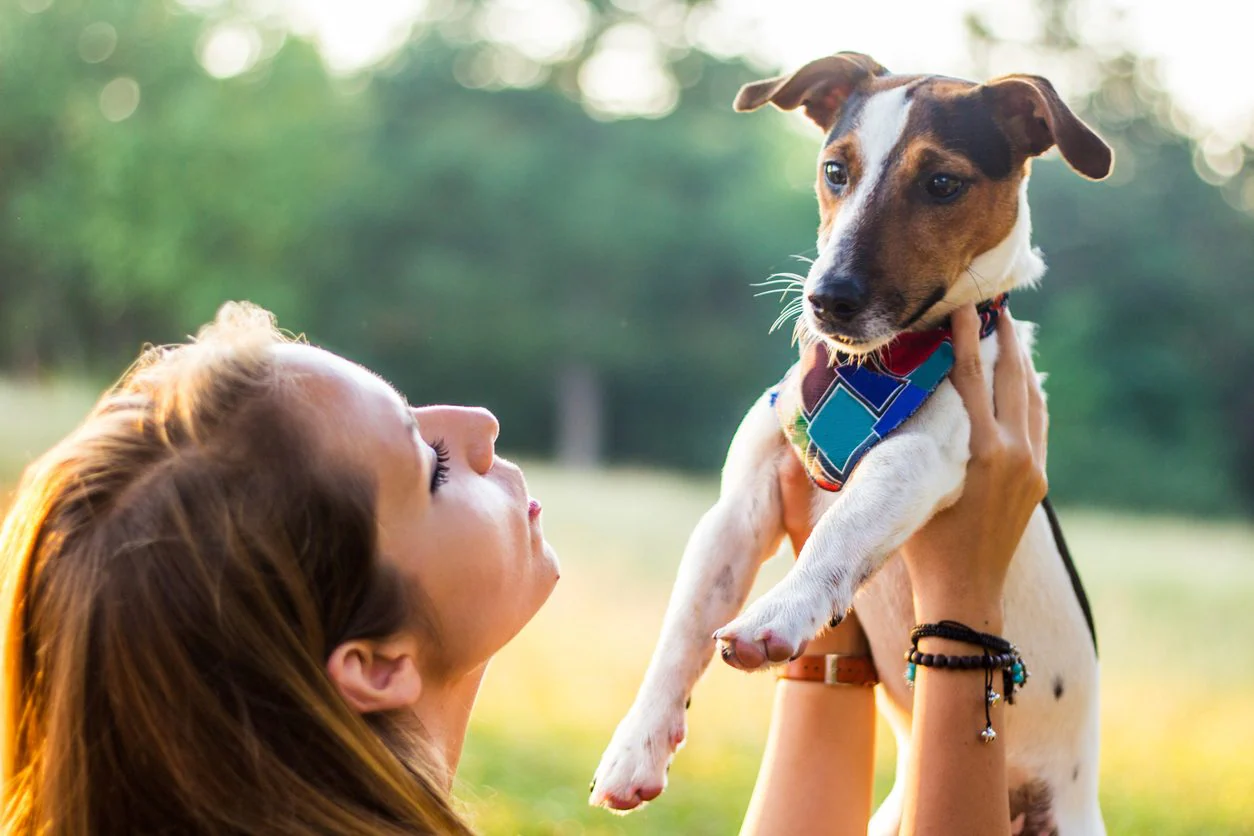
«But who is the most beautiful puppy in the world?». If you have a pet, you have probably said a phrase like this at least once using a voice very different from the one you would use to speak to another adult. More acutemore melodic and with a decidedly more expressive tone. That’s what we commonly call “baby talk”and the curious thing is that we don’t reserve it just for children at all. A study published in 2002 in the journal Science analyzed this very phenomenon, comparing the way some mothers spoke to their children, their pets and other adults. The result was surprising: when we turn to dogs and cats, we spontaneously change our voice much like we do when speaking to a newborn, perhaps because we perceive them to be equally vulnerable.
When we talk to children or animals our voice changes: study
It’s not imagination, our voice really changes when we talk to animals. In the study, the researchers recorded 12 mothers while they spoke, at different times, with their own children about six months, with your own dog or cat and with another adult. By analyzing the recordings, they found that both child-directed and animal-directed language had some characteristics in common.
In both cases, in fact, the voice became more acute compared to that used in conversations between adults and the intonation was richer and more expressive. This type of language is called infant-directed speechthat is, language aimed at children. Compared to normal conversation between adults, it generally tends to have a higher tonegreater variation in pitch, longer pauses and a particular rhythm. Many of these characteristics were observed in different languages and culturesalthough the precise way in which they are used may vary from one population to another.
The interesting thing is that we don’t necessarily decide to do it. We don’t stand in front of the dog thinking, “Now I’m going to raise the fundamental frequency of my voice.” Simply, when faced with a pet, our voice instinctively changes.
The reasons why “that” little voice is useful for creating bonds
From available studies, basically when we find ourselves in front of someone who we perceive as in need of care or with whom we want to establish an affectionate relationship, it seems that we spontaneously and almost unconsciously modify the way we use our voice. It is no coincidence that a study published in PLoSOne also found, through functional magnetic resonance imaging (fMRI), that overlapping areas linked to emotions and rewards were activated in the brain, both when the participants looked at images of their own child or dog and when they looked at photos of unknown children or dogs.
Here comes the most interesting detail of the 2002 study conducted by Australian researchers. The way we talk to animals it is not identical to the way we talk to children. When we address a newborn, in fact, in addition to raising the tone of the voice and making the intonation more expressive, we also tend to pronounce some vowels more markedly and distinctly. This phenomenon is called vowel hyperarticulationMeaning what hyperarticulation of vowels. In the 2002 study this feature appeared in language aimed at children, but not in the one aimed at pets. People, therefore, used a higher, more affectionate voice both with children and with dogs and cats, but they changed the pronunciation of vowels only when speaking to newborns.
And it’s an important difference. Subsequent studies have in fact shown that some characteristics of infant speech, such as a slower pace and more clearly articulated vowels, can facilitate speech word recognition in children. This suggests that baby talk is not just a tender way of speaking: some of its characteristics could also have a function linked tolanguage learning.
When we talk to our dog, however, we are not trying to teach him a human language. That high-pitched, melodic voice might have especially one social function: attract attention, communicate positive emotions and make the interaction more affectionate.
Even animals like the “little voice” more
In a 2017 study it was found that puppies pay more attention when spoken to in a high-pitched voice. A preference also shared by adult dogs, as demonstrated by research, also from 2017, published on Science Report, in which it was observed that the dogs kept their gaze on the speaker for longer if infant-directed speech (or rather pet-directed speech), compared to when they spoke normally.
It’s not exclusive to “classic” pets, but even horses seem to prefer babytalk. This is demonstrated by a 2021 study, in which the horses with which pet-directed speech was used were more attentive and interactive during grooming and followed up more effectively human indications in a task where they had to locate food. A sign that the sweet, sing-song and high-pitched vocal register of babytalk can encourage interactions with the animal.
In short, the next time you find yourself saying to your cat “how beautiful are you?” in a voice you would never use in a business meeting, know that you are not the only one. Science shows that our brains and voices appear to change register when we interact with beings that we perceive differently from other adults. And, apparently, dogs and cats manage to draw out of us a linguistic version very similar to the one we reserve for children.
Sources
Denis Burnham et al. ,What’s New, Pussycat? On Talking to Babies and Animals.Science296,1435-1435(2002). Kalashnikova M, Carignan C, Burnham D. The origins of babytalk: smiling, teaching or social convergence? R Soc Open Sci. 2017 Aug 2;4(8):170306. Song JY, Demuth K, Morgan J. Effects of the acoustic properties of infant-directed speech on infant word recognition. J Acoust Soc Am. 2010 Jul;128(1):389-400 Ben-Aderet T, Gallego-Abenza M, Reby D, Mathevon N. Dog-directed speech: why do we use it and do dogs pay attention to it?. Proc Biol Sci. 2017 Jeannin S, Gilbert C, Amy M, Leboucher G. Pet-directed speech draws adult dogs’ attention more efficiently than Adult-directed speech. Ski Rep. 2017
Lansade L, Trösch M, Parias C, Blanchard A, Gorosurreta E, Calandreau L. Horses are sensitive to baby talk: pet-directed speech facilitates communication with humans in a pointing task and during grooming. Anim Cogn. 2021
