Have you ever noticed that when you fold a slice of pizza, the tip does not go down practically never downwards, while it almost always does it if you don’t fold the slice? The reason does not lie in some physical consideration but is an example of a mathematical result linked to the curvature of surfaces: we are talking about the Theorema Egregium of the mathematical genius Carl Friedrich Gausswhich shows how we cannot bend a surface as we want if we don’t want to risk breaking it. Let’s see what the theorem says and how it can help us eat pizza, passing through chips, bananas and oranges.
What is the curvature of a surface from a mathematical point of view (and what to do with pizza)
To begin with mathematicians, they see pizza as one surfacethat is, an object of size two, which can be flat as a sheet of paper or have a curved shape such as the chip of the figure below that is curious both upwards and downwards.
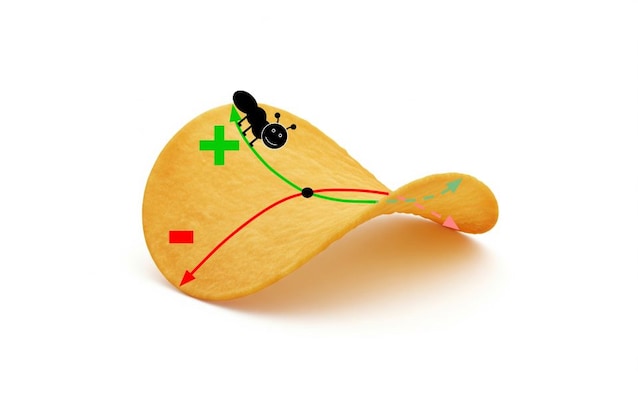
We take the central point of the potato chip and imagine a waters that walk straight from one high end of the chip to the other high end passing precisely for that point. Even if the ant walks straight, from outside we see it walk a curved line, such as the green one of the figure above. The same happens if the ant walks straight from one low end of the chips to the other, along the red curved line of the figure. The two curves traced by the ant meet in one point but are not the same: one is facing up and the other downwards. To distinguish them, as mathematics do, we can say that one of the two is negative and the other is positive (no, it is not a question of high low and in this specific case we could reverse the two signs, as long as they are different from each other).
Whenever the ant walks on a surface it runs through an inconvenience, so much or little, in one direction or another, depending on the shape of the surface. In the figure below we see the case of an orange in which the two lines are both positive because both curved towards the center of the orange, the two curves are quite similar, but this is not the case of those traced by our anthole on the banana.
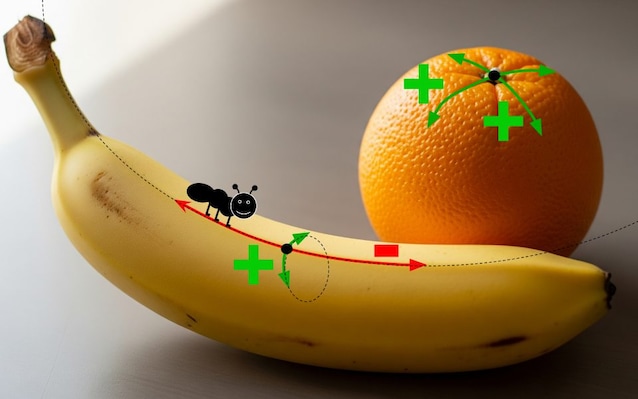
In the case of a banana, in fact, we have a point where the two lines that cross have the opposite sign, but this time the negative line is much more curved than the positive one, we can see it as piece of a small small circumferencewhile the positive line seems to be a piece of a much larger circumference. To describe how much a line is curved, the mathematicians refer to the length of the rays of these imaginary circumferences, thus managing to describe the curvature of a line with a number, which can be positive or negative, large or small.
There is a problem, however, if we take a point on a surface, as for the banana of the figure below, we can trace (always going straight like a ant!) Many different lines, which in general can be more or less curved.
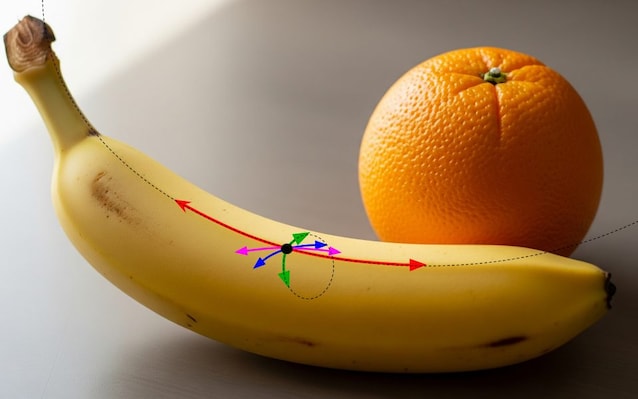
But then, if we want to establish how curved the banana is at that point, which of these lines do we have to consider? There are infinite, we can not analyze them all! The intuition of the German mathematician Carl Friedrich Gauss (1777-1855) It was enough choose two, the line with the greatest curvature and the one with the minor curvature, and multiply the two curvatures between themthus obtaining a single number for each point of the surface said curvature of gauss.
With this we can easily establish if a surface has a positive, negative or nothing curvature. For example, in the case of chipsince there are both lines with positive curvature and lines with negative curvature, the curvature of gauss At the point considered is negative Because, it is estimated by multiplying a negative and a positive number together, and as you know “more for less it does less“. The same goes for the point we took on the surface of the banana. As for theorange Instead, we have one curvature of gauss positive since all lines have positive curvature.
The easiest case is that of flat surfaceslike a table or a paper sheetwhatever line we trace going straight (yes, always walking like a ant) this is straight also seen from the outside and therefore its own curvature is nothingconsequently the curvature of gauss of a sheet or a table is just 0: who would ever wait for him?
What Gauss’s Theorema Egregium says
Well, we saw what the curvature of gaussbut this still does not tell us why the pizza does not collapse plus when we fold it. It comes to us again Gausswhich has shown a theorem, defined by him Theorema Egregiumaccording to which
If we fold a surface without tearing it, without lengthening it and without stripping it, its curvature of Gauss does not change
From a concrete point of view, the theorem tells us that If we try to crush the chip on the table, this must necessarily break: In fact, the chip has a negative curvature, if it could flatten on the table, its curvature should become zero, but this, according to the theorem, cannot happen unless there are breakages. And here we can finally explain what happens with pizza.
Like Gauss’s theorem helps us to eat pizza
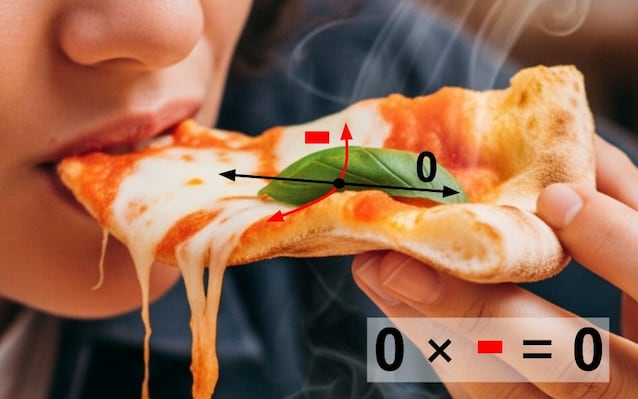
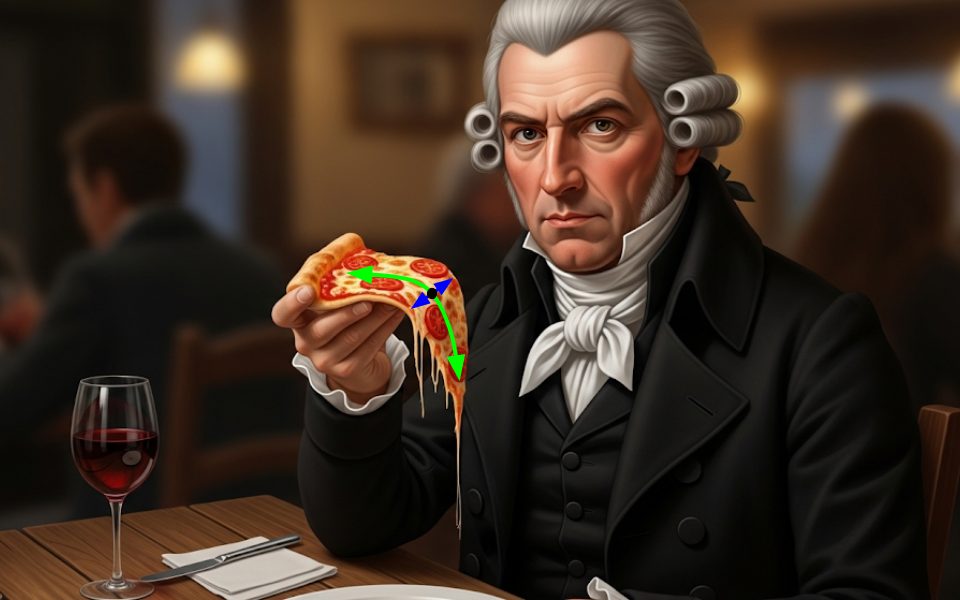
A slice of pizza can be seen as a flat triangular surface, so in every point its curvature of Gauss is worth zero. When we lift the slice by simply keeping it from the edge this bends inevitably downwards, but this does not contradict the Theorem Egregium because the curvature remains zero: the line that follows the fold has zero curvature, while all the others are positive, and zero for a positive number always makes zero (see figure below).
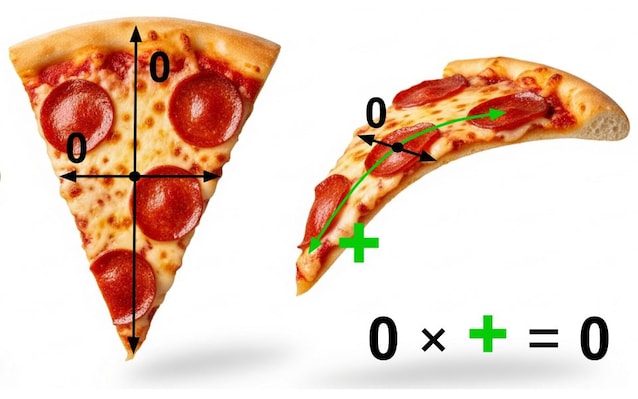
Similarly even when we fold the edges of the pizza upwards the curvature of Gauss remains zero: for the points of the curved part, a straight line passes, with zero curvature, and many curved lines upwards with negative curvature (see figure below), so the product continues to be zero. Now, if the pizza folded down even down, it would be created at least one point for which they pass both curved upwards and curved lines downwards and the curvature of Gauss would become negative (“more for less it does less“!): this for the Theorema Egregium It is impossible, unless tear, and in fact if we try to do it the pizza tears!