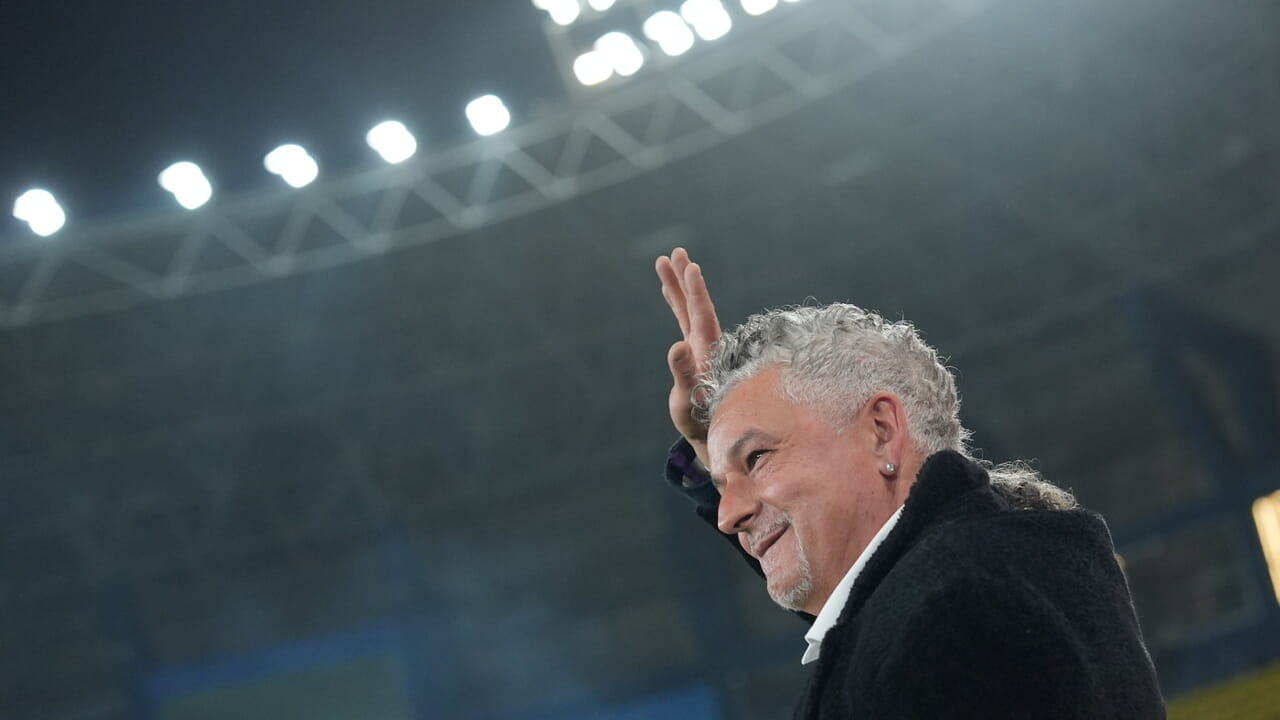
But in the end, would the ‘Baggio Plan’ really be useful today?
The “Piano Baggio” today it should not be read as a sentimental relic, but as a diagnosis that remains open. In 2010 the FIGC he presented the cornerstones: technical training, relaunch of the nurseries, quality of the instructors, collaboration with the clubs, sports and IT infrastructures. Fifteen years later, the official numbers say the system continues to suffer right there: few players grown at home, too much dispersion along the supply chain, too little space for young Italians in the elite championships. Not having applied that plan has not deprived Italian football of a magic formula; it made him lose the most precious thing a reform can have: time.
An old plan only on paper
There are ideas that age and ideas that remain there, like an alarm left on in an empty room. The “Piano Baggio” belongs to the second category. When the FIGC presented it in December 2010, the vocabulary was already clear: “technical training and valorization of talent”, “relaunch of the nurseries”, “ethics and human qualities”, strengthening of the Coaching School, courses for instructors of young footballers, closer relationship with the clubs and modernization of the sports and IT infrastructures. If you reread it today, it doesn’t sound dated: it sounds tragically current. The point is not that Roberto Baggio was a seer. The point is that he had identified the exact location of the fracture: Italian football still knew how to manage the existing situation, but was already struggling to build the future. And in fact, fifteen years later, the official photograph of the FIGC tells of a system that continues to produce too little elite talent compared to the great European competitors and, above all, to disperse too much of it along the way.
The crux: not the talent, but the supply chain
In Italy we often continue to discuss as if the problem was the absolute scarcity of talent. The numbers instead suggest something more uncomfortable: the problem is the supply chain. The 2025 Calcio Report certifies that Serie A is third to last among the 30 main European championships for the use of players trained in its youth sector, with just 6.6%. At the same time, the playing time of foreigners reached 65.4%, a figure higher than even that of the Premier League. It is not an identity or nationalist argument. It’s a question of the industrial capacity of the system: if you train little at home, you depend more on the market and you lose the ability to build your own technical identity. The data on dispersion is even more difficult. Among the approximately 2,400 footballers aged between 15 and 21 who were registered for Serie A clubs ten years ago, today almost 50% play in the amateurs, 28% have stopped and just 4.5% are still registered in Serie A. It is here that the “Baggio Plan”, if it had been translated into coherent federal policy, could have really had an impact: not only in the selection of talent, but in its protection, in its accompaniment, in its technical and educational.
Italian football arrives late to its own future
The delay can also be seen in international comparison. As of 31 December 2024, Italian national youth squads have accumulated 57% fewer minutes than their French peers in the first division championships and approximately eight times fewer minutes in the Champions League. The distance is not just quantitative: it is cultural. It means that young Italians can also emerge in category tournaments, but then find a system that accompanies them worse towards the top. It is the distinctive trait of organizations that know how to celebrate wonders but not build continuity. In this sense, the “Baggio Plan” was a deep maintenance proposal. It did not aim to resolve the emergency of a national team, but to change the grammar of growth: more technique, more territory, more specific skills for those who work with children, more infrastructure, more data, more long vision. It was, essentially, a project against the culture of haste.
The protagonists of Italian football today say the same thing
The most interesting proof of the relevance of the “Baggio Plan” lies in the fact that many of the words spoken today by the protagonists of Italian football seem to be paraphrases of it, even when they do not quote it. Gigi Buffon, in December 2025, said that “talent is not forged in a year”, that behind it there is “a vision and a path that starts even twenty years before” and that, if you want a certain type of player, you need to intervene “in the basic age between 7 and 14”. It is the same logic as the dossier: the future is not repaired in a press conference, it is built in the fields where the child touches the ball for the first time. Gian Piero Gasperini, a few months earlier, had said something equally decisive: “In Italy we make the mistake of immediately asking the kids in the youth sectors for results instead of leaving them free to play and make mistakes… Physical performance is preferred over everything.” It is a striking phrase because it puts the finger in the oldest wound of our football: the anxiety of anticipated performance, the precocious tacticism, the result as an obsession even at the age in which technical and motor literacy should count above all. Here the “Baggio Plan” does not appear as a utopia, but as a failed reform of the mentality.
Something came in, too late
However, it would be wrong to describe these years as if nothing had happened. Some of those insights have been absorbed. The FIGC has built the Federal Territorial Centers and already in 2018 it spoke of 50 centers of excellence operating throughout Italy (currently around 35 are active), designed for the medium-long term monitoring of young footballers and for raising the technical and managerial level of youth football. Later, the Evolution Program consolidated that trajectory with a structure divided into Territorial Development Areas, CFTs and training activities also for adults, managers and families. This means only one thing: the initial diagnosis was right. But a correct diagnosis, if it becomes political after seven or ten years, has already lost a decisive part of its effectiveness. In football, time is not an accessory variable. Seven years is a whole generation of kids. They are a complete training cycle that can be constructed methodically or left to fragmentation, chance, territorial disparities, and the goodwill of individual technicians and individual companies. Not having applied the “Baggio Plan” when it could still have had an in-depth effect meant losing at least one long development cycle.
What has Italian football really missed?
Not just a document was lost, nor a possible shortcut to becoming competitive again. The advantage of starting earlier has been lost. The time necessary to better train those who train, to make the paths more homogeneous, to preside over the territory with a stable network, to accompany the transition between youth talent and adult football has been lost. And this lost time today is measured in official data: in the minutes that Italians don’t accumulate, in the kids who slip out of professionalism, in the youth teams who don’t become the first team, in the Italian clubs absent from the European top 10 for producing elite footballers. The paradox is that the “Baggio Plan” would not be sufficient on its own in 2026. Today it should be updated with a more advanced culture of data, mental health, educational protection, women’s football, new forms of scouting and the economic sustainability of the paths. But here is the point: it is no longer enough now because it would have been useful then. If it had been applied in 2011, today perhaps Italian football would be discussing how to evolve a structure; instead he continues to ask himself how to build it.
What’s left
Italian football hasn’t just left a former champion’s plan in a drawer. He left in a drawer the idea that the future requires discipline, continuity and vision. Every time the system goes into crisis, it reopens that file like you reopen maps after getting lost. But a map is needed before the trip, not after. And the real damage isn’t not having been right too soon: it’s having chosen, for fifteen years, to always arrive late where we needed to start.
