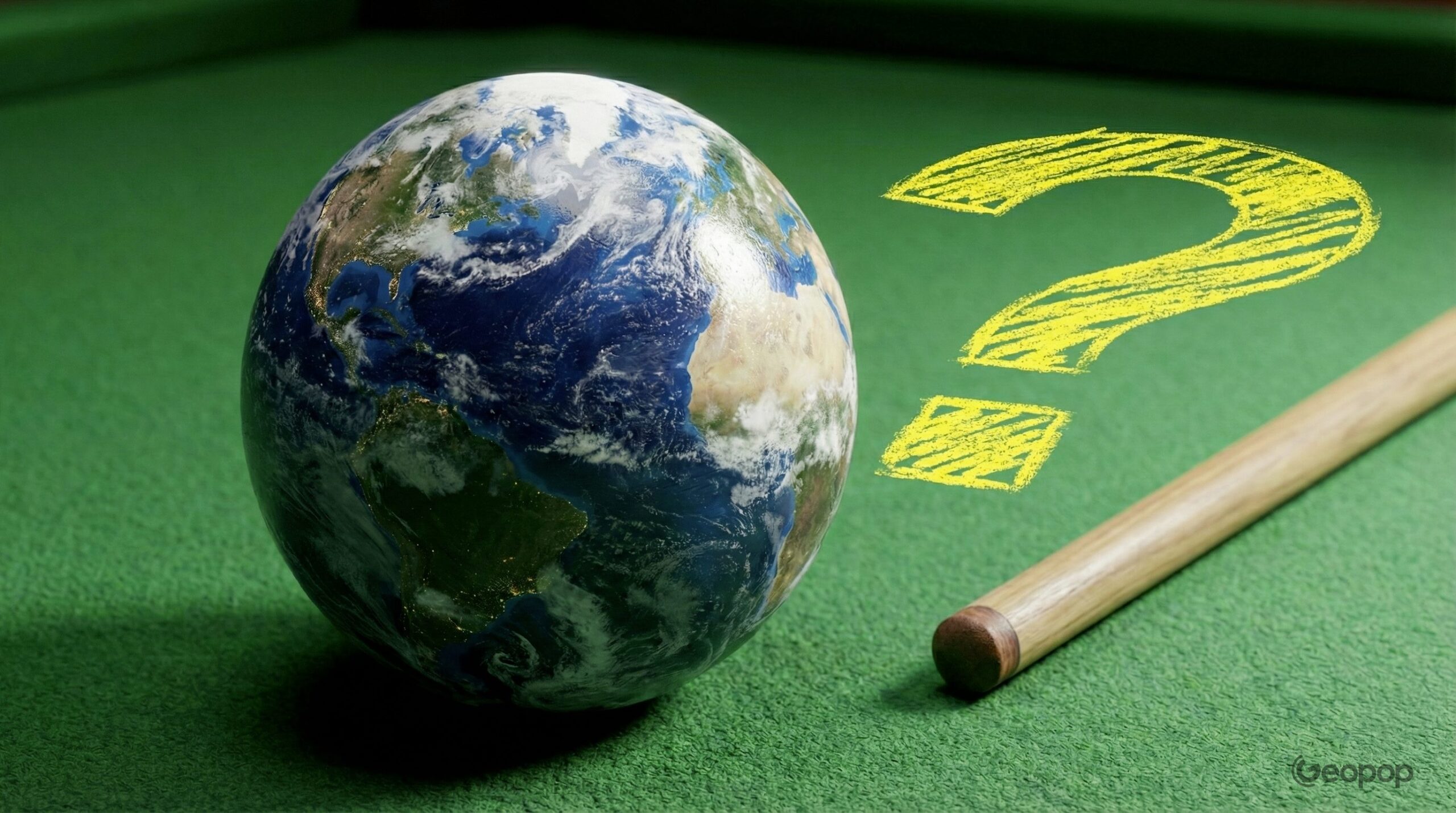
Sometimes you may have read or heard that the Earth would be smoother than a billiard ball. In reality this is not true: the roughness of a billiard ball is much lower than that of our planet. The origin of this cliché probably lies in a misinterpretation of the official regulations on the dimensions of a regulation billiard ball. The Earth still remains a rather smooth “ball” when viewed from afar: but if it were the size of a billiard ball, a professional player probably wouldn’t play with it.
Ok, let’s start crunching some numbers. The largest “roughnesses” on Earth compared to sea level I’m there Mariana Trench with his 10,994 meters of depth and the Mount Everest with its 8848 meters of height (while the highest mountain from base to summit is Mauna Kea in Hawaii with 10,210 metres). These are notable values, but we must take into account that the average diameter of the Earth is 12,742 km: in percentage the two “roughnesses” are 0.086% and 0.07% respectively. So we can say that the Earth is smoothbut smooth enough to compete with a regulation pool ball?
And here we come to the key point of the matter. In its official regulation, the World Pool Billiard Association establishes that:
All balls must (…) measure 2¼ ± 0.005 inches (5.715 cm ± 0.127 mm) in diameter.
This is the phrase that is often misinterpreted. The “standard” reasoning in fact sounds more or less like this: given the proportion, the tolerance allowed for the diameter of a billiard ball corresponds to a roughness of 28km approximately on Earth. Since both Everest and the Marianas are well below this limit, then the Earth is smoother than a billiard ball.
Be careful, though. What the World Pool Billiard Association is talking about is tolerance on the diameter of the ball, not on his imperfections: we’re talking about yours sphericitynot his roughness. In other words, the diameter medium of a ball can deviate from the nominal 5.715 centimeters within a range of 0.254 millimeters (i.e. double 0.127 millimeters). We’re playing devil’s advocate a bit, we realize, but that’s technically what the official rules say.
One may ask whether the Earth lies within these limits. Our planet is not a perfect sphere, mostly because of the fact that it is slightly flattened at the poles. In fact, its diameter from pole to pole is approx 12,714 kmwhile the equatorial diameter is approximately 12,756 km. The difference compared to the average diameter of the Earth is 14km for the equatorial diameter and of 28km for the polar diameter: the latter corresponds to the limit allowed by the regulation and which we calculated before, therefore we can consider the Earth “round enough” to be used as a billiard ball, even if barely.
But we want to know if our planet is also “smooth enough”. The regulation doesn’t say anything about it, so what you can do is measure the roughness of a billiard ball and compare it with that of the Earth. This has been done, and in the image below you can see an example where you can see imperfections up to about 55 microns (thousandths of a millimetre).
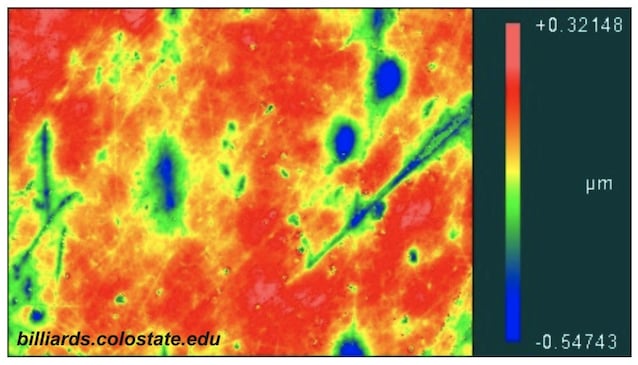
Proportionally, this corresponds to a roughness of approx 1.2 km on the earth’s surface, well below the highest mountains and deepest seabed. This is for a normally worn billiard ball, but a brand new ball, fresh out of the factory, can be estimated to have imperfections under the 30 microns: the equivalent of about 650 meters on Earth, little more than a hill.
In short, if the Earth were the size of a billiard ball, it would be decidedly less smooth. To the touch, however, it would not be particularly rough, on the contrary. Proportionately, Mount Everest would be a tall “bump”. 0.04 millimeterswhile the Mariana Trench is a deep depression 0.05 millimeters.
