Have you ever looked at a bird in flight and felt a hint of envy? Paragliding is probably the closest way we have to imitating that freedom: no enginesno closed cabins, just a fabric wing and a backpack on the shoulders. But how does a “piece of fabric” support us at altitude without falling like a stone? In this article we will discover the physical secret of liftthe technology that hides between the fibers of modern sails and the incredible records of those who have challenged the atmosphere. From flights beyond 600km at the marathon of the skies of Red Bull X-Alps.
The secret of paragliding: the aerodynamics of a fabric wing
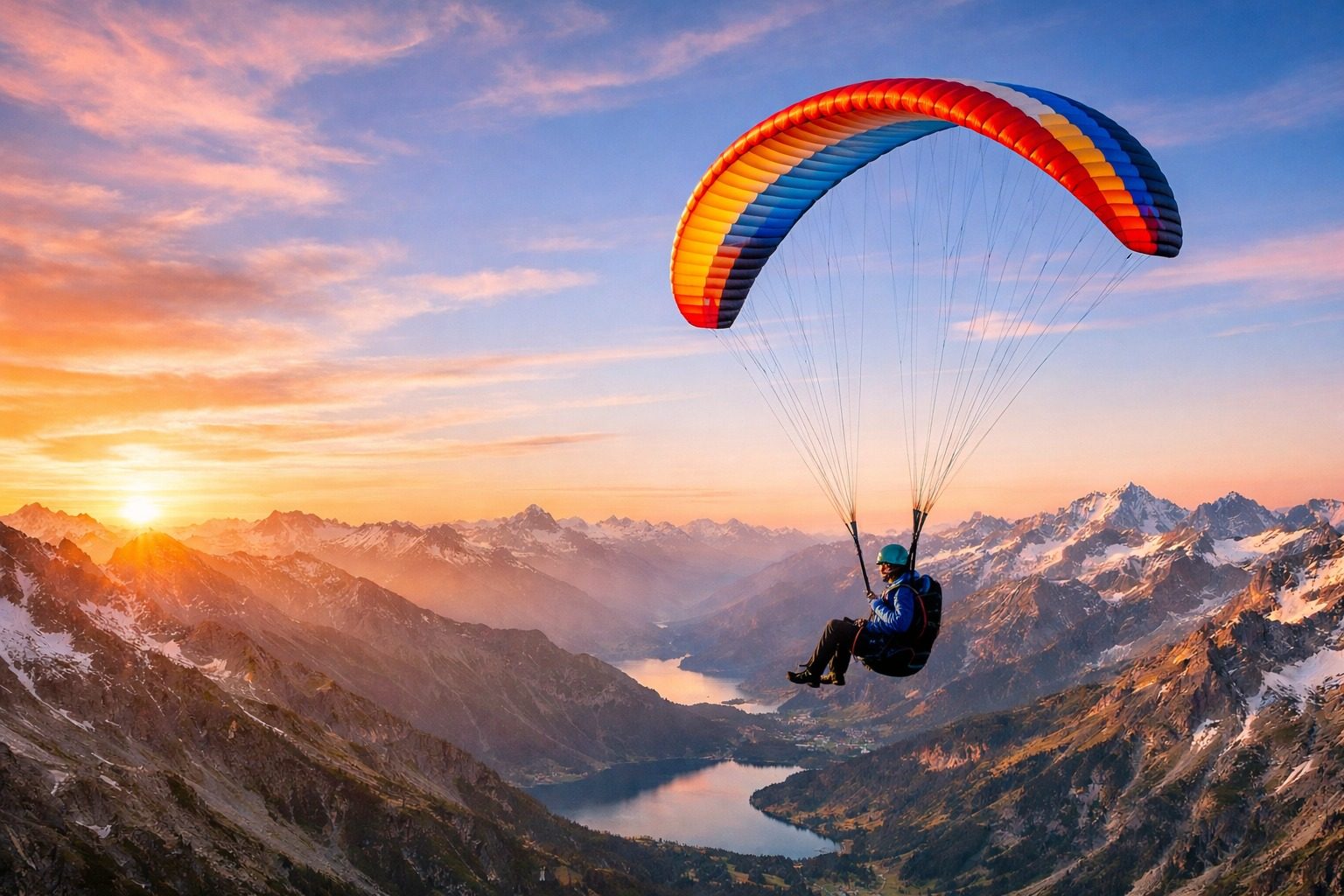
To understand how a paraglider flies, we need to get the idea of a parachute out of our heads. If the parachute is used to break a fall, the paraglider is designed for planarexactly like a glider or the wing of an airplane. The trick is wing profile: the wing is made up of two layers of fabric (extrados above and intrados below) which create cells called caissons. When the pilot runs on takeoff, air enters the front vents and inflates the wing, transforming it into a semi-rigid aerodynamic solid.
At this point physics comes into play, in particular the Bernoulli’s principle. The curved shape of the top forces the air to travel faster than the bottom. According to the laws of fluid dynamics, a faster fluid exerts less pressure: a pressure difference is thus created which generates an upward force called liftwhich literally “sucks” the wing towards the sky, counteracting the force of gravity. But without an engine, How does it gain altitude? The system constantly glides forward through the air; but if he meets athermal” — a column of hot air rising thanks to the energy of the Sun — the paraglider rises together with it as if it were in an invisible elevator.
Equipment in a backpack
A modern paraglider must find a delicate balance: being light enough to carry on the shoulder, but also robust enough to withstand the stresses of flight. The tissue main part of the sail is almost always the ripstop nylon: weighs just 30 grams per square meter, less than half of a common sheet of paper, yet offers surprising resistance.
The lanyards. They have a diameter ranging from 0.5 mm to just over 2 mm, and are made with high-performance fibers such as Dyneema or Kevlarcapable of withstanding loads of the order of 150–200 kg each. They are also inserted into the leading edge of the wing semi-rigid splintswhich help maintain the correct profile in flight, limit deformations and help improve aerodynamic efficiency.
On the performance front, a modern racing wing can reach speeds around 70 km/h and an aerodynamic efficiency greater than 11. In practice, it means being able to travel 11 km in calm air starting from a difference in altitude of 1000 metres. Numbers that until a few years ago seemed out of reach.
Even the harness it is much more than just a seat. It is a true aerodynamic structure, which integrates protections for the spine and houses the emergency parachute. In racing models, called cocoonthe rider’s legs are completely faired to reduce air resistance and improve the overall efficiency of the system. In the lighter configurations, designed forHike & Fly – paragliding discipline in which the pilot walks or climbs the mountain carrying the equipment on his shoulders and then takes off in flight – all the equipment can go below i 5-8kg: a fraction of the 20kg needed just twenty years ago.
Records and races: the marathon of the skies and the limits of man
The world of free flight is the scene of feats that seem impossible. The most famous competition is the Red Bull X-Alpsa race of approx 1200 km across the Alps to be covered only on foot or by flight: after a Swiss domination that lasted 16 years, the 2025 edition was won for the first time by the Italian Aaron Durogati thanks to a brilliant tactical move in the Karwendel mountains.
Paragliding is the simplest way to fly, I can cross the Alps under my own power and when you know how to use it well, it gives you a lot of freedom and very few limitations. From above you see everything from another perspective.
Aaron Durogati-winner X Alps 2025
However, alongside the historic competitions, new competition formats are emerging – such as the LIT Paragliding RS BRANDS 03 IT – designed to make paragliding attractive to the general public too. The races take place in a single compact areawhich allows you to have pilots always visible throughout the competition: thanks to real-time tracking and continuous reading of flight data, the spectator can follow the evolution of the race at any moment, understanding the tactical choices and their impact on the final outcome. The video below shows this technology in real time:
But beyond the races there are the records. The world distance record belongs to the American Sébastien Kayrouz, who in 2021 flew for a long time 610 km in Texas, staying in the air for 11 consecutive hours at an average speed greater than 60 km/h.
With regard to the altitudethe voluntary record is held by Babu Sunuwar and Lakpa Sherpa, who in 2011 took off from the top of Everest reaching the 8865 meters. However, there are also involuntary and frightening records: in 2007, Ewa Wisnierska was sucked into a cumulonimbus cloud – a storm cloud with very violent upward currents – up to 9946 meters of altitude, miraculously surviving at temperatures of –50°C and lack of oxygen.
