
After the seismic peaks recorded at the end of February, the area of Phlegraean Fields is going through a phase of greater calm. The new weekly bulletin released by the Vesuvian Observatory (INGV), relating to the period 2-8 March 2026, highlights a significant decline in events: the seismographs have traced 47 shocksa number that is down compared to 70 episodes from the previous week. The maximum magnitude also underwent a reduction, stopping at 2.4 against the peak of 3.5 from a few days ago. Good news also on the bradyseism: the speed of ground lifting remains at lower values, equal to approximately 10 mm/month. However, the thermal and geochemical picture remains unchanged, with the main fumarole of the Solfatara continuing to record average temperatures of 173 °C. There are no elements that suggest significant short-term developments.
Decreasing seismicity: 47 tremors recorded and no swarm
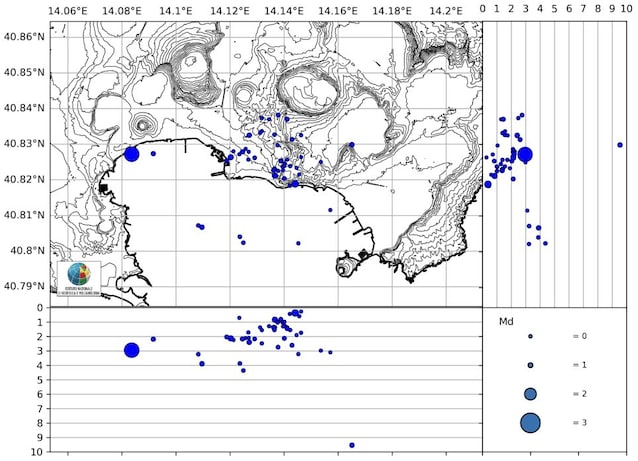
Between 2 and 8 March 2026, the monitoring network located in the Phlegraean area 47 earthquakes. This is a clear decline compared to the last survey, characterized byabsence of new seismic swarms (the only event of this type mentioned in the report remains that of 52 tremors which occurred on 28 February in the Pozzuoli-Agnano area). The shock that released the greatest energy in the last week reached a magnitude of 2.4 and it occurred on the night of March 5 at 04:04 (UTC time). The National Institute of Geophysics and Volcanology calculated for this event a hypocenter located at 2.96 km deep.
Ground deformations: heaving consolidates at 10 millimeters per month
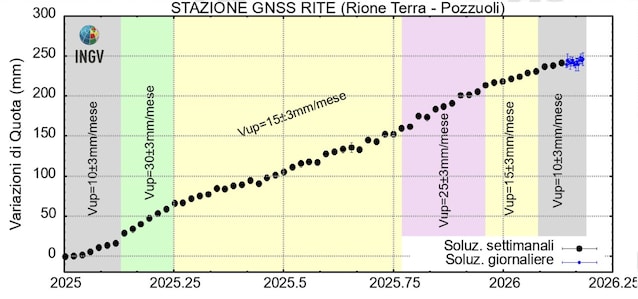
The Phlegraean bradyseismresponsible for the periodic altimetric variations of the terrain, is confirming a slower pace. Starting from the first days of February 2026, the instruments of the Vesuvian Observatory continue to detect an average uplift speed of approximately 10 mm/month. This data reiterates the progressive slowdown compared to the much more sustained rates recorded at the end of 2025, when the 25 mm/month between October and December. Looking at the cumulative data, the GNSS station installed in Rione Terra (RITE) reports that, from January 2025 to today, the ground has risen overall by approximately 25cm.
On the slope geochemistthe parameters remain faithful to well-established hydrothermal warming trends. Inside the crater of Solfatarathe main fumarole (BG) continues its rising thermal trend, recording an average temperature of 173°C. In the area of Pisciarellihowever, the average temperature is around 96°Ca value close to the condensation threshold of the fumarolic fluid, accompanied however in recent months by a new trend towards an increase in carbon dioxide flows emitted from the soil.
Summary of the INGV weekly bulletin
In summary, the INGV weekly bulletin on the Campi Flegrei area (2-8 March 2026) reports:
- Seismicity: decreasing, with 47 localized earthquakes and maximum magnitude 2.4. No new swarms recorded during the reference week.
- Bradyseism: Ground heave rate stable compared to the previous week, at approximately 10 ± 3 mm/month. Total lift of approximately 25cm from January 2025.
- Temperatures: the BG fumarole in the Solfatara crater confirms the increasing trend (~173 °C).
