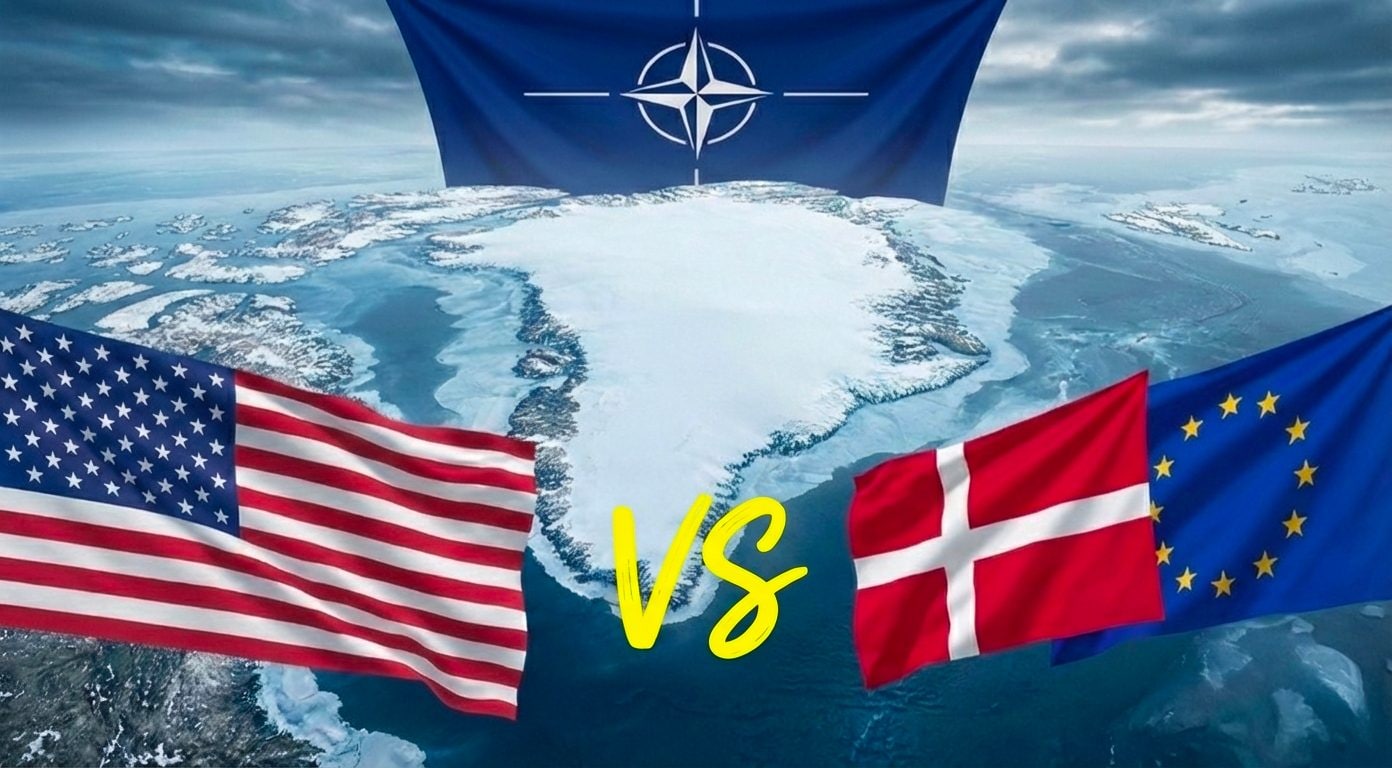
The expansionist aims of Donald Trump on the Greenland they opened a fracture inside the BORNespecially after the US President has threatened to invade the island largest in the world – part of Denmark – just to gain control of it. In the last hours, after a firm and compact European response (as had not been seen for some time), Trump made an about-face, reassuring the other 31 members that the issue will be resolved with a agreement diplomatic.
But what would have happened if the US had attacked Greenland, the territory of another NATO country? This eventuality was never taken into consideration and, in fact, within the North Atlantic Treaty of 1949 there is no article that regulates this option. NATO, in fact, is a military alliance of mutual defense between states, designed with the aim of mutually protecting each other from external attacks (and not internal, in fact).
In the event of a US attack on Greenland, the credibility of the Atlantic Pact would have failed, with the risk of an enormous internal crisis within NATOan option inconvenient not only for Europe – which would lose its alliance with the strongest military power in the world – but also for the USAwho would have had to give up all NATO military bases in the Old Continent, which were essential to maintaining their military supremacy. Suffice it to say that they exist only in Italy 120 American basesincluding Sigonella or Camp Darby.
What does the article say? 5 of the Atlantic Pact in the event of an attack against a NATO country
The idea of a NATO country attacking another member state of the Alliance is considered so remote that thearticle 5 of Atlantic Pact – considered the pillar of this defensive military alliance – does not foresee this eventuality.
The article, in fact, establishes:
The parties agree that an armed attack against one or more of them in Europe or North America it will be considered as a direct attack against all partiesand consequently agree that if such an attack were to occur, each of them, in the exercise of the right of self-defence, individual or collective, recognized by the art. 51 of the Charter of the United Nations, shall assist the party or parties so attacked by taking forthwith, individually and in concert with the other parties, such action as it deems necessary, including the use of armed force, to re-establish and maintain security in the North Atlantic region (…)
If a state were to attack one or more NATO members, that action would therefore be considered as a direct attack against all the countries of the Alliance, which would therefore be called upon to intervene with a collective defense. However, it is not made clear in any way what would happen if two NATO members went to war with each other.
It would in fact be a legal paradox for the Alliance, given the nature of the Atlantic Alliance: NATO was founded in 1949 with the aim of guaranteeing the mutual protection of the states parties in Europe and North America. Back then, the main threat was represented by the Soviet Union: after its dissolution in the early 1990s, NATO “reinvented” itself with the main aim of ensure world peace and security.
Likewise, in the event of a mutual attack, the states could have invoked article 4which provides:
The parties will consult each other whenever, in the opinion of one of them, theterritorial integritythe political independence or security of one of the parties was threatened.
Even in this case, the Pact does not establish the methods of action in the event that a NATO member threatens the territorial integrity of another party, as happened with the USA.
Nonetheless, the fact that the North Atlantic Treaty does not contemplate this hypothesis, does not 100% rule out the possibility of it occurring: so, yes, a NATO member could attack its ally. It all depends on the strategy that each state decides to adopt and the advantages – in economic, political and international prestige terms – that it can obtain.
Would Europe respond to a Trump US attack on Greenland?
As several international relations experts point out, if Trump had really attacked Greenland, that is unlikely than Denmark or other European countries that are members of NATO decided to intervene in defense of the island. Simply because it does not have the military numbers to compete with the USA: the United States, in fact, has over 1.3 million active military personnel, divided across all its armed forces; Denmark has around 13,100.
Added to this is the fact that, according to official NATO data, in 2025 Washington he spent approx $845 billion for defensewhile all the others 31 Member States they would have spent in total 559 billion of dollars. It should also be remembered that the USA, unlike Copenhagen, already has one military base in Greenland, the Pituffik Space Base, from which it would have been much easier to coordinate all operations.
In short, the US invasion of Greenland would have mainly caused a weakening of the Atlantic Alliance, with the risk that NATO would end up crumbling internally, changing the global geopolitical balance after 76 years of coalition.
