
Written language is among the few elements that distinguish our species from other animals: although complex communication systems have evolved in many animal species, none have developed the association between written concepts, words and symbols corresponding, typical of our civilizations. But there are some cases of animals with high cognitive abilities that learn to recognizeif properly trained, even written human words. These are particularly gifted specimens capable of learning, and then using, words, symbols and pictograms to interpret information and communicate with us. Sometimes, animals – especially domestic ones – seem to react to certain written words as if they were able to read them even if not trained, but this is a reaction to our body signals rather than the words themselves. These animals “read” our body language rather than written language, a demonstration of their underrated emotional understanding abilities.
Which species are able to recognize words and symbols
In evolutionary terms, writing as we understand it today (made of ideograms or alphabetic, made of corresponding graphemes and phonemes) is a very recent invention, dating back to around 3500 years BC. No other species, not even those closest to us, have evolved anything similar: this is probably attributable to a combination of communication complexity, vocal range And symbolic mind which led to the birth of languages, in addition to precise manual skill which allows us to transfer this language to a physical medium. In no other species did this combination of factors that led to the birth of writing occur – however, some species possess i prerequisites for reading of human language, at least at a very basic level.
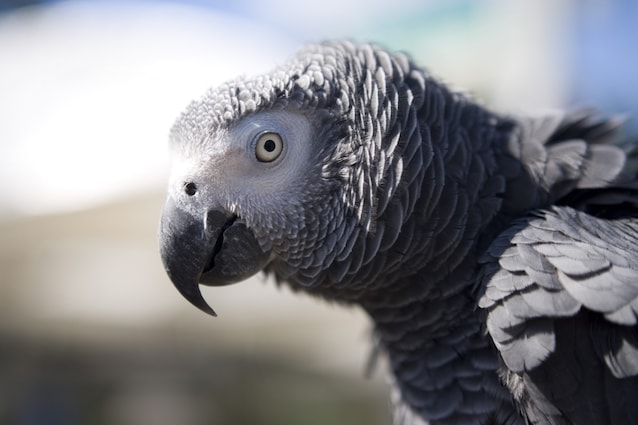
Some species of parot like kakatuas or gray parrots, for example, possess high abilities of mimicry and understanding of human language and if raised in a domestic environment they are able to carry on short conversations with us human beings. These cognitive abilities also extend to written symbols: researchers from Northeastern University have taught parrots to recognize words and ideograms and to draw letters of the alphabet using special tablets. According to the Roatan Institute in Honduras, their trained dolphins are capable of interpret drawn symbols as you command, and respond accordingly.
Pigeons were instead trained, in an experiment at Duke University, to recognize up to 60 words and distinguish them from meaningless sequences of letters: using a touchscreen, they had to peck the correct word among the non-existent ones, or peck on a star symbol if they were all nonsense, thus demonstrating the ability to spelling recognition of letters and sequences.
It is important to point out that some type of is still necessary prolonged training for these animals to learn to read: the specimens must be exposed daily, usually at a young age, to human language, and motivated with a reward system in a controlled environment. Individuals of the same species but raised in the wild, without ever having been exposed to written words, are unable to recognize any written symbol.
It is equally important to distinguish between “reading” a word and its actual reading comprehension: an animal might learn to recognize a specific sequence of letters and react accordingly, but it doesn’t necessarily understand the meaning of that word. For this, without an understanding of human language, which no other species seems to possess, even the most sophisticated examples they are not considered real “reading” in the common sense of the term.
Pictogram reading in primates: Kanzi’s story
Most laboratory experiments for understanding language in animals involve i primates closest to us – chimpanzees, bonobos and orangutans. The most famous of these is undoubtedly Kanzi, a bonobo who was taught the English language and sign language since childhood. Died in March 2025 after 44 years of life, Kanzi is considered the first non-human primate to be able to understand human language, associating spoken English words with corresponding symbols.
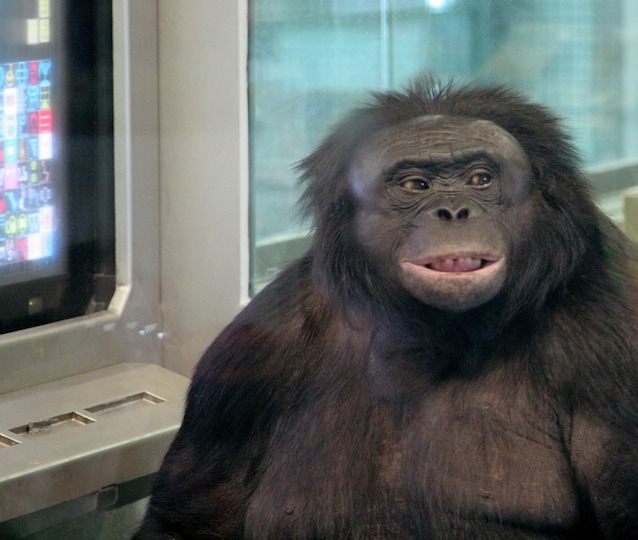
Kanzi communicated with the researchers via a special panel of ideograms, called lexigram. These 384 stylized symbols do not represent objects and actions in a visual way, but constitute a real artificial written language (the Yerkish) specially created by researchers. Of all the primates subjected to the experiments, Kanzi was the one who demonstrated the greatest mastery of language, responding to requests, communicating his emotions and exhibiting a limited ability to creative combination: scared by a beaver, which he had never seen before, Kanzi called it “water gorilla” combining the lexigrams of the two words. Even if these are limited capacities compared to those of our species, they show that the basic elements for reading and the association between symbols and meanings are present in the animals most evolutionarily close to us.
The case of Kluge Hans and the reading of body language
Sometimes what may appear to us as a reaction to a written word by an animal may instead be hiding what is the our reaction to that word. Many pet owners report cases of cats and dogs showing interest and appearing to recognize written words as if they could read. What happens instead is that the animal stays responding to signals from our body: if we react (often unconsciously) to a certain word in front of our pets, they will end up associating the reaction with the word itself.
The most emblematic case is that of Kluge Hans, Hans the Intelligent, a trained horse that seemed to be able to spell and solve calculations. Owned by the mathematician Wilhelm von Osten, who exhibited it in shows, Hans had actually learned to interpret his master’s reactions when he was given the right answer, stamping his hooves. After a test experiment in 1911, it was discovered that Hans was unable to give a response when his master did not know it or he was not presentand that he could not distinguish symbols and numbers from each other. Von Osten himself apparently did not even intend to defraud the spectators and was truly convinced of the horse’s logical abilities, without being aware that the latter was actually reacting to his body language.
