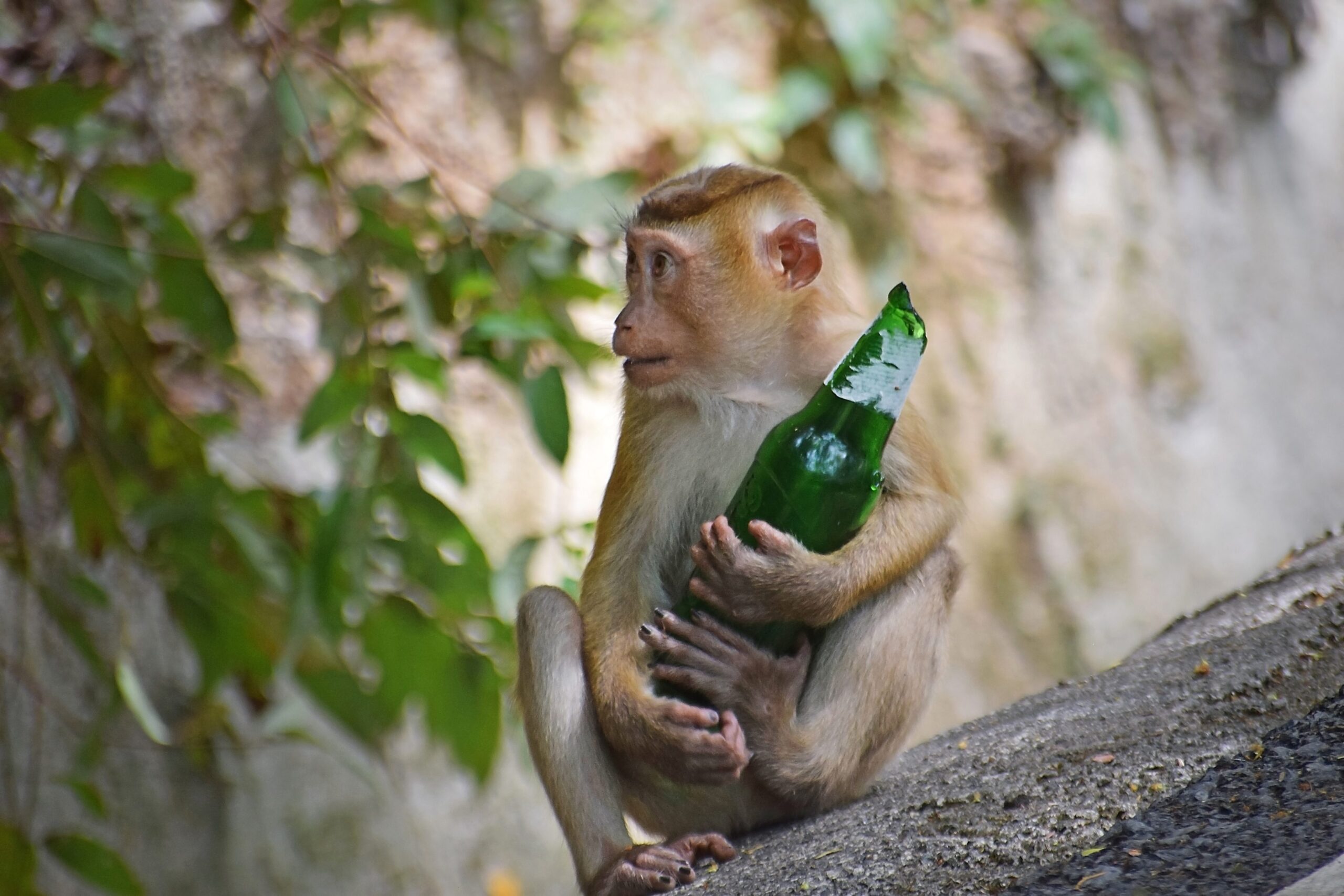
Why does alcohol exert such a strong call on human beings? The answer is not only cultural, but it seems that our attraction for this substance sinks the roots in the most remote past. Measuring the content of ethanol in the fruits eaten by chimpanzeea very recent study published on Science Advances calculated that these animals ingest around every day 4.5 kg of fruitmeans an average intake of 14 grams of ethanolthe equivalent of a glass of wine. This is not an exception, but a clue to how our ancestors have lived with alcohol for millions of years. Other works have even reconstructed ancient enzymes, discovering one Ten million appearance mutation years ago that has increased our ability to metabolize ethanol by forty times: an interesting evolutionary strategy. If we widen our gaze, we discover that hundreds of wild fruits contain alcohol, From Nordic berries to tropical fruits, with values that in some cases touch 10%.
Wild chimpanzees unconsciously take alcohol
Chimpanzees do not drink beer or wine, but still take alcohol. They do it unconsciously, eating ripe fruits colonized by yeasts, which start the fermentation sugars in the fruit and transformation into ethanol. Dr. Maro and his colleagues have collected more than one hundred fruit samples in the Ivory Coast and Uganda, analyzing its content. The average content of ethanol is around the 0.31–0.32%with tips higher than 0.5% especially like Ficus Mucuso.
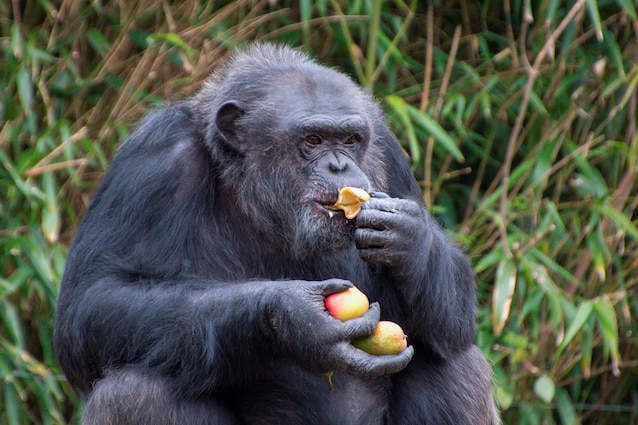
Now, if you think that a single chimpanzee comes to consume about 4.5 kg of fruit per daymeans an average intake of 14 grams of ethanolequal to just over a pint of beer or a glass of 125 ml wine according to international standards. We are not talking about drunkenness, but of a chronic and constant exposurewhich may have played a role in failing primates – and our ancestors – to metabolize small doses of alcohol as a normal part of the diet. The quantity, however high it may seem, It has no particularly serious effects on animals.
What for chimpanzees still exposed to small doses of ethanol with the diet is still a adaptive strategy, for man in the modern world he turns into a riskdue to the excessive concentration of ethanol that is consumed with alcoholic beverages, concentrations that no ancestor has ever experienced.
A genical mutation has turned into an adaptation for survival
If the field data show what happens today, the paleogeneticsthat is, the study of the past through the genetic material preserved in the remains that we have available, tells us how we have developed this attraction towards ethanol.
A group of scientists from the University of California has “resurrected“Nine ancestral versions, recovered in finds that cross around 70 million years of the history of primates, of the enzyme Adh4that is, the first enzyme that ethanol encounters in our body when we ingest it. The result is surprising: almost all these enzymes were ineffective against ethanol, but about 10 million years ago one appeared mutation who changed the cards to the table. In one step, the efficiency of the ADH4 in metabolizing the ethanol increased 40 times.
This epochal moment coincides with the transition to a more terrestrial life: on the ground, the fruits collected were more than fermentation and therefore were richer in alcohol. Who knew how to exploit this resource had a energy advantage. A small genetic mutation thus turned into a crucial adaptation for survival.
Putting these pieces together leads us to a clear conclusion: the predisposition to alcohol is The result of a long coeximation. Our ancestors have regularly met small doses of ethanol in fermented fruits and a genetic mutation has made it easier to metabolize it.
Ethanol is present throughout the animal and vegetable world
Alcohol, however, is not just a question of primates. A study by Dr. Bowland and his team shows that Hitanol is widespread throughout the animal and vegetable kingdom. In the wild fruits of Sorbo or whites, in Finland, the concentrations oscillate between the 0.05 and 0.41% ABV (alcohol in volume); In Israel, figs and dates almost reach the1%; In the tropics, the figures splash up, up to a maximum of the 10.3% recorded in palm fruits (Astrocaryum Standleyanum) collected in Panama.
It is not surprising then that many animals have developed specific adaptations. The fruit midges (Drosophila) live and reproduce in environments with ethanol beyond the 4%coming to the 15% in contexts influenced by man, e they metabolize alcohol with extraordinary efficiency. These examples question the idea that only humans have to do with alcohol: in reality, ethanol is integral part of ecosystemsa substance that influences relationships between plants, yeasts, insects and mammals.
