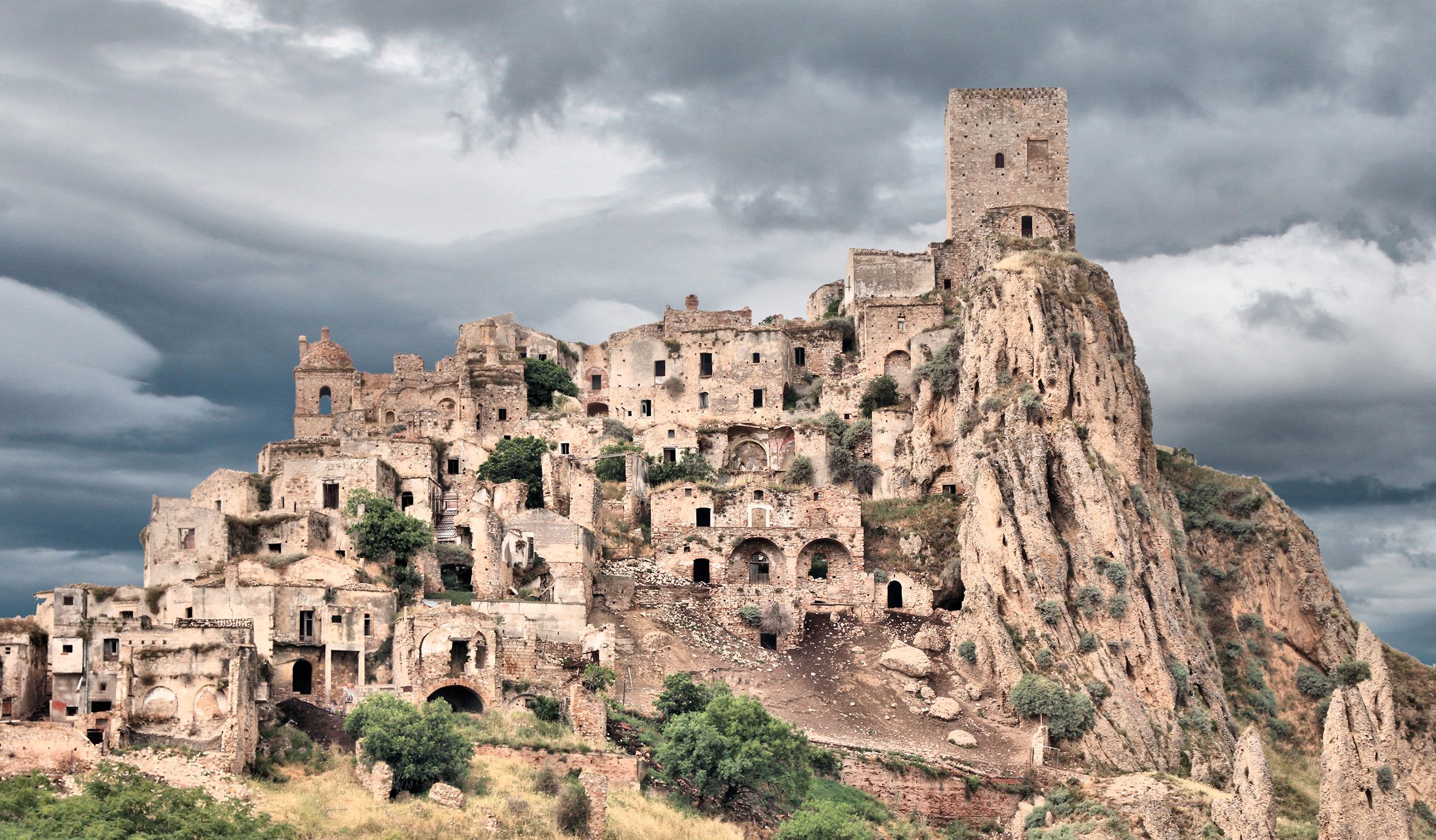
In the heart of Basilicata, perched on a hill among the clayey gullies in the province of Matera, lies Cracoa medieval village which today is a ghost town. Once strategic for its defensive position, Craco has been abandoned since the 1960s due to landslides which compromised the stability of buildings and the possibility of growth and territorial expansion. This surreal landscape has been chosen as the set for some historical films including The Passion of the Christ (2004) by Mel Gibson, Basilicata Coast to Coast by Rocco Papaleo (2010) and Christ Stopped at Eboli (1979).
The history of Craco, the ghost town
Perched on a small mountain in the province of Materain Basilicata, Craco is a small town but with a strategic past: its dominant position offered an excellent observation point and a solid natural defensemaking it precious in past centuries. Today, however, it is known for a very different reason: it has become a ghost town. Starting from the 1950s-60s, a series of increasingly frequent landslides and dangerous conditions has made the buildings unstable and susceptible to ground movements: the continuous movements of the ground induced by landslides have led to the creation of failures in the foundations of the buildings, consequently causing serious structural damage and forcing the inhabitants to evacuate. By 1975, the village was completely abandoned. Craco stands on a clayey relief typical of the Lucanian gulliesgeological formations characterized by fine materials (clays and marls), equipped with a low cohesion and one reduced permeabilitywhich favors the accumulation of water and the triggering of landslides due to sliding along surfaces that show weaker resistance.
Today Craco is one tourist destination as fascinating as it is fragile, it can only be visited via guided tours and with personal protective equipment, such as special safety helmets. Its ancient walls, supported by temporary structures, tell a story of a past time, immersed in a landscape dominated by suggestive gullies, the clay formations typical of the area which recall scenarios with predominant desert features.
What happened in the town near Matera: the landslides
Contrary to what you might think, one landslide it is almost never a sudden event. In most cases, it is a slow and progressive process, which evolves over time until it manifests itself with visible and potentially dangerous movements for buildings and infrastructures. At the base of a landslide there is a condition of ground instability: the soil, which normally behaves like a single body, loses its internal cohesive bonds. It is as if an invisible blade cuts it, creating a sliding surface along which a portion of the ground begins to move.
This phenomenon is at the basis of what also happened in Craco, whose history of landslides can be reconstructed over time through the following events, considered among all the most significant, documented in the documents of the municipal archive:
- 1688 – An intense one earthquakewith its epicenter between Craco and Pisticci, reactivates numerous quiescent landslides, including the one involving the lower part of the town. From this historical point onwards, various landslides, even of modest magnitude, followed which can be summarized in a period ranging from 1870-1866. The phenomena are partly countered by the construction of arched retaining walls.
- 1954 – The construction of a sports fieldor near the lower area of the built-up area, it modifies the equilibrium conditions of the slope, already at the limit of stability. The leveling of the area for the construction of the sports facility alters the profile of the slope, worsening the overall stability of the terrain.
- 1959 – An exceptional rainfall event, with approx 400 mm of rain in five days, causes a further increase in instability. The infiltration of water into the landslide causes new settlements, in particular in the area of the sports field, damaging arched walls and houses located above the SS103. The state road becomes impassable and 153 homes are declared unusable.
- 1968 – Despite the creation of a new retaining wall on foundation piles approximately 30 meters deep, the landslide movement did not stop, a sign that the sliding surface was well below the estimated depth. The new movements destroy the wall, the piling and numerous houses upstream from the SS103.
Following these events, the inhabitants of Craco decided to definitively abandon the countryalso thanks to the 1980 Irpinia earthquake, which caused further damage to the village even in the part still inhabited.
The works of risk mitigation in the context of a landslide they aim to “sew up” the sliding surface with interventions such as deep drainage or pilings of adequate length compared to the depth of the possible sliding surface. However, the development and extent of landslides can nowadays also be predicted and controlled with the aid of monitoring works designed ad-hoc for the specific case.
