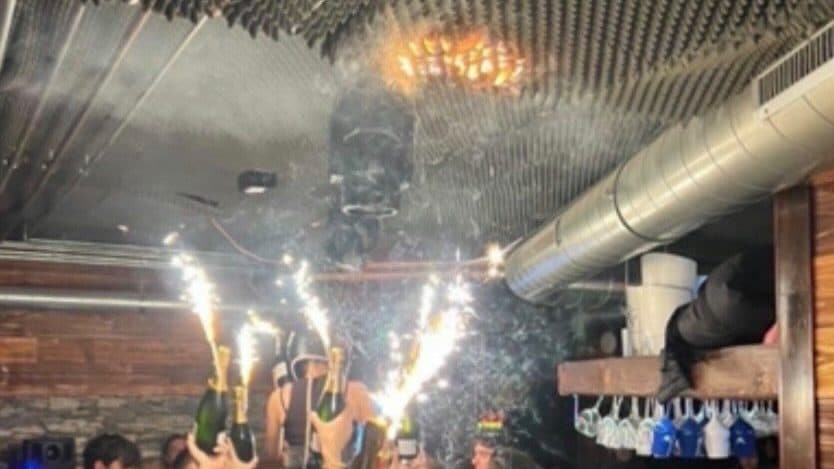
On New Year’s Eve 2026, around 1:30 in the morning, a violent explosion occurred in the bar The Constellations in the ski resort of Crans Montanain Switzerland, which caused at least 47 dead and 115 injured. The investigations are still ongoing and the dynamics of the tragedy are not yet known: one of the hypotheses being worked on is that of flashoverthat is, a generalized fire, which according to some testimonies may have been started by sparks produced by luminous fountains which would have set fire to the soundproofing covering of the ceiling. The fire, initially localized, could then have evolved into a general fire in the entire bar (a flashover), which was also a basement.
According to theInternational Fire Service Training Associationflashover is «The phase of a fire in which all surfaces and objects within an environment have been heated to their ignition temperature, and flames blaze almost simultaneously across the entire surface of every object in the space». This is a particular type of fire extremely dangerous – often fatal even for the most experienced firefighters – because it involves the entire environment and can develop very quickly (sometimes just ten seconds), leaving the occupants no time to escape the flames.
Not every fire is destined to evolve into a flashover: appropriate ventilation conditions, temperature and so on are needed. It is usually a phenomenon that occurs in closed environments. It all starts with localized flames, like those that hit the ceiling of the bar in Crans-Montana. As the fire grows and the temperature rises, a point is reached where the room and the materials it is made of cannot absorb any further heat; therefore, in an attempt to maintain thermal equilibrium, they disperse part of the energy received in the form of very hot and flammable gases. This phenomenon in technical jargon is called off-gassing.
These hot gases accumulate under the entire ceiling of the room and emit in the form of thermal radiation (i.e. electromagnetic waves) a large amount of heat that radiates all the surfaces of the environment, in a widespread and very rapid way, bringing them to a temperature that causes further off-gassing. This vicious circle is practically unstoppable: the temperature increases steadily and, once the combustion limit is reached (typically between 500 °C and 600 °C), they catch fire in a general way, simultaneously setting the entire environment on fire.
The flashover hypothesis could explain how this accident could have caused the death and injury of so many people. These fires can in fact develop within the space of a few seconds or a few minutes and involve the entire room. Plus the bar was relatively small in size, basement and no windowsconditions that favor the accumulation of flammable gases necessary to trigger a flashover. To this we must add that the only way out for the people inside was a steep staircaseand also that the mass of people were in a state of panic – and probably in less than optimal psychophysical conditions – therefore hardly able to move in a timely and organized manner to exit the premises.
