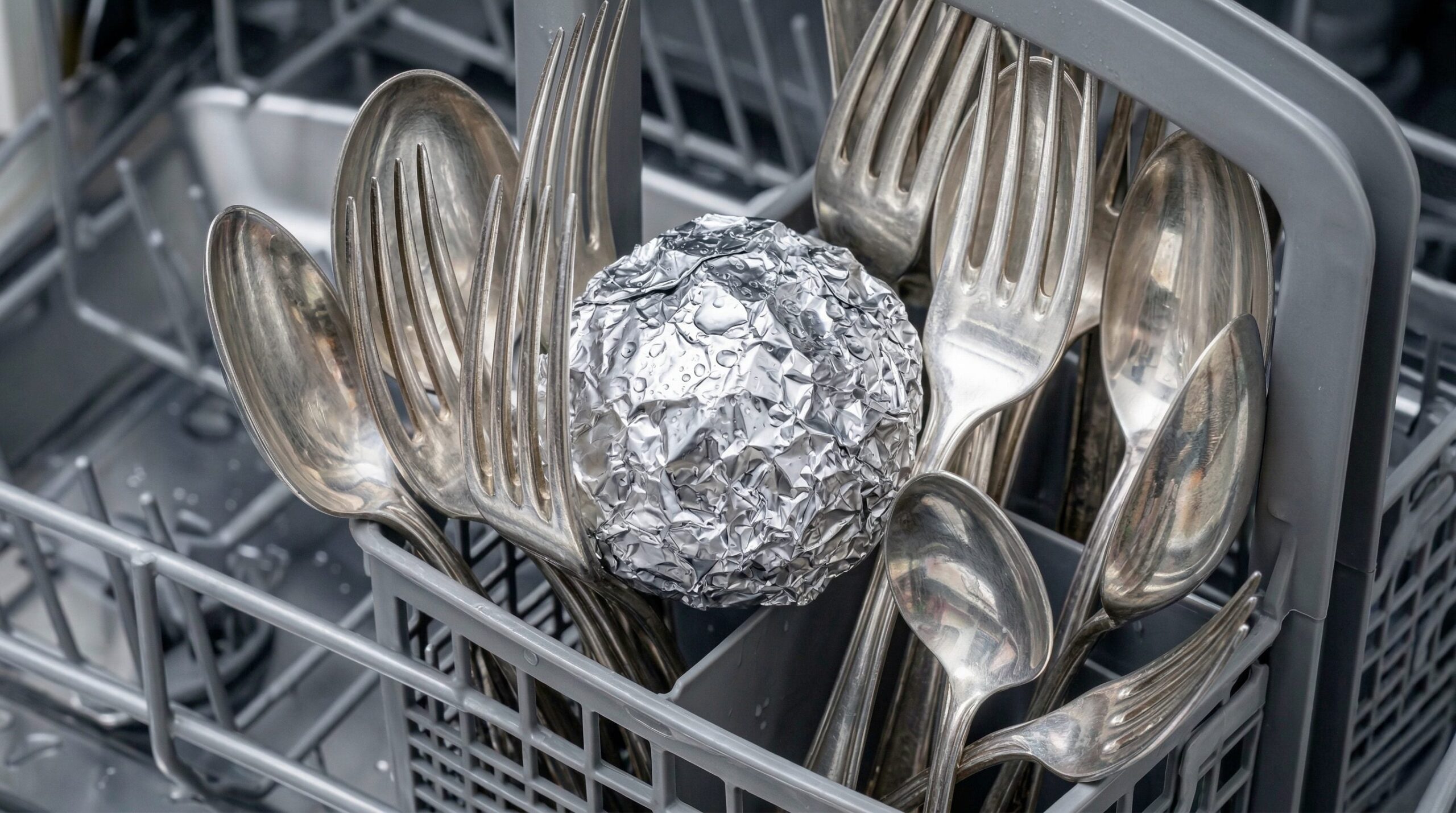
You may have heard that adding one or more foil balls in the dishwasher would help make silver cutlery shiny again. It’s very simple: crumple up some tinfoil, place the ball (or more balls) in the cutlery basket together with the silverware, and start the dishwasher. But does it work? Unlike other “aluminium-based” home tricks that do not have a solid scientific basis – such as using foil in the washing machine – this one is perfectly motivated from a chemical point of viewas long as we are aware that It only works with silverware (has no effect on steel, ceramic or glass) e he doesn’t clean the dishes, but polishes them. In short, in principle it works. However, in the dishwasher it has alimited effectiveness: it is better to immerse the cutlery in salt water in a basin lined with foil, as we explained in this article.
The Chemistry of Aluminum Makeup in the Dishwasher
Over time, the pure silver in our silverware can bond with other chemical elements and gradually develop an external coating oxidized silver which reduces its shine. As an example, if silver (Ag) meets compounds containing sulfur (S) can produce a layer of silver sulfide (Ag2S), which has a decidedly more opaque appearance. To remove it, it is necessary to “peel off” the sulfur from the silver so that the atoms of our metal can return single and make our dishes shiny again.
This is where tinfoil comes in. Aluminum (Al), in fact, is more attractive to sulfur than silver: there is more chemistry between them, to use a play on words. And in fact, if we put silver sulfide in direct contact with aluminum, the sulfur will tend to break its bond with the silver to build one with the aluminum. The chemical reaction is this:
3 Aug2S + 2 Al → 6 Ag + Al2S3
You see what happened: aluminum stole silver’s partner. The sulphur, which previously was with the silver, has bonded to the aluminum producing aluminum sulfide (Al2S3). And the poor silver found itself single.
Metaphor aside, this is a reaction of oxidation-reductionthat is, in which a passage of electrons occurs between a chemical species that transfers them (i.e. yes oxidizes) and a chemical species that receives them (i.e. yes reduces). In this case, aluminum oxidizes and silver sulfide is reduced, turning into metallic silver. Which is exactly what we wanted.
To convince sulfur to leave silver and join aluminum, however, the latter needs a helping hand to facilitate the passage of electrons. This help, in the dishwasher, comes fromwater in which electrolytes are dissolved. In this case we are mainly talking about dissociated salts positive and negative ions which facilitate the movement of electric charges. The relatively high temperature of the wash water can also facilitate this type of reaction.
The limits of the silverware polishing trick
As we were saying, for oxidation-reduction reactions to occur, it must be present physical contact between silver and aluminum. So here we encounter the biggest limitation of this trick: if we put a ball of foil in the cutlery basket, there will hardly be prolonged physical contact with the entire surface of the silverware we want to polish. It’s not useless, but you can do better.
There’s another thing, then: our makeup needs electrolytesand in the dishwasher we can only rely on the ions dissolved in the washing water. But even here we can do better.
If you want to make your silver objects shiny again – therefore not only crockery but also rings, necklaces or bracelets – you should therefore line the inside of a basin with tin foil, insert your silver into it and fill the basin with hot water in which you have dissolved some salt or bicarbonate: a simple and do-it-yourself method that should give much better results.
