
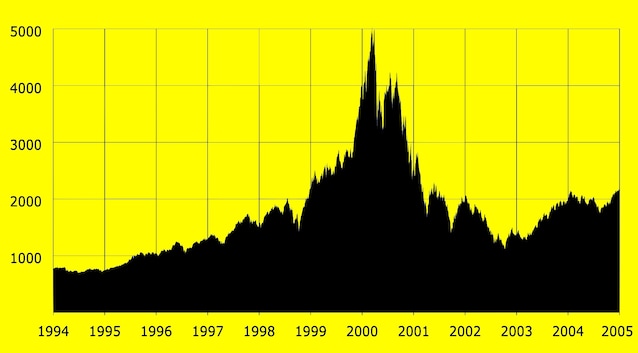
There dot-com bubblewhich occurred between 1995 and the 2000represents one of the most emblematic phenomena in the history of modern financial markets and the Internet revolution. Adding “.com” to a company’s name in those days could turn it into a rising stock market star, even if it didn’t have a solid business model or tangible profits. That’s how the Nasdaqtechnologically prevalent financial index, went from 743 points in 1995 to over 5,000 points in 2000reflecting investor enthusiasm for Internet startups, many of which they were backed by venture capitalist eager to participate in IPOs, the initial public offerings that allow a company to go public on the stock exchange. Companies like Priceline.com demonstrated that it was possible to turn real inefficiencies into online opportunities, creating “win-win” models for consumers and suppliers. Too bad that the apparent success hid enormous losses and unsustainable growth plans: the bubble was based more on investor euphoria than on concrete economic data, a phenomenon that the American economist Alan Greenspan defined «irrational exuberance».
When the Federal Reserve raised interest rates in 2000the market began to correct itself, leading the Nasdaq to lose nearly 80% of its value by 2002. Despite huge losses, dot-coms laid the foundation for modern digital infrastructure, from fiber optics to user familiarity with the Internet. In addition to this, the bursting of the dot-com bubble has left lasting lessons on the relationship between technological innovation and financial markets even if, according to some experts, what happened at the beginning of the millennium is happening again, and in greater proportions, with the AI bubble.
The causes that inflated the dot-com bubble
Between 1995 and 2000, the so-called “dot-com” companies shared some key characteristics: they promised to radically transform commerce, they aimed for maximum rapid growth (the so-called Get Big Fast) and often they were operating at a loss to acquire market shares. Priceline.com is the most illuminating example: founded by Jay Walker to sell unsold airline tickets via an online bidding system, managed to achieve over 100,000 sales in just a few monthsdespite every ticket being sold at a loss. Investors ignored the losses and expensive model, focusing only on the promise of changing the future of the business. Similarly, other iconic companies such as Pets.com, Kozmo.com or eToys followed the same pattern: aggressive advertising campaigns, large marketing spend and skyrocketing stock valuationsregardless of actual profitability. IPOs became the real point of arrival for venture capitalists and entrepreneurs: a public exit guaranteed immediate profits without the company necessarily having to be successful in the long term.
As the stock prices of Internet-related companies, both new and established, continued to rise, many investors began to believe that the U.S. economy was undergoing a profound transformation. Faced with such a perspective, elements that are usually fundamental for evaluating a company – financial situation, revenues, profits, market share, cash flow, etc. – were considered not very useful for predicting the future performance of companies in the sector, especially start-ups. Consequently, capital continued to flow even towards highly indebted companies with no real possibility of obtaining profits. This excessive investor confidence led the stocks of dot-com companies to reach enormously higher individual share price levels to those justifiable according to traditional evaluation criteria.
The burst of the first technology bubble in history
At some point the Nasdaq index peaked in March 2000 at 5,048 points. The “perfect storm” was practically ready and the bubble was now ready to explode. The “pin” that caused the bubble to burst was represented byincrease in interest rates on the part of Federal Reserve which, combined with the intrinsic weakness of many companies, triggered a massive sell-off in stocks. Within October 2002the index had fallen to 1,139 pointseffectively canceling almost all the gains accumulated up to that point. Hundreds of dot-coms failed. Individual investors who continued to pour money into stock funds lost trillions of dollars. Only in Silicon Valley are they respected 200,000 jobs lost between 2001 and 2004leaving generations of young entrepreneurs literally stranded.
