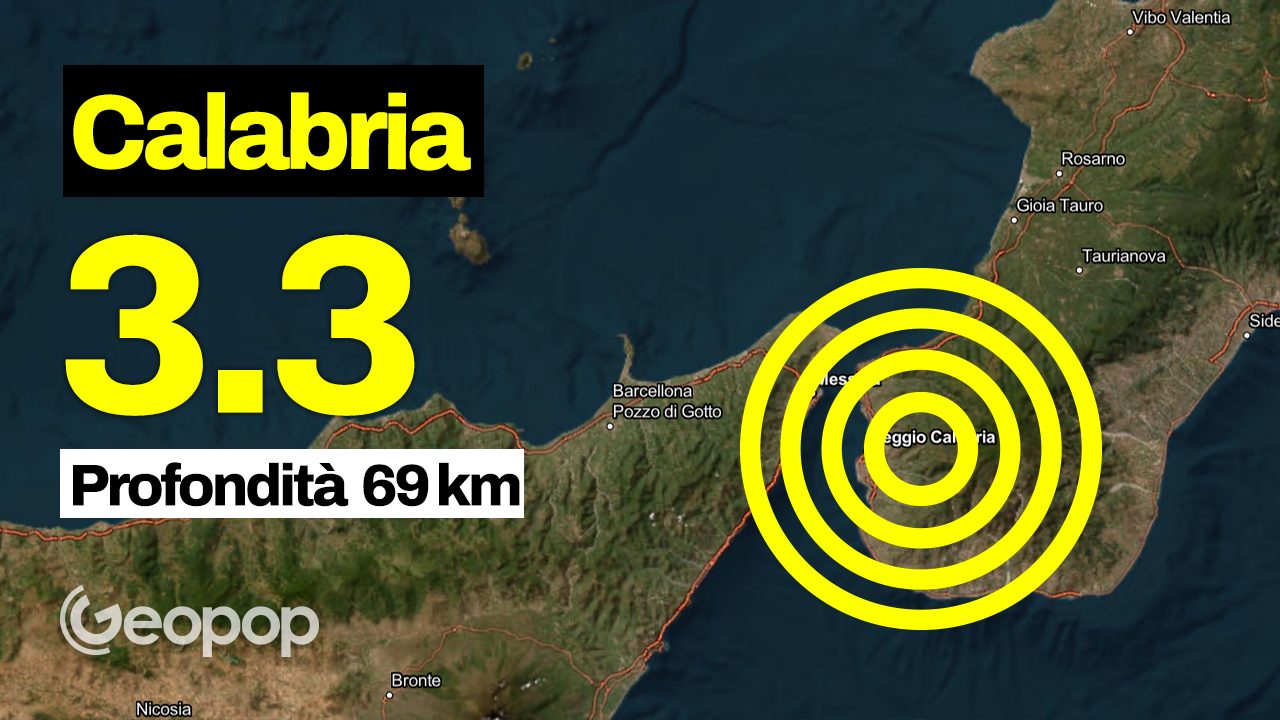
An earthquake of magnitude 3.3 was recorded at 13:34 today, Tuesday 12 August, in the area of Reggio Calabria: as reported by the Ingv, the epicenter was identified to 4 km to the east of Reggio Calabriato a depth of 69 km. The earthquake was warned throughout the province, even if for the moment no damage to buildings or people have been reported. Just yesterday, 11 August, a shock of magnitude 2.6 was located in the Strait of Messina11 km deep.
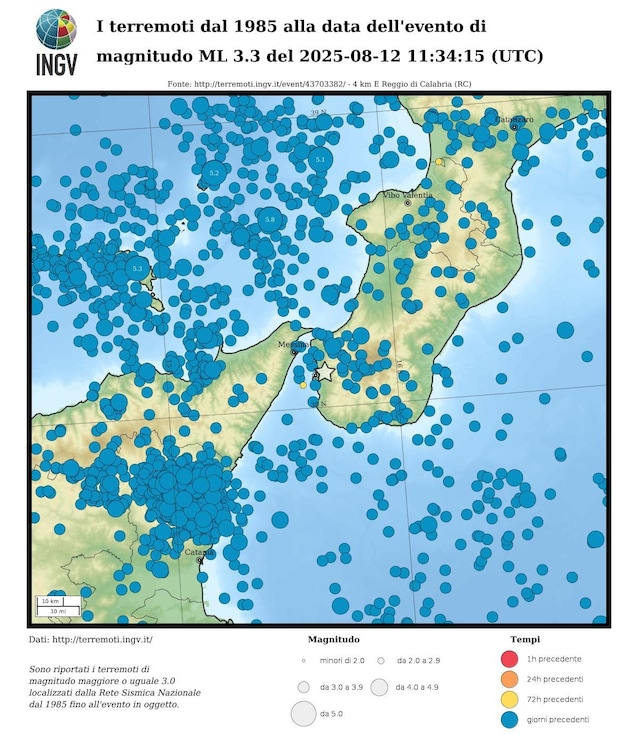
In general, however, in Calabria the earthquakes are not rare: the region, in fact, is one of the most seismic areas in Italy and is located along the convergence line between the African and the Euro -Asian plaque. Precisely in Calabria, among other things, it was hit by the most powerful earthquake ever recorded in Italy in the instrumental era, which took place on December 28, 1908 with a magnitude of 7.1. The National Institute of Geophysics and Volcanology has developed a map of all the earthquakes recorded in this area between the 1985 and the August 12th: The size of the blue dots depends on the magnitude of the shocks.
After the earthquake of this afternoon it is therefore spontaneous to ask what is the maximum magnitude that the Bridge on the Strait It would be able to bear, now that the project has received the approval of the Cipess (Interministerial Committee for economic programming and sustainable development) and, therefore, the start of the works is getting closer.
The same close company of Messina Spa confirmed that the bridge was designed to have satisfactory seismic performances up to one magnitude 7.1 of the Richter scale, underlining that the extension of the seismogenetic area (conventional seismic source) of greater interest for the strait is not able to produce higher magnitude earthquakes.
The bridge over the strait, therefore, will be made according to seismic design canons provided for all strategic works. Clearly, there are gods risks associated with a possible collapse, which are well known and which are the same risks accepted for any other construction, such as a building or a hospital: in the case of the bridge over the strait, however, these risks are partly mitigated by the structural conformation that distinguishes a very flexible structure such as that of the suspended bridge.
