
The main earthquakes that occur near the Caldera of the Campi Flegrei due to the volcanic phenomenon of bradyseism are anticipated by a preparatory phase made up of precursor signals significant. To document it, in a study in the magazine JGR Solid Earthare researchers from the University of Naples Federico II, from the Seismological Research Center of the National Institute of Oceanography and Experimental Geophysics (OGS) and from the University of Genoa. By integrating seismic and ground deformation data, they identified a increase in ground deformation and of theenergy released by small earthquakes before each major seismic event. Even if it is still early to talk about predictions, the study represents the first important step in this sense: in the future it could be possible, in this context, to estimate the potential magnitude of major earthquakes with a few days early.
The study on the precursor signals of strong earthquakes in the Campi Flegrei
In recent years at the Campi Flegrei there has been a progressive increase in seismic activity and ground uplift. At the origin of the phenomenon is theincrease in pressure of meteoric water accumulated underground: these fluids, heated by the gases released by the magma present deep inside, expand, exerting considerable pressure on the rocks and determining the deformation of the ground, accompanied by earthquakes. The link between deformation and seismicity at Campi Flegrei is therefore well known, but the new study is innovative because it demonstrates that integrating data relating to deformation and seismicity could potentially allow us to formulate short-term forecasts. The researchers took this into consideration 20 particularly strong earthquakes and the associated seismic sequences, which occurred in the caldera between 2015 and 2024. These events took place in nearby areas, in the Solfatara and Pisciarelli area, where the subsoil is very fractured and saturated with gases which are difficult to release due to the presence of poorly permeable covering rocks.
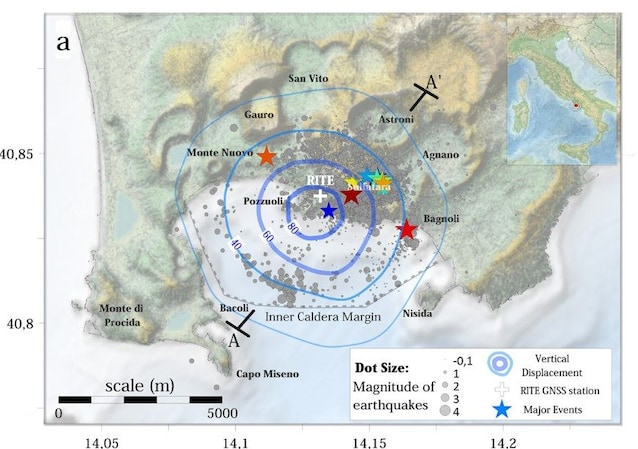
The analyzes focused on the changes that occurred during the 100 days previous to each major seismic event. The researchers thus verified that each major earthquake is preceded by an increase in both deformation both of theenergy released from microearthquakes. These variations are strongly evident correlated with the magnitude of the seismic event.
«This correlation – underlines one of the authors of the study – allowed us to identify a key parameter, lo strain residual, which describes the balance between deformation and seismicity.”

What is the purpose of analyzing deformation and seismicity that precede strong earthquakes
Starting from 2020 were recorded at the Campi Flegrei around 20,000 earthquakes with a hypocenter within 3 km of depth: even if most had a magnitude lower than 3, being superficial they caused strong ground shaking in a very densely populated area. It is therefore clear that improving the seismic risk mitigation it’s a priority. This study constitutes a first model for forecastinga few days in advance, of the potential magnitude of the strongest earthquakes. This does not mean that we can already predict them, since they are still there great uncertainties in the development of estimates and risks of false alerts. However, in the future further research relating to the preparatory phases that anticipate strong earthquakes could make this possible in volcanic contexts such as that of Campi Flegrei. This way they would improve there risk mitigation and emergency planning and management by the Civil Protection.
