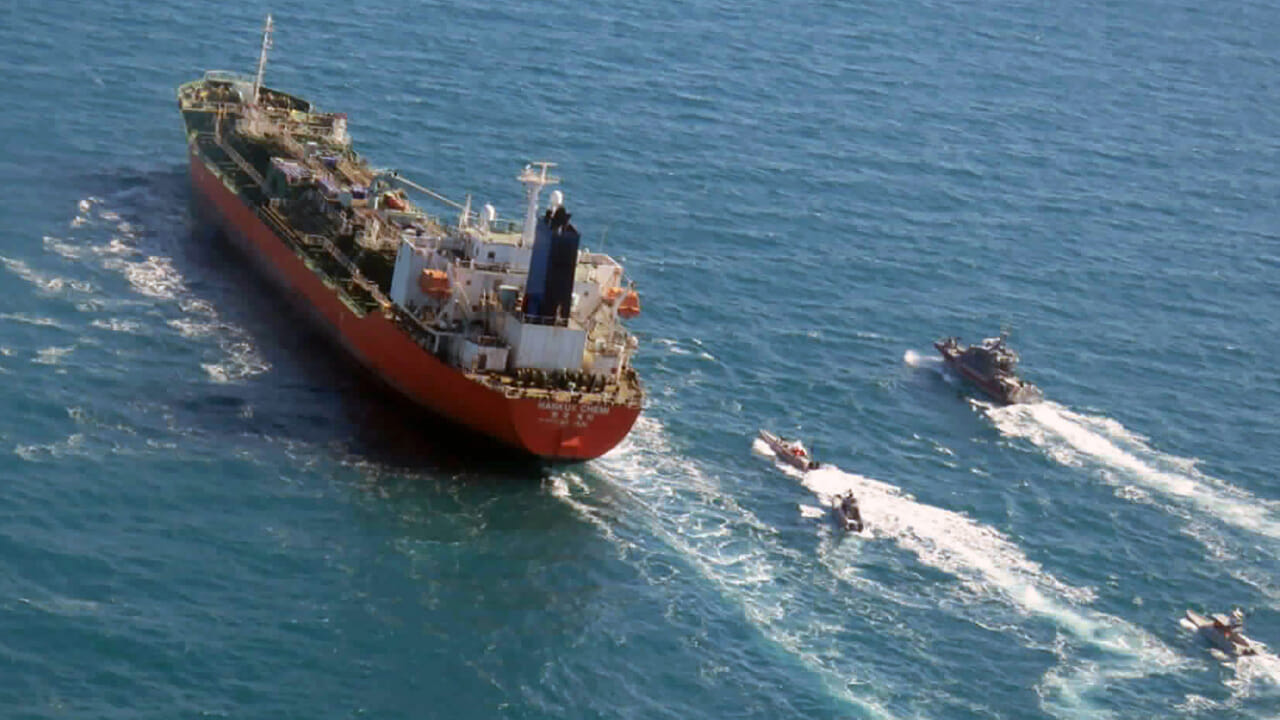
From 100 to 2 boats per day. In the Strait of Hormuz, that sea corridor where Oman and Iran are only 3.7 kilometers apart at their minimum point, the traffic of ships on which approximately 20% of the hydrocarbons consumed on the planet travels has almost disappeared. It is the effect of the new war in the Middle East, in which Iran plays the leading role in missile and drone attacks on the Gulf countries and in control of the strategic artery of the world economy.
Customers from the Gulf countries are agitated
As the escalation intensified, Tehran led to the paralysis of merchant traffic in the Strait of Hormuz. He did it with now well-known methods: targeted raids on boats navigating that narrow waterway now declared a “war area”. The effect was immediate. Over a thousand ships are stopped on both sides of the Strait, waiting for the situation to return to normal. Total value of goods transported: approximately 25 billion dollars floating at sea, according to March 5 estimates by the Lloyd’s Market Association, the body representing insurers within the Lloyd’s of London market. As a result, some manufacturers have begun to reduce production, further shrinking markets. Customers in the Gulf countries are understandably nervous. 80% of the hydrocarbons that pass through the Strait of Hormuz are destined for the main Asian economies: India, China, South Korea and Japan.
The remaining part reaches Europe. And here the paradox of the Old Continent emerges. To free itself from gas in the aftermath of the war in Ukraine, Brussels has focused heavily on LNG (Liquefied Natural Gas) transported by ship from the Middle East. Qatar, in fact, has become the pillar of European energy security, especially for Italy and Germany. The effect of so much supply suddenly removed from the markets can be seen on prices, with oil above 80 dollars a barrel, and methane doubled to 50 euros on the European Stock Exchange in Amsterdam.
What are the solutions Brussels is thinking of?
In Europe, the sharp increase in oil and gas prices is on the agenda of the next European Council on 18-19 March. The Twenty-Seven will discuss the diversification of supply sources with the aim of containing the cost of energy and strengthening the competitiveness of the European economy. In view of the appointment, the European Commission has called an extraordinary meeting of the college of commissioners entirely dedicated to the energy dossier for Friday 6 March.
Petrol and diesel, red alert after the attack on Iran: how much the Strait of Hormuz crisis can cost us
At the heart of the energy pricing debate is the controversial mechanism by which the price of electricity is determined. The system in force today, known as the “order of merit”, provides that energy producers are called upon to feed electricity into the grid based on the cost of production, from lowest to highest. It is the last plant needed to meet demand – often a gas plant – that sets the final price for everyone. The result is that even electricity produced from renewable sources, which is very cheap to generate because it uses wind and sun, ends up being paid at higher prices, linked to the costs of fossil fuels. The call to reform this system is not new. The topic had already exploded during the 2022 energy crisis in the aftermath of the large-scale invasion of Ukraine, without however leading to concrete changes.
The new war scenario in the Middle East was enough to reignite the confrontation between the different economic interests in Brussels. Energy industry groups argue that the current system is no longer suited to a crisis triggered by fossil fuels. Energy producers have a completely different opinion. In a letter sent to the Commission and EU governments, the trade association Eurelectric called on Brussels not to reopen the electricity market reform, defining the price system based on the order of merit “the most efficient and robust mechanism to guarantee economically efficient dispatching, transparent price signals and adequate investment incentives”.
Italy’s push: abandon the ETS
Another option circulating is to abandon or weaken the EU’s emissions trading system (ETS), making it cheaper for power companies and industry to emit planet-warming gases. Some member countries, in particular Italy and Germany, are pushing for the revision of the European system, driven by the interest of seeking simple solutions to contain increases in energy bills. The Italian government has explicitly asked that the ETS mechanism be frozen until the reforms are implemented and in the meantime has launched a measure that aims to eliminate carbon costs from bills.
What is the ETS (which the Meloni government doesn’t like) and what does our bills have to do with it?
There are those in Brussels who already have the solution in their pocket: producing more clean energy. Today, almost 50% of the electricity that turns on European light bulbs now comes from wind, sun and water. But if you look at overall energy – transport, heating, steelworks – renewables slip to a modest 20%. For some, therefore, the solution is not to look for new sources of hydrocarbons, but to accelerate the path towards total electrification. The lesson of the war in Ukraine first and of the crisis in the Middle East now crystallizes a thought: speeding up the electrification of industry and transport allows us to “armour ourselves” from global geostrategic events.
The China factor and its concrete solution
In this context, the China factor weighs heavily. Beijing, despite having diversified with Russia and Central Asia, still depends heavily on merchant ships sailing off Muscate. And for this reason, according to sources ReutersChina is in talks with Iran to allow ships carrying Qatari crude oil and liquefied natural gas to safely pass through the Strait of Hormuz.
Oil, digital surveillance and investments: China’s dilemma on aiding Iran
Discontent is palpable in the corridors of Zhongnanhai due to Tehran’s decision to paralyze shipments across the Strait. And he suggested a concrete solution: a ship called Iron Maiden passed through the Strait overnight after changing its reporting to “China-owner.” China-owned ship.
