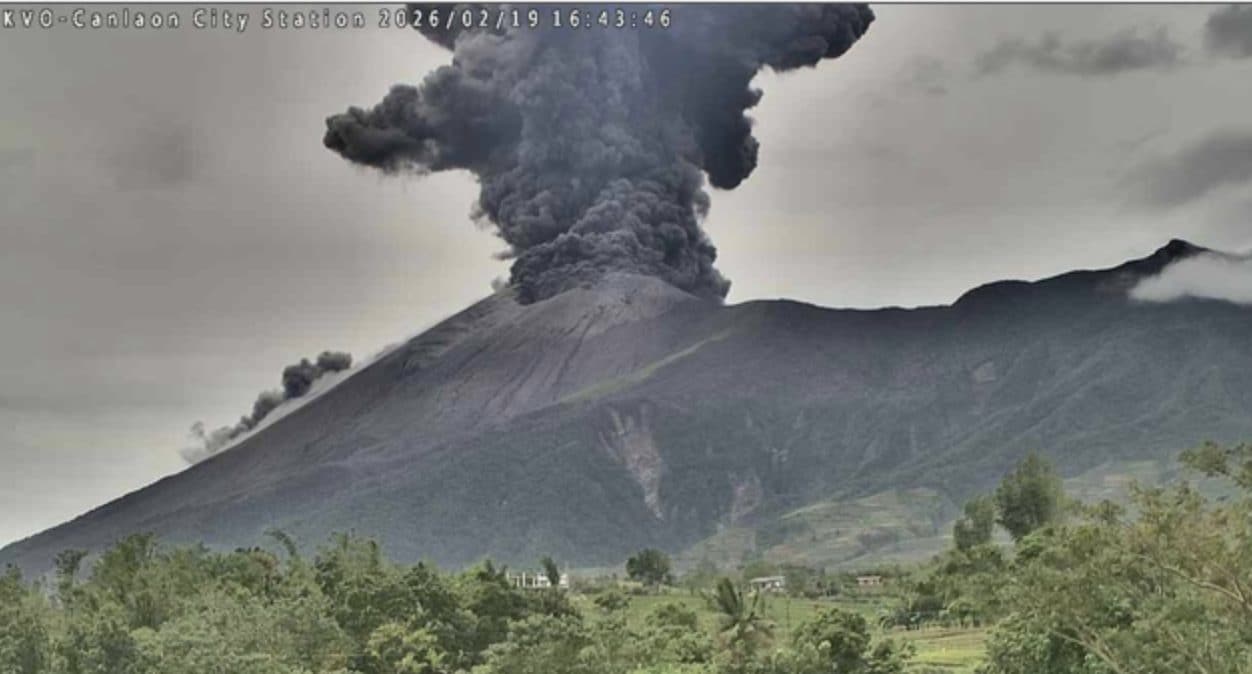
There was a new one eruption of Kanlaon volcano, located in the Visayas archipelago, in the Philippines: the episode occurred at 16:39 local time (09:39 in Italy) on Thursday 19 February, generating a column of ash beyond 2,000 meters above the crater.
The Philippine Institute of Volcanology and Seismology (PHIVOLCS) – the Philippine Institute of Volcanology – published a timelapse of the eruption (visible in the video above), specifying that the event lasted approximately two minutes. At the moment, the authorities have maintained the level of alert to 2 which indicates moderate instability (on a scale ranging from 0 to 5), recommending residents not to enter the permanent danger zone – extending for 4 km around the volcano – while air traffic near the summit has been closed. Kanlaon is one of the most active volcanoes in the Philippines and is characterized by periodic eruptions, mainly of the explosive type.
The current state of the volcano and the pyroclastic flow
Second the data emerging from the PHIVOLCS bulletin, before the eruption of the Kanlaon volcano the monitoring instruments had recorded another 10 volcanic earthquakesincluding 7 low-frequency seismic events associated with volcanic gas activity.
As anticipated, the eruptive episode produced a dark gray ash plumewhich rose 2 km above the crater, before being carried southwestwards by strong winds. At the same time, the pyroclastic density currents (i.e. mixtures of hot volcanic gas, ash and rock fragments) produced by the eruption descended from the upper slopes up to about 1 km from the summit crater. The explosive event was immediately followed by approximately 40 minutes of continuous ash emission.
Alert level 2, which indicates a period of increased volcanic activity and instability but not yet an escalation to a catastrophic eruption, reflects the state increased instability of the volcanowith potential for further ash emissions or brief explosive eruptions. For this reason it is forbidden to fly near the volcano, and entry into the so-called is not permitted PDZthe “Permanent Danger Zone”, which has a radius of 4 km from Kanlaon.
Kanlaon Volcano is located in the Pacific Ring of Fire
The Kanlaon is among the most active volcanoes in the Philippines and represents the highest peak on the island of Negros, in the Visayas archipelago. With its approximately 2,435 meters above sea level and a large still active crater, Kanlaon is classified as stratovolcano: to be clear, it is the classic cone-shaped volcano, originating from the superposition of numerous levels of debris and solidified lava. Its eruptions are predominantly explosivealthough effusive episodes have also occurred in history.
The volcano, among other things, is part of the Pacific Ring of Firethe belt with the most volcanoes and earthquakes in the world, which extends from western America (including Chile and Alaska) and runs along eastern Asia, Southeast Asia and Oceania.
