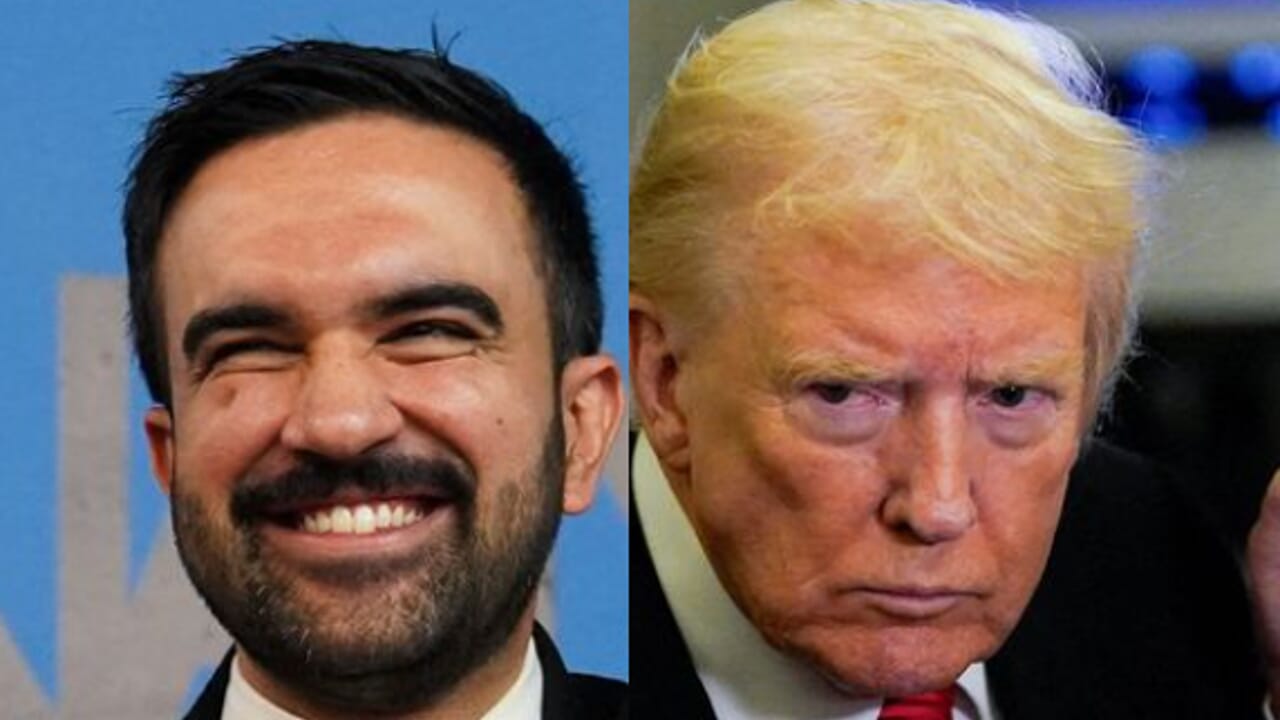
First creaks for Trump: the signs that count (beyond Mamdani)
Twelve months after Donald Trump’s victory, the first answer arrives from the United States to the question that has been hovering since November 2024: where have the Democrats gone? On the night of November 4, 2025, three signals arrived: Zohran Mamdani won in New York, becoming the city’s first Muslim mayor; in Virginia Abigail Spanberger prevailed; in New Jersey Mikie Sherrill won the governorship; in California voters approved Proposition 50 on the redrawing of the constituencies, potentially favorable to the Dems towards the 2026 midterms.
Zohran Mamdani is the first Muslim mayor of New York: “Let’s show how Trump can be defeated”
In New York the rise of Zohran Mamdani (34 years old, democratic socialist, born in Kampala and raised in Queens) has been very rapid and covered by the media. His platform – frozen rents, free buses, universal kindergartens, public supermarkets, higher taxes for the rich – has sparked enthusiasm on the left and fears in the centre. Trump labeled him a “communist”, a label that still carries weight in the USA; Mamdani still won, defeating Andrew Cuomo, who returned to the field as an independent.
The New York case, beyond the “phenomenon”
But pay attention to the proportions. New York is only one part of America, the one closest also culturally to distant Europe and as such light years away from the Ohio of Vance’s American Elegy, from the anti-immigrant walls of Texas and from the thousand other facets of the over fifty US states. Furthermore, many of Mamdani’s promises are considered unrealizable even in New York by the Dem leaders themselves. First of all because they depend on Albany (the State of New York) more than on City Hall, the New York City Hall: state approval is needed on taxes and large transfers, and governor Kathy Hochul has already signaled coldness towards tax increases “only on the rich”. In other words, even for a strong mayor the institutional constraints remain very tough. Not to mention Mamdani’s claims to arrest Netanyahu or adopt his own immigration policy, all topics that clearly fall outside his mandate.
Then there is a point of substance: the idea of free public transport is not “non-existent in the world” – there are real cases (Luxembourg free from 2020; Tallinn free for residents; Dunkirk on bus lines) – but scaling it up in a megacity like New York implies very different costs and governance compared to those experiences. Feasibility, rather than principle, is the real front line.
Mamdani, Trump’s false problem
If the “anti-Trump redemption” does not come from a single leader of the left (yesterday Sanders, today Ocasio-Cortez, tomorrow Mamdani), the most corrosive political signals for the White House are probably three others.
Virginia, a swing state that went to Trump in 2024, today elects Democratic governor Abigail Spanberger and sends a message to the moderate suburbs.
In New Jersey Mikie Sherrill takes the governorship: another confirmation that the dem wave is not confined to New York City.
In California, voters approve the district reform (Prop 50) which could be worth up to 5 seats in the House in 2026. A technical but heavy impact: with more favorable constituencies, for the Dems it is the classic “structural” victory that is valid beyond the news cycle.
If the Dems put together urban “symbols” (NYC) and structural victories (Virginia and California maps), 2026 can become a referendum on Trump’s power in Congress. For the president, who today governs with a republican-led parliament, losing that barrier would mean facing two much less easy final years. Mamdani makes headlines; Spanberger, Sherrill and Prop 50 make numbers. And, in the midterms, numbers count above all.
