The floods occurred in Emilia-Romagna in 2023 and 2024 they are the result of the combination between the particular conformation of the territory And extreme weather conditions increasingly widespread due to climate change. The phenomenon, called “cul-de-sac effect”, was analyzed by the Euro-Mediterranean Center on Climate Change (CMCC) in a new study published in the journal Scientific Reports. It consists ofentrapment by the Alps and Apenninesfor a few consecutive days, of humid air coming from the Adriatic: the result is that on the affected area they occur intense and very prolonged rainfall. At the basis of the phenomenon there is also the fact that the Mediterranean is warming much more of other areas of the planet, therefore other coastal areas overlooking this sea are also at risk of serious floods. The objective of these studies is to be able to contribute to the development of more effective warning systems towards events of this magnitude, which are destined to become increasingly frequent.
The cul-de-sac effect underlying the Emilia-Romagna floods in 2023 and 2024
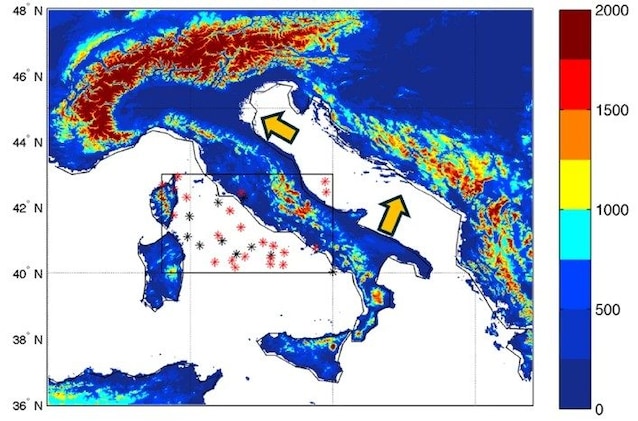
THE’flood of 2023 in Emilia-Romagna was caused by persistent rainfalllong-lasting, which caused severe flooding. These are events that were repeated in the past every 500 years approximately, while today they are increasingly frequent (a similar event hit the same area in 2024). This rainfall was fueled by a stationary cyclonic disturbance which persisted over Italy for several days. The Mediterranean Sea it is one of the seas on the planet that are most affected by global warming, with an increase in water temperature above average. This leads to increased evaporation and a greater quantity of water vapor in the air above, which being warmer can contain more. This humid air feeds the cyclonesassociated with intense precipitation. In the case of Emilia-Romagna, the flood cannot be attributed only to the greater quantity of water vapor in the air because it was not caused by heavy rains of short duration, but very prolonged. A fundamental role was that of geographical conformation of the territorybordered by mountain chains that retained the humid air coming from the Adriatic, amplifying and prolonging rainfall. Similar conditions occurred in Emilia-Romagna also in 2024. The phenomenon has been defined as “cul-de-sac effect”, an expression that well describes the “dead end” into which the humid air was conveyed.
The usefulness of the study in future predictions
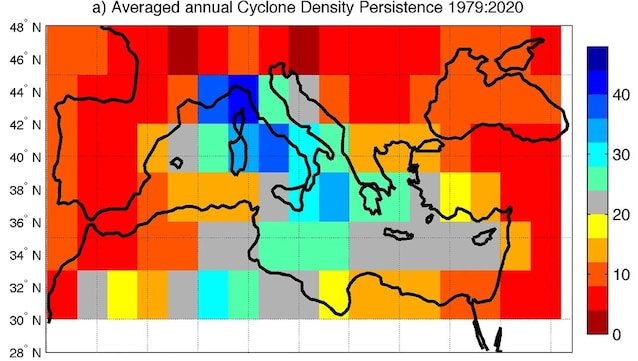
As part of the study, the researchers developed an indicator, the Cyclone Density Persistence (Cdp), which takes into account the number of cyclones that occur in a given area in a year and how long they stay in it. If the indicator value is high it means that the probability of a flood of a certain severity occurring is also high. Thanks to the CDP, they could be developed more effective warning systems. Closer monitoring of cyclones stationed over a given area could allow for elaboration more accurate predictions of extreme events. In this way, the consequences of a flood like the one in 2023 could be stemmed, which displaced thousands of people and caused enormous damage to the economy and infrastructure. Cyclone monitoring is essential not only for Italy, but also for other coastal areas overlooking the Mediterranean and which have a similar geographical conformation. The study also highlights the need for further research to identify other critical conditions which can influence flood risk, including soil moisture, land use and the state of hydraulic infrastructure.