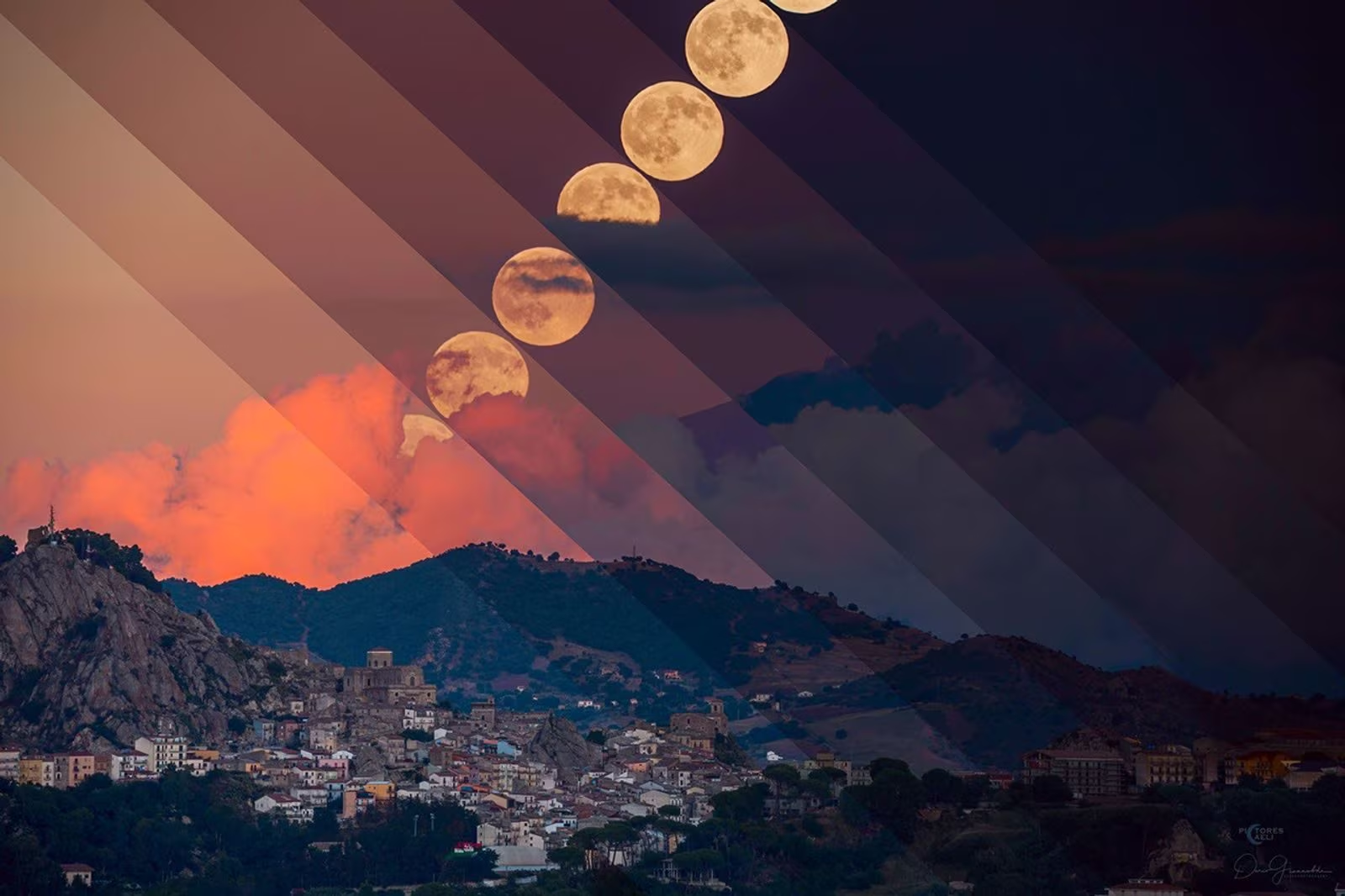
Not everyone knows it but every day, for more than thirty-one years, on the “Astronomy Picture of the Day” (APOD) page, NASA publishes a selected image or photograph depicting “our fascinating universe”, together with a short explanation written by a professional astronomer or astrophysicist. Doing the math, that’s over 11 thousand days.
The idea was born in 1995, when the Internet was still very young, from the mind of two astronomers from the Goddard Space Flight Center in GreenbeltMaryland, Robert Nemiroff And Jerry Bonnell: the two launched the site on 16 June of that year with the aim of posting an image a day, accompanied by a short and clear specialist text that explains it. The project was born to enhance the endless archive of NASA images collected through expeditions, probes and telescopes, and then opened the invitation to anyone to participate by sending their own submissions. Today Nemiroff (Professor at Michigan Technological University since 1996) and Bonnell receive at least thirty a day.
Not all images are photographs: they can also be videos, simulations, artistic representations or visualizations of astronomical data, atmospheric phenomena, space explorations and so on. Most of the contributions come from amateurs, who thanks to their passion can contribute to scientific research, providing points of view on the sky that official telescopes, for example, would not provide.
Today APOD, still coordinated and edited by Nemiroff and Bonnell, with two new editors on board ready to carry the project forward, Cecilia Chirenti and Keighley Rockcliffe, is available in over 20 languages and received recognition in the International Astronomical Union (IAU) dissemination awards. A few days ago the page became an official section of the main NASA website; However, it is still possible to search for the images published from the launch of 16 June 1995 to 31 January 1996 on the page that preserves the archive and all subsequent ones in this calendar. At the end of the main page, which is updated daily, you will also find a “Random APOD Generator”, which offers a random image from the archive.
We interviewed Nemiroff to tell us the behind-the-scenes story of this incredibly long-running project.
How did the project come about?
My colleague Jerry Bunnell and I started discussing Mosaic, the internet and gods one summer so-called “web browsers”trying to understand what kind of project we could do and, since we both specialized in this, we wondered if we could somehow answer astronomy questions. At the time we received a lot of images via emailand often those who had attached them had not filled in a correct caption. NASA itself sent out many press releases, but they were very long and not very usable texts. So we thought about it choose one image a day and explain it in a few wordsthen making it accessible on the web. The first day of Astronomy Picture of the Day we had something like 14 page views, we don’t know how they found us… We realized it was a good idea, so we started doing it every day and, as I like to tell it, “we forgot to stop”.
Have you ever missed a publication?
It happened: NASA is a US government agency, and sometimes the US government and related websites go into shutdown, blocking content from being published online. At first we thought about ignoring it, but then it became clear that we weren’t allowed to ignore it. There was also a perception problem: even if we had wanted to work voluntarily in our free time it would not have been considered acceptable. So, we found some mirror sites and when the US government went into shutdown we then chose one of these as the main unofficial APOD site: many times it was the University College of London site, until the US government resumed activities. It happened a few times, but never for more than a week or two.
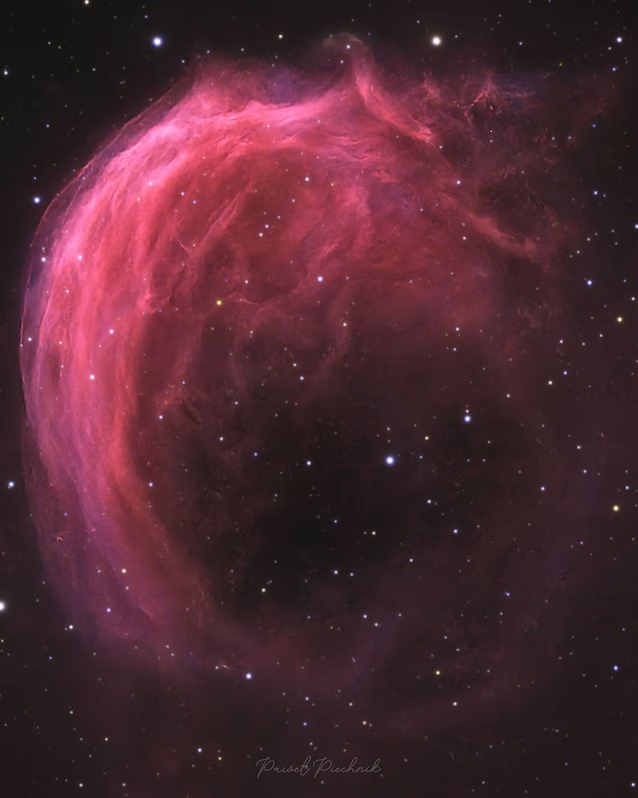
How many applications do you receive every day, and how many were there at the beginning?
At the beginning, when we were discussing it and trying to understand if it was really possible to carry on with the project, we even feared running out of images, but in reality that wasn’t the case at all. For example, the NASA Ranger program he took hundreds of thousands of photographs of the Moon, which are available online. The real risk, if anything, was to become boring or repetitive: “Here’s crater number 684, we haven’t published this one yet!”, do you understand?
In the early days we drew from images that came to us via email and from websites main astronomical observatories around the world: If we found something interesting and the image was protected by copyright, we asked permission to use it. Then we started receiving images directly from users. If ten years ago there were about ten, then we reached 20 and now we will be at I think 30 images a day. But we can only publish one, and therefore, when we receive phenomenal applications we post them on the Sky Facebook profile or on Instagram, on the Universe View screen, without a detailed explanation. One of the countries that sends us the most images, however, is Italy!
It’s a shame not to be able to share more, astrophotography is growing a lot and over time the images of the universe have become more and more beautiful and spectacular… Indeed, today the problem is that they are almost too spectacular, so much so that they are not true, and here we are at generative AI problem. Today just ask her: “Give me a picture where I am on the surface of a moon of Saturn and there is an aurora in the sky.” But if you were actually on a moon of Saturn, you probably wouldn’t see such an aurora: maybe in some cases there might be, but on most moons it wouldn’t be like that. For this we had to become very good at identify the most obvious fake images. The line is quite blurry, because cleaning up most astronomical images requires some kind of image processing, and today some software uses AI, so we have to establish rules to decide what we consider legitimate and what is not.
Do you use specific software to recognize AI content?
We are the AI detectors! And there are several astrophotographers we ask for advice, including one of my students. When we are not sure, we submit them to him.
How do you choose the image in the end?and of the day, among all those applications? Is there an editorial plan and how far in advance?
Sometimes we decide a few days in advance, sometimes a few weeks, so even from prepare the captions with the necessary timeand to give our mirror operators time to do the translations. Many times we wait because we know that something good will come, as in the case of the total solar eclipse in Spain, or the so-called Harvest Moon. In those cases we wait to see what comes. In short, there is a slower and a fast mode.
How is the project changing today?
Jerry and I started when we were in our thirties and now we are over sixty, the page is very popular, so many at NASA ask us what our succession plan is. Jerry will retire next year, I haven’t yet, but we’ve brought on board two new editors to help us carry on the work. It’s both PhD in Astrophysics and are therefore able to understand why an image is important and explain it: Cecilia Chirenti and Keighley Rockcliffe have been helping us since the beginning of 2026 and are bringing new energy and points of view. We have never all been together in the same room at the same time: we have our meetings every Monday afternoon via Zoom!
What direction is astrophotography going today?
The amateur one is continuing to improve, thanks also to quality of telescopesto increasingly accessible prices and to their diffusion compared to the past – even in those areas, for example, of Africa or the United States, where there is less light pollution. The professional telescopes of NASA or ESA monitor only some parts of the sky and, even if thanks to Rubin and Euclid we are broadening our gaze, amateurs allow us to cover portions where we would not reach, offering us images and details that otherwise wouldn’t exist. Some images are real works of art, yet it’s science! So it’s a fantastic time for astrophotography.
Can these images therefore contribute to official studies and research?
Yes, and one of my students is creating programs that process amateur images on which there are no studies yet to analyze them. Perhaps photographers don’t realize that they are revealing information that is not yet known to the scientific world. One of the things I love about astronomy and astrophotography is that we all see the same skyis something that unites all of humanity and is one of the main themes of the International Astronomical Union. APOD tries to give space to images that come from all over the world, because the sky belongs to everyone, no matter politics or any other type of division.
