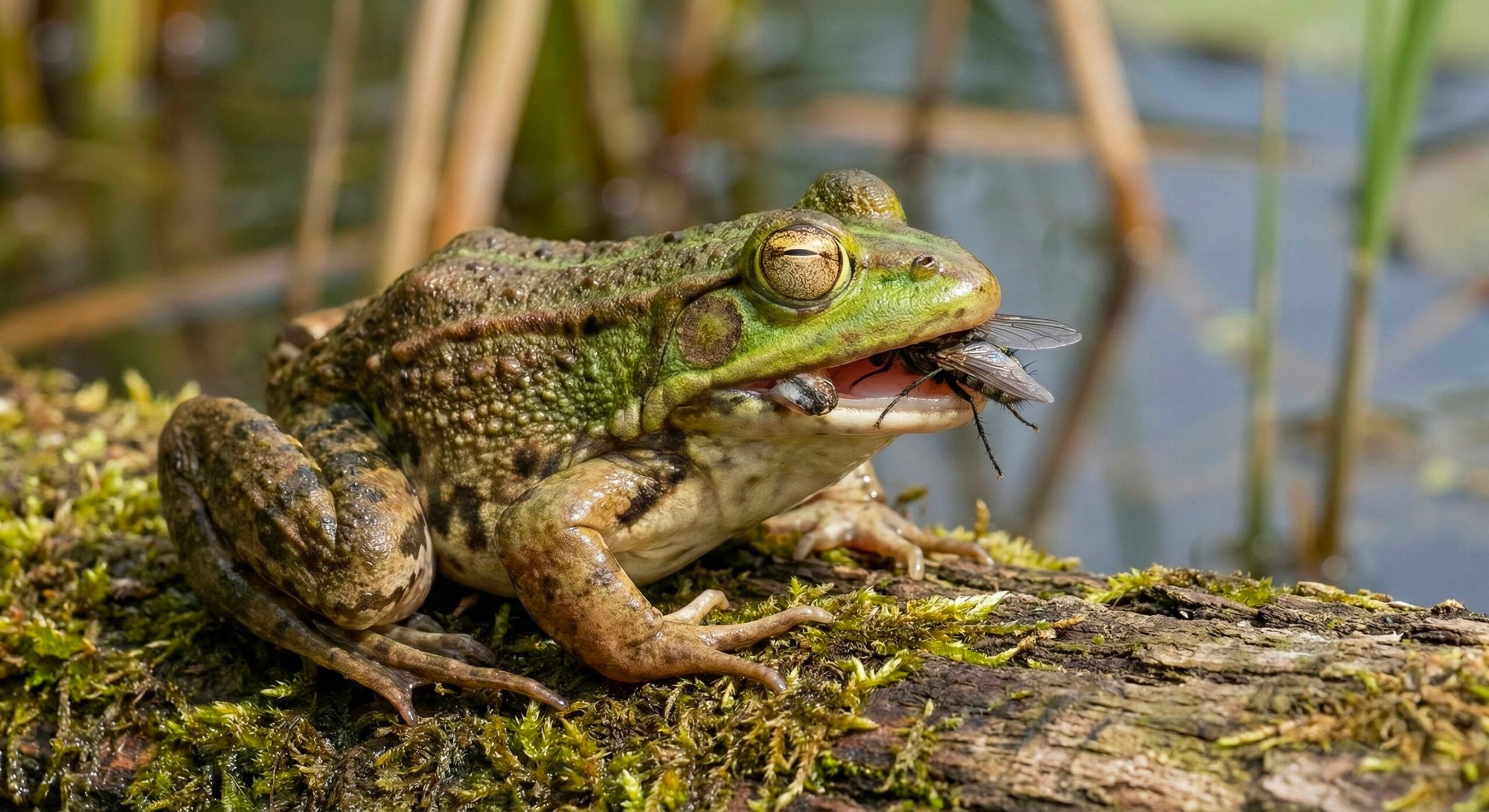
Whoever observes one frog while he eats he often notices a curious detail: while he swallows his prey, he eyes seem to disappear inside the head. It’s a curious impression, at times even unsettling, but apparently, frogs’ eyes play a role in swallowing. Experiments show that, while food is ingested, the eyes can re-enter the oral cavity and touch the prey. In this way they contribute to hold it still and push it towards the esophagusworking together with the tongue and mouth movements. It is not an indispensable mechanism, but it makes swallowing easier faster and more efficient. However, quantitative measurements and X-ray imaging indicate that the eye movements observed during breathing are minimal and passive, making it clear that the eyes do not actively participate in pumping air into the lungs.
The movable eyes of frogs are used for swallowing
In frogs (and many other amphibians) the eyes are not rigidly fixed to the skull as in mammals. They can instead move downwards and backwardspartially entering the oral cavity. This movement is possible thanks to a specific muscle, called retractor muscle of the eyeball (retractor bulbs), which draws the eye inwards. Below the eye there is also a relatively “open” area of the palate, which allows the eyeball to descend unhindered.
For a long time it was discussed whether this “eye retraction” movement was just a side effect of head movements, or whether it had precise function when feeding.
The answer comes from an experimental study conducted on the leopard frog (Rana pipiens), in which the researchers used the cineradiographyMeaning what X-ray videoto observe what happens inside the head while the frog eats.
To make the movements visible, small ones were inserted markers that block x-rays in the muscles that move the eye; then the prey (crickets approximately long 1.5cm) were marked with bariumso as to follow the path. The videos clearly show that during swallowing the eyes descend into the oral cavity and come into direct contact with prey. The eye physically presses the food from above.
What is this mechanism for eating food for
Once it has been demonstrated that the eye actually enters the mouth, the crucial question remains: is it of any use? The researchers themselves tested this hypothesis with a very direct experiment. In a group of frogs they have the nerve is interrupted which controls the retractor muscle of the eye, thus preventing ocular retractionwithout interfering with other mouth movements.
The result was clear, that is, frogs they can still swallow, but to ingest a single cricket they pass on average from 2.3 swallows to 4.0 swallows: that is, an increase in 74% in the number of necessary acts. In other words: eyes are not essentialbut they make swallowing more efficient. They function as a mechanical aid that pushes the prey towards the esophagus and stabilizes it while the tongue carries it backwards, a supportespecially with medium-large sized prey. This is an elegant example of cooperation between different structures, each with a specific role.
The data also shows that in 42% of cases frogs swallow without retracting your eyes and that in any case the language remains the main mechanism of food transport.
During breathing, the eyes do not move (or almost)
A second study addressed another historical hypothesis: that eye movements also help breathingpushing air into the lungs during the so-called “buccal pumping”.
Using an advanced technique of three-dimensional reconstruction from X-raysthe researchers analyzed 22 breathing sequences in bullfrogs and axolotls, measuring the movements of the eyes and floor of the mouth with millimeter precision. The numbers speak clearly: during breathing, the eyes they move very littleon average 0.06mm. These movements are passivei.e. caused by the displacement of surrounding tissues e they do not actively contribute to the flow of air to the lungs.
However, when the frog moves or carries prey, the eyes can also retract over 3 mmbut this happens only in the context of nutrition or body movementnot breathing.
