In recent years the alarms of the scientific community and United Nations they became more and more pressing. The climatological reports and the evidence in the field, from the dramatic melting of the Alpine glaciers to the serious suffering of the waterways, confirm one fact: the global warming is running at a faster rate than past estimates. The threshold of 1.5°C above pre-industrial levels, set by Paris Agreements as a safety limit to avoid i points of no return of the climate, risks being permanently exceeded in the coming years, also thanks to the consequences of the intense El Niño developed in the Pacific Ocean.
But what is the cause of this acceleration? And above all, what are the concrete consequences on our territory, starting from the rivers that feed agriculture and our cities?
What does it mean to exceed the 1.5°C limit established in Paris
The 1.5°C threshold it is not an arbitrary number. It represents the limit value beyond which the Earth’s ecological and climatic systems risk exceeding the so-called tipping points (points of no return), triggering irreversible changes.
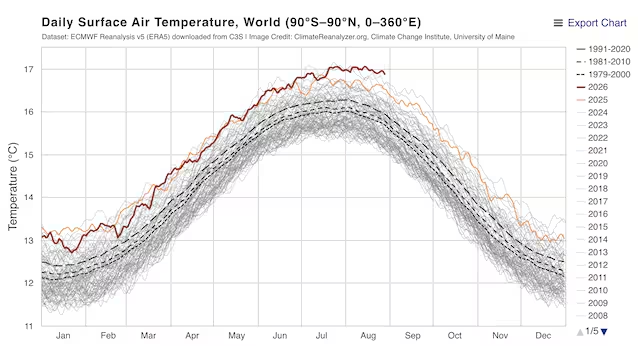
The World Meteorological Organization (WMO) and the UN highlight that the global average temperature continues to set record after record. The temporary or definitive exceeding of this target in the coming years means that the extreme weather eventslike the prolonged heat wavesthe drought hey storms, will become the norm, with direct impacts on the water resources of entire nations.
Why is the climate changing faster than expected?
To understand the speed of the phenomenon it is necessary to analyze the fundamental difference between the climate changes that have occurred in the history of the Earth and the current one:
- Natural cycles (Milanković cycles): during the geological erasthe climate has varied due to the eccentricity of the Earth’s orbit and the inclination of the axis. However, these variations occurred in time scale of tens or hundreds of thousands of yearsallowing ecosystems to adapt.
- The anthropic effect: since the beginning of the Industrial Revolution, the combustion of fossil fuels (oil, coal and gas) has released billions of tons of into the atmosphere carbon dioxide (CO2) and methane at a rate never seen before. The current temperature increase occurred in less than two centuriesa blink of an eye from a geological point of view.
What is “positive feedback” and why does it accelerate warming?
The anthropic origin makes warming an extremely rapid process that escapes the linearity of traditional mathematical models. This happens due to the mechanisms of positive feedback (feedback loop):
- Albedo effect and glacier melting: ice and snow reflect up to 80% of solar radiation back into space. When glaciers melt, they expose dark rocks or sea water, which absorb heat instead of reflecting it. The more the planet warms, the less ice remains, and the more the process accelerates.
- Suffering of rivers and water availability: the disappearance of glacial reservoirs in the mountains reduces the supply of fresh water into the rivers during the summer season. This not only causes water crises for agriculture and drinking purposes, but alters the ability of waterways to thermoregulate the surrounding territories.
- Gas release from permafrost: The thawing of perpetually frozen land releases enormous quantities of trapped methane, a greenhouse gas with a climate-altering power tens of times greater than CO2.
The “Mediterraneanization” of Alpine rivers: a twenty-year trend
The impact of anthropogenic warming is particularly visible on Alps. An emblematic example comes from the recent stage of Legambiente’s Glacier Caravan 2026 on the slopes of Monvisonear the Coolidge glacier, now reduced to a residual accumulation of snow and ice.
As explained by prof. Stefano Fenoglioprofessor of Zoology at the University of Turin and among the founders of the AlpStream research centre, we find ourselves faced with a process of real “Mediterraneanization” of Alpine rivers.
Why does this happen? In the past, the deposits of snow and ice accumulated in the winter functioned as a static water reserve. Even during dry summers, the gradual melting at altitude ensured a constant flow of water in the streams. What happens Today? Even when it snows a lot in winter, the high average temperatures cause the snow it melts too quickly.
Without the “supply” of the glaciers, the rivers only have water when it rains, and then remain dry or almost dry during dry periods. This is not an isolated event: already in 2017 the sources of the Po had dried up. We are not faced with a single unlucky year, but with a structural trend which has been going on for at least twenty years.
A scientific certainty: it is not a natural cycle
Attributing current warming to a natural oscillation of the Earth is scientifically incorrect. No natural factors (solar activity, volcanic eruptions or orbital cycles) is able to explain the surge in temperatures recorded over the last 150 years.
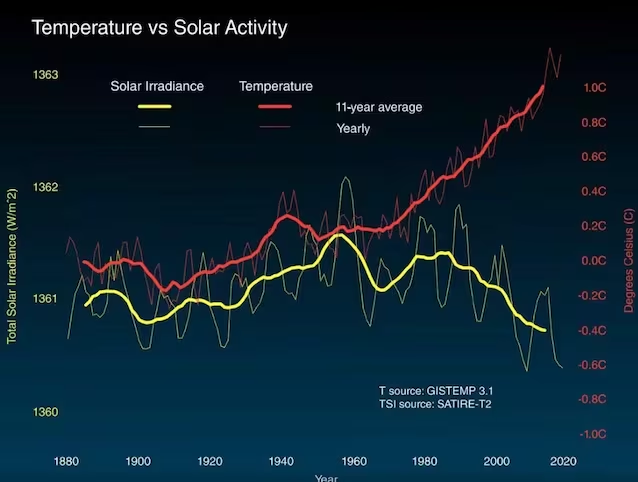
All the data agrees: the primary cause is the accumulation of anthropogenic greenhouse gases. Understanding the human matrix of the phenomenon is the first step in intervening on the energy transition before the points of no return are definitively crossed.
