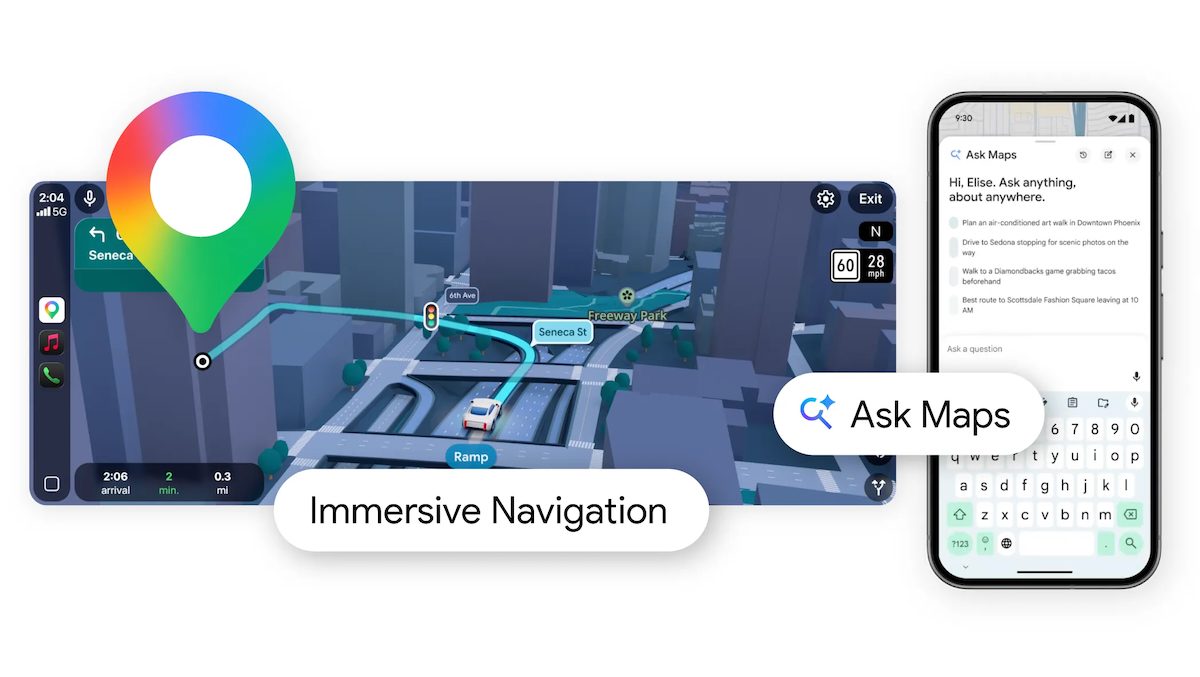
Google Maps is about to undergo one of the biggest updates of the last ten years. In the past few hours, the development team of the famous navigation app has announced the arrival of important innovations. Among the most relevant is the integration of artificial intelligence and a new mode of three-dimensional navigation. This shows how the application is evolving towards a system capable of understanding complex questions, suggesting activities and guiding us in space with an increasingly realistic representation of the world. Let’s delve deeper into these new features “Ask Maps”the conversational feature based on Gemini’s AI models and “Immersive Navigation”a profound update to the driving experience, making it immersive by introducing a dynamic 3D visualization of the urban and road environment.
How Ask Maps by Google Maps works: what’s new
Let’s start from Ask Maps. With this innovation, interaction with Google maps changes paradigm. Instead of typing a series of keywords (such as “vegan restaurant near” or “tennis court open”) the function in question will allow you to ask detailed questions, as we would do in a natural conversation we have with a friend of ours. The system interprets the context and returns answers integrated directly into the map. All thanks to Maps’ new conversational interface: a system that uses advanced linguistic models to interpret natural language, i.e. the way people normally formulate sentences.
The feature is based on Gemini models developed by Google to analyze language, images and structured data. In the case of Maps, these models combine information from beyond 300 million places featured in the application database with contributions from a global community of over half a billion users. The reviews, photos and suggestions entered by people then become a large collective archive that AI can analyze to generate personalized responses. This approach allows you to address requests that until recently would have required a lot of manual research.
An interesting aspect concerns the travel planning. If we indicate a series of destinations, the system can suggest intermediate stops or points of interest along the route. The result is not just a list of places to visit, but an integrated itinerary with directions, estimated travel times and suggestions from user reviews.
What changes with the Immersive Navigation update
In parallel with conversational search, Google has also redesigned the way the map guides us during navigation. The update, called Immersive Navigationhas been defined by Google as «the biggest transformation of the browsing experience in over a decade». The most obvious change is the new one three-dimensional representation of the surrounding environment: Buildings, overpasses and terrain features are displayed in 3D with a greater level of detail than traditional two-dimensional maps.
This spatial reconstruction derives from the combined analysis of Street View images and aerial photographs. AI models process this information to build a coherent view of the environment along the route. The result is a map that doesn’t just indicate a line on a screen, but that shows the urban context more intuitively. When necessary, the interface highlights crucial elements for driving (such as lanes, pedestrian crossings, traffic lights and stop signs) helping us prepare for subsequent maneuvers, especially when turning.
This should make driving more predictable and less stressful. Furthermore, the map can automatically widen the field of vision to show what awaits us along the road: complex curves, lane changes or motorway junctions become visible more in advance thanks to intelligent zooms and to buildings made temporarily transparent. To complete the work, then, there are the information on the final stretch to reach your destination, including a preview of the destination to know in advance where to park once you arrive, which side of the road the place you want to reach is on, etc. In the following demo you can see a preview of what the new immersive interface will look like.
New Google Maps: other relevant updates and when it will be available
In addition to the two big news we have already talked about, there are other relevant updates of the new Google Maps which deserve to be mentioned. The voice directionsfor example, have been redesigned to be more natural. The goal is to bring the communication closer to that we would receive from a passenger who guides us on the journey. Instead of fragmented instructions, the system can anticipate maneuvers with more contextual indications, making it easier to understand the sequence of actions to be performed. Another novelty concerns the management of alternative routes. Traffic is an extremely dynamic system: every second the platform integrates millions of updates from sensors, road data and user reports. Now the app doesn’t just suggest a different route, it also explains the differences between the available options, such as a longer route but with less congestion or a faster one that includes tolls.
Regarding the availability of the new Google Mapsthis is what Google declared:
Ask Maps begins rolling out now in the US and India on Android and iOS, with desktop coming soon. (…) Immersive Navigation begins rolling out today in the United States and availability will expand in the coming months to eligible iOS and Android devices, CarPlay, Android Auto and cars with Google built-in.
