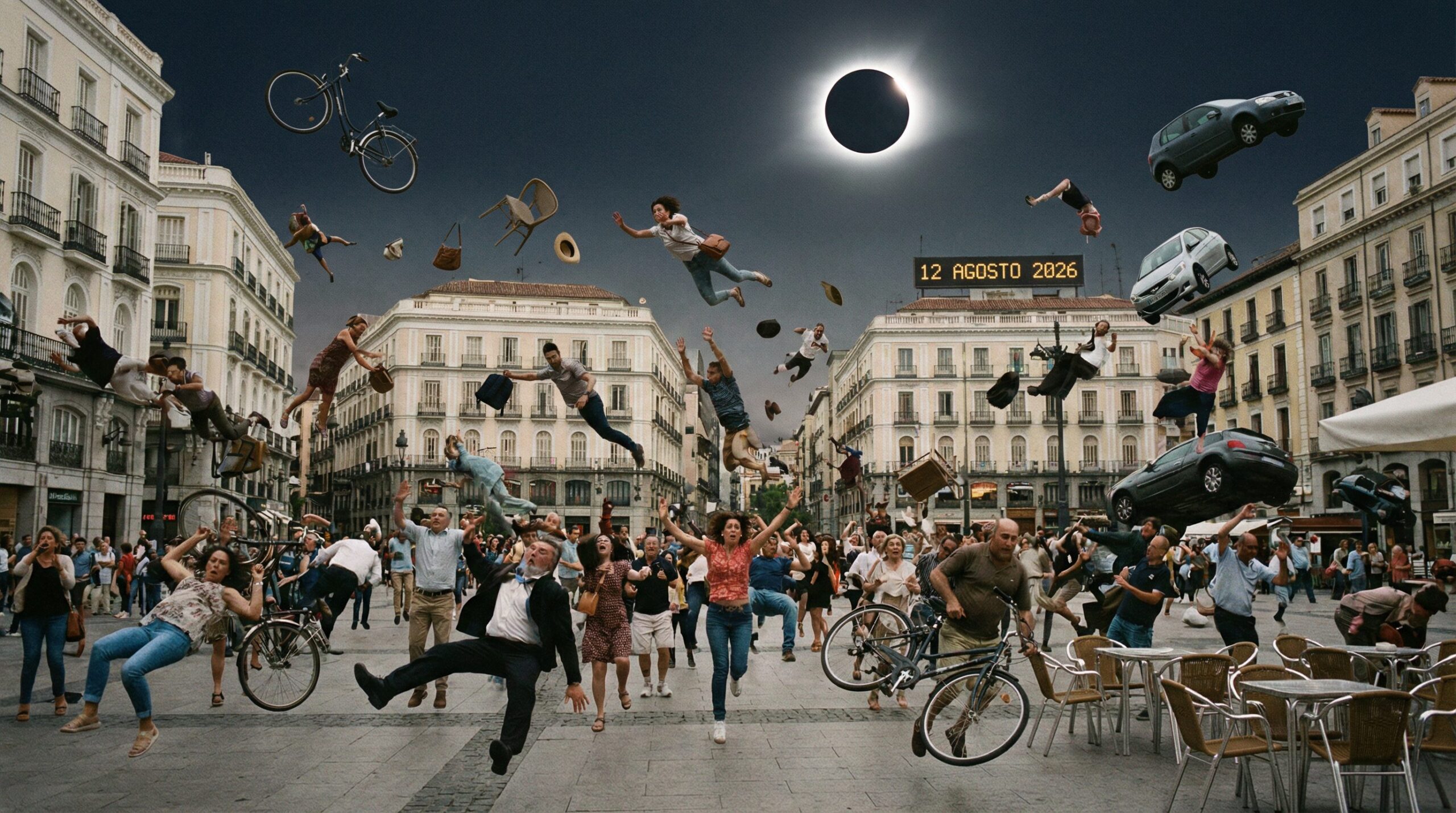
«August 12, 2026 the world will lose gravity for 7 seconds. NASA knows this. They are preparing but they won’t tell us why.”
This is the beginning of one conspiracy hoax – built around a real event such as the total solar eclipse – which is making the rounds on social media, according to which a phantom NASA project, called “Project Anchor”which would aim to survive the catastrophe due to the “gravitational anomaly” predicted at 14:33 UTC on August 12. Catastrophe, yes: the text that is circulating – which stylistically seems to have been written by an artificial intelligence – talks about «40-60 million victims» estimated and of a «economic collapse which will last over 10 years.” The American space agency would know all this but has decided to keep it secret so as not to cause panic among the masses.
It’s a beautiful subject for a screenplay disaster movie science fiction, but we can sleep soundly: none of this will ever happen. How do we know for sure? Simply, the “switching off” of the Earth’s gravity is an eventuality that does not It makes no scientific sense. It is physically impossible: the source of gravity is the massso as long as the Earth has mass, the gravitational force that keeps us on the ground isn’t going anywhere. And there is currently no known physical mechanism that can make the mass of an object disappear, much less as large as Earth.
In this regard, the text that is circulating speaks of it as the cause of a «intersection of two gravitational waves from black holespredicted in 2019 with a probability of 94.7%.” An explanation which, again from a scientific point of view, leaves us perplexed to say the least. Gravitational waves are disturbances in the geometry of spacetime, a bit like light is a disturbance in the electromagnetic field. We know that merging black holes produce gravitational waves detectable by Earth, but it is absolutely not clear how gravitational waves could “turn off” Earth’s gravity. It is one thing to deform spacetime, it is quite another to cancel the deformation caused by the earth’s mass.
It must be considered that even the closest black holes are still found at thousands of light years from usand gravitational waves by their nature are incredibly weak (we have only been able to observe them for about ten years), so it is totally out of the question that two gravitational waves generated by black holes, even in a condition of constructive interference, can alter Earth’s gravity in any way.
It’s not even clear how NASA – or anyone else – could predict the intersection of two gravitational waves. The state of the art in gravitational wave astronomy is to keep the detectors turned on and wait for something to come along; there is no way at the moment to make such precise predictions, especially with such a modest margin of uncertainty.
One thing that catches the eye is the date on which the elusive disaster should occur: August 12, 2026 does not seem like a random day, because on that day it will happen a total solar eclipseof which, however, no mention is made in the text that went viral. Now, does it make sense to think that a solar eclipse could disrupt gravity on the planet? The fact that it has never happened in the past should suggest to us that no, such a thing is not possible. Technically, during a solar eclipse the acceleration of gravity perceived along the line of alignment between the three celestial bodies decreases very slightly. But it’s an effect totally negligible. In short, nothing will happen even similar to what happens during the “trisolar syzygy” described in Three-body problem!
NASA itself denied this through a spokesperson reached by the debunking portal Snopes:
The Earth will not lose gravity on August 12, 2026. (…) A total solar eclipse has no unusual impact on Earth’s gravity. The gravitational pull of the Sun and Moon on the Earth, which has no effect on the Earth’s total gravity but does on tidal forces, is well understood and predictable decades in advance.
