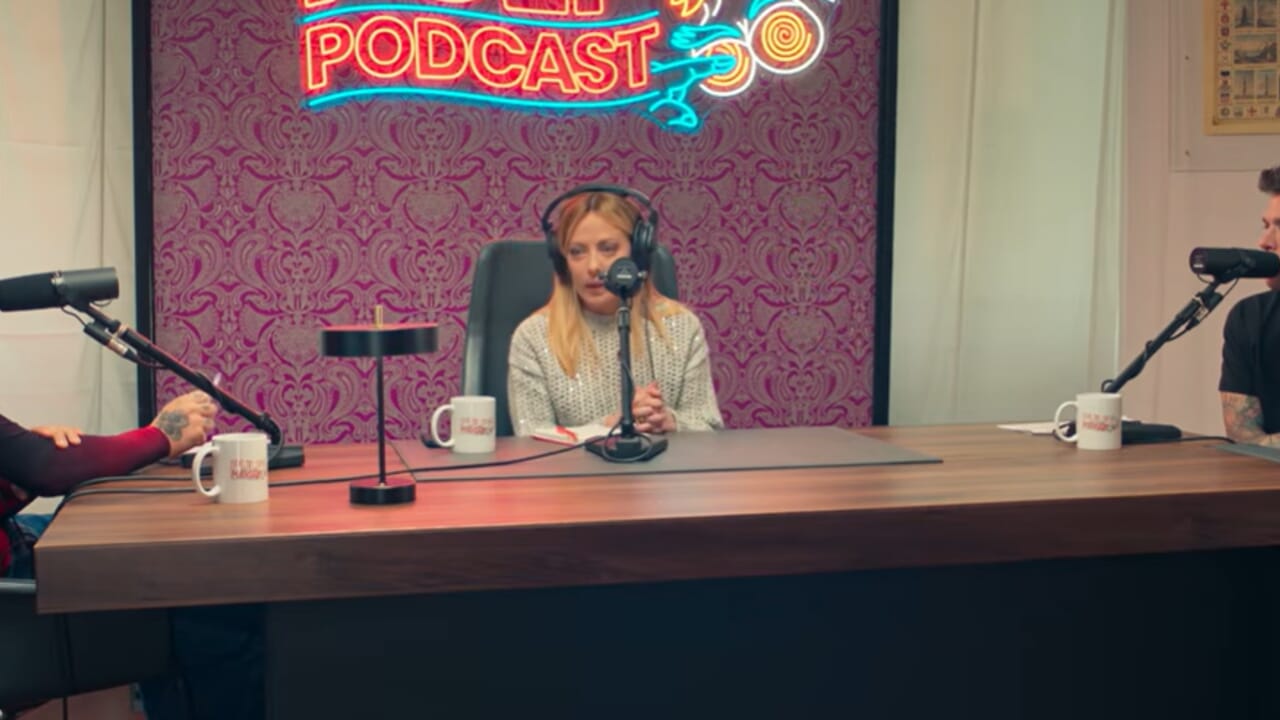
Having a podcast is not enough to interview Giorgia Meloni
It is difficult to read positive evaluations of the interview done by Fedez and Mr. Marra with Giorgia Meloni on their Pulp podcast. Many have compared it to an episode of Porta a Porta or Emilio Fede’s program, or have defined it as a one-hour rally. In fact, it was impossible not to notice that the two hosts didn’t ask half an uncomfortable question (they tried once, failing), they didn’t insist on any topic, they never argued. The Prime Minister, on the other hand (or rather, also as a consequence), cut an excellent impression: friendly, approachable, available, clear, competent.
Just ask for his opinion
Not that the interviewer’s job is to tear down the guest, of course; but when the guest is a politician, and even more so if he is the President and even more so if he systematically refuses to answer journalists’ questions, you must be able to press him, put him in a corner, confront him with his contradictions or lies (omnipresent in any politician). An interview in which you simply ask for your opinion, nodding and thanking you for the explanation, has no value, from any point of view. It is only used for visualization.
Politics on Youtube
However, it seems that it is not very fashionable to ask why this failure occurs: it is treated like any other interview conducted by a journalist or a political expert. But a journalist or a political expert, except those aligned and intending to promote the politician in question, would never have made such mistakes. And this is where the central question should arise: how come a former rapper and a YouTuber decide to interview the Prime Minister? Even before that: how is it that a podcast that deals with everything, from gossip to prurient news to conspiracy theories, becomes a place where politicians go to talk?
Meloni is not the first guest in this area: Calenda, Fratoianni, Tajani have been there. Many believe this is right, because today podcasts are a widely followed source of information, considered an alternative to newspapers and television, in short, modernised, closer to ordinary people. The world advances (or retreats, depending on your point of view) and the politician must move with it. From my point of view, if anything, politics has reached the level of vulgar podcasts, so it’s only natural that it ends up with Fedez.
The institutional offices forgotten, the competence not received
The politician, in fact, was once an institutional figure: that is, he behaved like one. He adopted a language appropriate to his role, a decorous behavior, he at least pretended a certain seriousness. For decades, however, things have changed, and we are not at all surprised to see a member of the Government or Parliament sitting laughing and messing around with people with whom in theory they would have nothing to do. The politician who refuses – perhaps because he has respect for himself, or for the citizens – is considered an old man closed to dialogue.
The problem, however, is not just decorum: it is, first and foremost, competence. Now, to make a podcast in which you interview various people of dubious value (the tiktoker who talks about Sanremo, the showgirl, the nun who holds Pacciani’s secrets and so on) it doesn’t take much, if you are rich, famous and good-looking. To interview a politician, especially of the caliber of Giorgia Meloni, you would need something else, and that is to be skilled in the profession.
It’s not like chatting with Last Generation, it’s a little more delicate and complex. You need to know what questions to ask, how they should be asked, how to select the topics to cover (which cannot be 1,800 and must be well connected to each other). And we must be able to not be intimidated by politicians, to stand up to them.
The political interview as chat
Here, when you (inevitably) address the politician as “lei” and the politician addresses you as “you”, the necessary conditions for all this to happen are not there. And they are not there also because to talk about war, the cost of energy, international relations, the Constitution and so on you need to have studied these things. To identify the interviewee’s rhetorical tricks, catchphrases, turns of phrase, it is necessary not only to have experience with politicians and with the serious interviews that are done with politicians, but also in-depth skills. How do you know they’ve lied to you if you don’t know the subject? How can you deny data or explanations if you yourself are not familiar with them?
The most tragic thing is that the answer is that real journalists don’t know any better. But it’s not true: in Italy we have always had serious journalism, and we still have it; it simply doesn’t build an audience, unlike the Youtube channel. We certainly haven’t often seen Meloni dealing with a real journalist, because – very appropriately for her – she refuses to give him his time: who knows why instead she happily went to these two! But if it was to make her advertise herself, the interview wasn’t necessary: she already does it very well on her own and with the help of her political opponents, who perhaps in terms of political communication and grip on the opponent are no better than Fedez.
