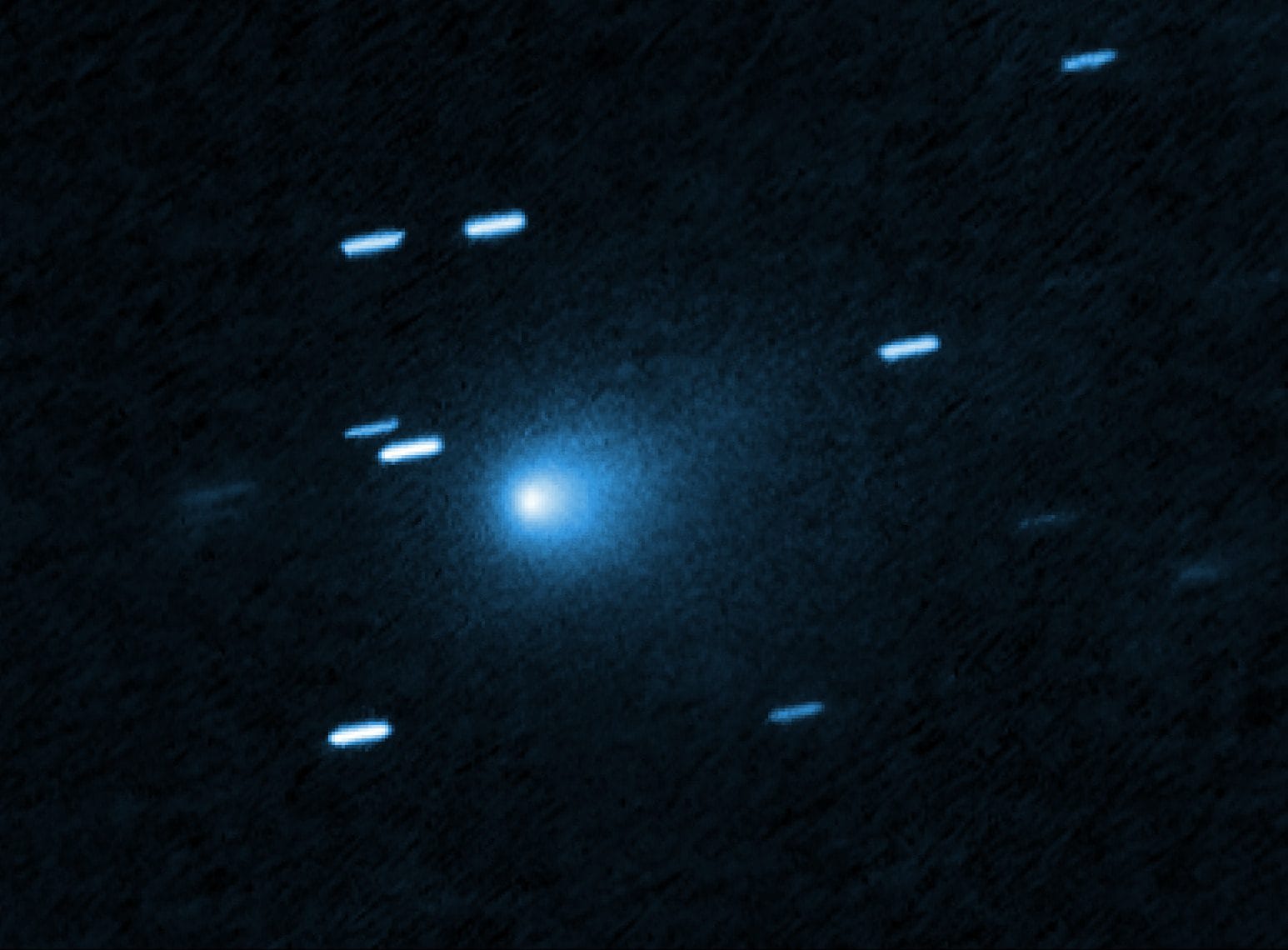
The space telescope Hubble has obtained the highest resolution image so far of Interstella 3i/Atlas cometthe third object from another star system never discovered in our Solar System after 1i/’Oumuamua and 2i/Borisov. Hubble’s observations have allowed astronomers to confirm the comets of this object (which is not an alien artifact as someone has recently hypothesized), to estimate their size (approximately 2.8 km) and quantity of dust and ice emitted due to the effect of sun radiation. 3i/Atlas is currently in just over 470 million km from the sun, more or less halfway between the orbits of Mars and Jupiter, and will reach Perdie (the point of the sun from the sun) on 29 October 2025. Its high speed of Over 200,000 km/h It suggests that the comet has been darting in the interstellar space for billions of years, accelerated by the gravitational forces of the objects of the Milky Way. In any case, it is not a danger to the earth.
What does the image of the Hubble telescope on comet 3i/Atlas show
The image of the Hubble Space Telescope is the highest corner resolution ever obtained by Comet 3i/Atlas. Was obtained in visible light by combining Two images of 25 seconds exposure e Two images of 40 seconds.
3i/Atlas darts in the solar system to more than 200, ooo km/h of speed that combined at a distance of about 480 million km, causes the comet to move very quickly compared to the “fixed” stars. That’s why in the image The stars appear as bright stripes: The Hubble Space Telescope keeps the comet at the center of its field of view during the exhibition, while everything else moves generating the “stripped” effect. Exactly the same effect that is obtained when the photographers take a photo of a Formula 1 car during a Grand Prix.
What we learned again on the interstellar comet
The discovery of 3i/Atlas four months before Perielio offers the opportunity to study theIncrease in the comet When approaching the sun, in what is almost certainly the first heating event of the core comets experienced by this body since the time of its training billions of years ago.
The image obtained from Hubble has made it possible to clarify several details on the nature of the comet. The image shows the presence of the characteristic crown and a weak hint of the tail. The hair is generated by the dispersion of sunlight by the powders emitted by the comet and sublimation of the commercial ice due to sun energy, which increases as the celestial body approaches Perdielio. The tail, on the other hand, is generated by the pressure of the solar wind which pushes ice and dust of the comet in the opposite direction to the sun.
The observations also made it possible to estimate the dust loss rate of the comet, approximately 60 kg per secondconsistent with the other comets that are detected at about 480 million kilometers from the sun, and the dimensions of the nucleus, whose radius is approximately 2.8 km (perhaps even smaller), but 10 times larger than the nuclei of the other two visitors uncovered, 2i/Borisov and 1i/’Oumuamua.
