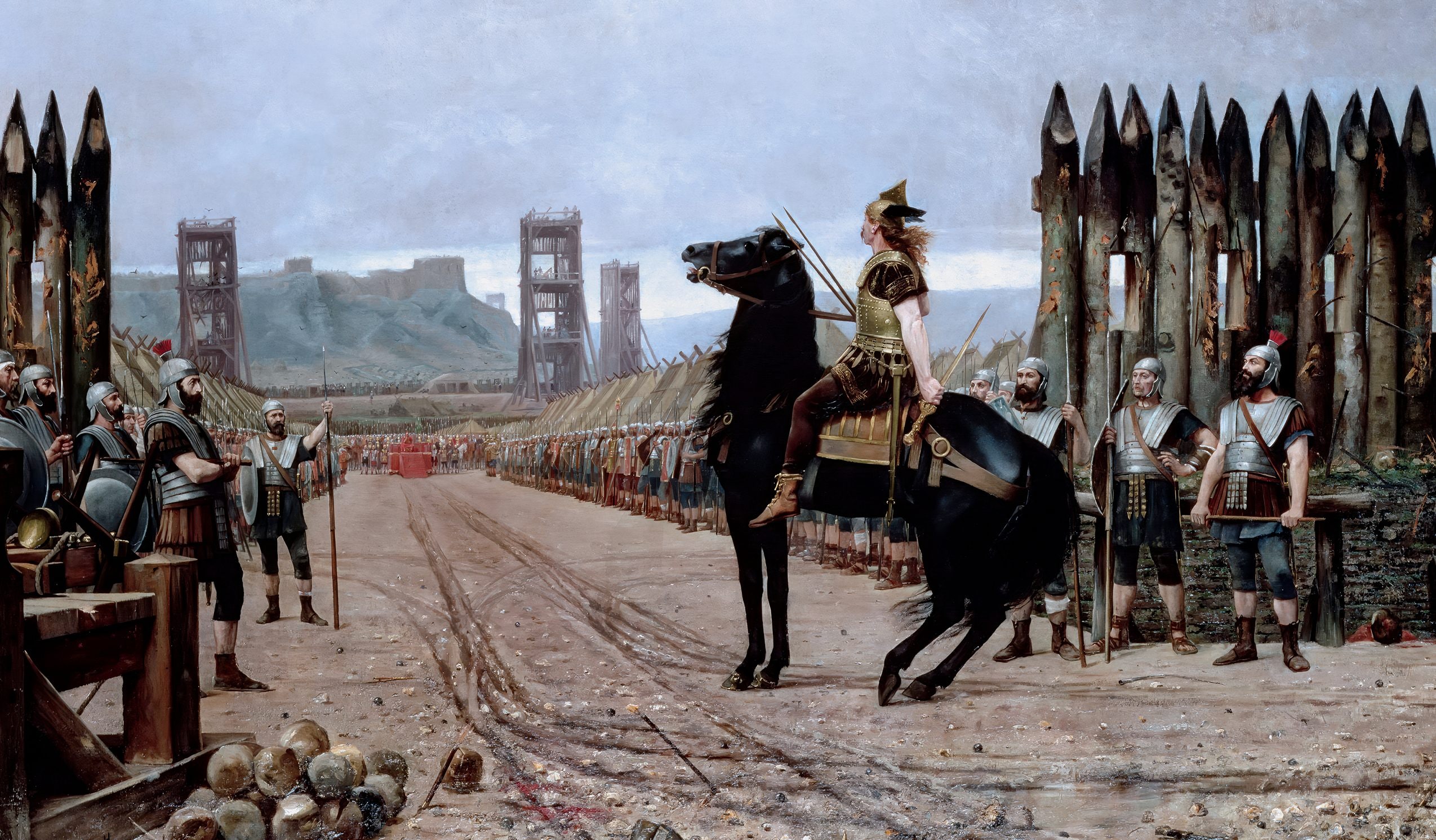
There conquest of Gaul It was one of the most famous military enterprises not only in the history of Rome, but of the whole ancient world. Was conducted from 58 to 50 a. C. From the Roman legions to the command of Caio Julius Caesar who, obtained the appointment a proconsul (a sort of governor), of Gallia Cisalpina and Narbonense, conquered the rest of the Gallic territory, that is, the area that today is occupied by France, Belgium, parts of Germany and Switzerland. In 52 AC Caesar’s troops fought the Battle of Alesiathe most important, defeating the roosters in command of Vercinetorrige. After the conquest of Gaul, Cesare defeated his rival Pompey in one civil warbecoming, in fact, the only master of Rome. The conquest of Gaul is known above all through the story that the same leader made it in De Bello Gallico.
Why did Cesare want to conquer Gaul? The historical context
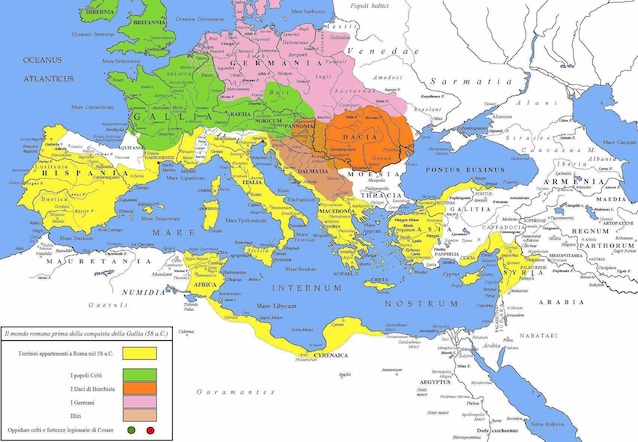
In the 1st century BC. C. Rome was in the phase of rapid expansion, but at the same time lived a period of civil wars and internal contrasts. One of the major political exponents was Caio Giulio Cesare, born in 101/100 BC. C. from a very visible family. After being elected consul, the highest political charge of ancient Rome, in the year 59 BC, Cesare made an agreement, known as First triumviratewith the two most visible politicians of Rome, Gneo Pompeo And Marco Licinio Crasso. At the end of the consulate he was appointed proconsul from the Gallia Cisalpina (roughly today’s Po Valley) and theIllyrian (the western part of the Balkan peninsula), later obtaining the control of the Gallia Narbonense (i.e. the south of France), already conquered by Rome. Cesare intended to take his political career off, but to do so he needed a military success: for this reason he turned his attention to the part of Gaul that Rome had not yet conquered. It was a territory inhabited by populations of Celtic originknown precisely as Galli, as well as by other Indo -European populations.
The beginning of the campaign in Gaul
In the year 58 BC it officially began war. The pretext was the migration of the Elvezi, a people allocated to the current Switzerland, who intended to cross the Narbonense Gaul: Caesar faced them and defeated them in the Battle of Bibracte; Later, he turned against the Swabians, a Germanic population led by the king Arrovistowhich intended to trespass into Gallic territory. The legions of Rome thus obtained a new victory and attacked the Belgians and other Gallic populations that did not intend to submit peacefully. By 57 AC, a large portion of Gaul had been conquered. Caesar had shown himself a very skilled military commandercapable of making his troops move quickly and to guide them efficiently in battle. He was aware, however, that to preserve his position he also needed political support. In 56 AC temporarily returned to Italy, leaving his legions in Gaul, and He met Pompeo and Crasso in Lucca To renew the agreements of the triumvirate: the three men established that the proconsular command of Caesar in Gallia would be extended by another five years and that Pompey and Crassus would have been elected consuls in the year 55 BC.
Caesar’s raids in Britannia and the battle of Alesia
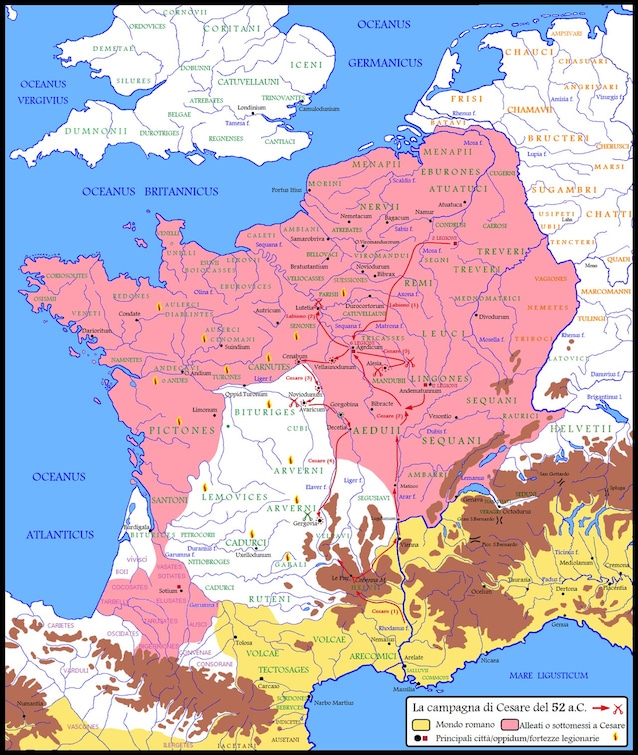
After the meeting of Lucca, Cesare returned to Gaul, occupied much of the territory not yet conquered and even managed to lead two Fils in Great Britainalthough not conquering the island (most of which would have been subjected to Rome in the first century A.). The rebellion of the Gallic populations who, in 53 BC, coalized against Rome under the command of Vercinetorrigeking of the Arverni, put it on the test: the decisive clash took place in 52 BC to Alesia (perhaps with the current Alise-Sainte-Reinein Burgogna-Franca Counta). Caesar besieged the city, building a dual line of fortifications to reject both the besieged and the Gallic forces of rescue and after several failed attempts to break the siege, verchingetorige yes surrender.
The consequences of the Roman conquest of Gaul
At the end of the battle of Alesia, VercingetoTorige was delivered to the Romans who imprisoned him for five years, in order to make him parade in triumph of Caesar (i.e. the parade to celebrate the victory), which took place in Rome in the 46 BC, after the civil war. Most of the Gallic soldiers was slavery and the last outbreaks of resistance were sedated without difficulty. In the 50 AC Gallia was transformed into one Roman province. For Rome, the conquest constituted an important turning point: until then it had expanded only in the territories of the Mediterranean and with the occupation of Gaul it became the main power of transalpine Europe. In Cesare, the victory over the Gauls gave the military success he needed, guaranteeing him to become the most in view of Rome with Gneo Pompeo, against whom he will fight the civil war In the years 49-45 BC, imposing itself as dictator of Rome. The Gallic war accelerated the passage from the Republic to the Principality Which, started by Cesare, would have been completed by Ottaviano Augusto.

The De Bello Gallico
The main source for the conquest of Gaul is Commentary De Bello Gallico (“Commentary on the war in Gaul”)written by Caesar himself. The work, divided into eight bookscovers the entire conflict, with theeighth book drawn up by his lieutenant Aulo Irzio. Cesare wrote in third person To give an appearance of objectivity, but the text is also a skilled propaganda operation; In addition to the battles, it describes the Uses and customs of the peoples encountered, making the work a precious source for the history of Rome and a classic of Latin literature.
