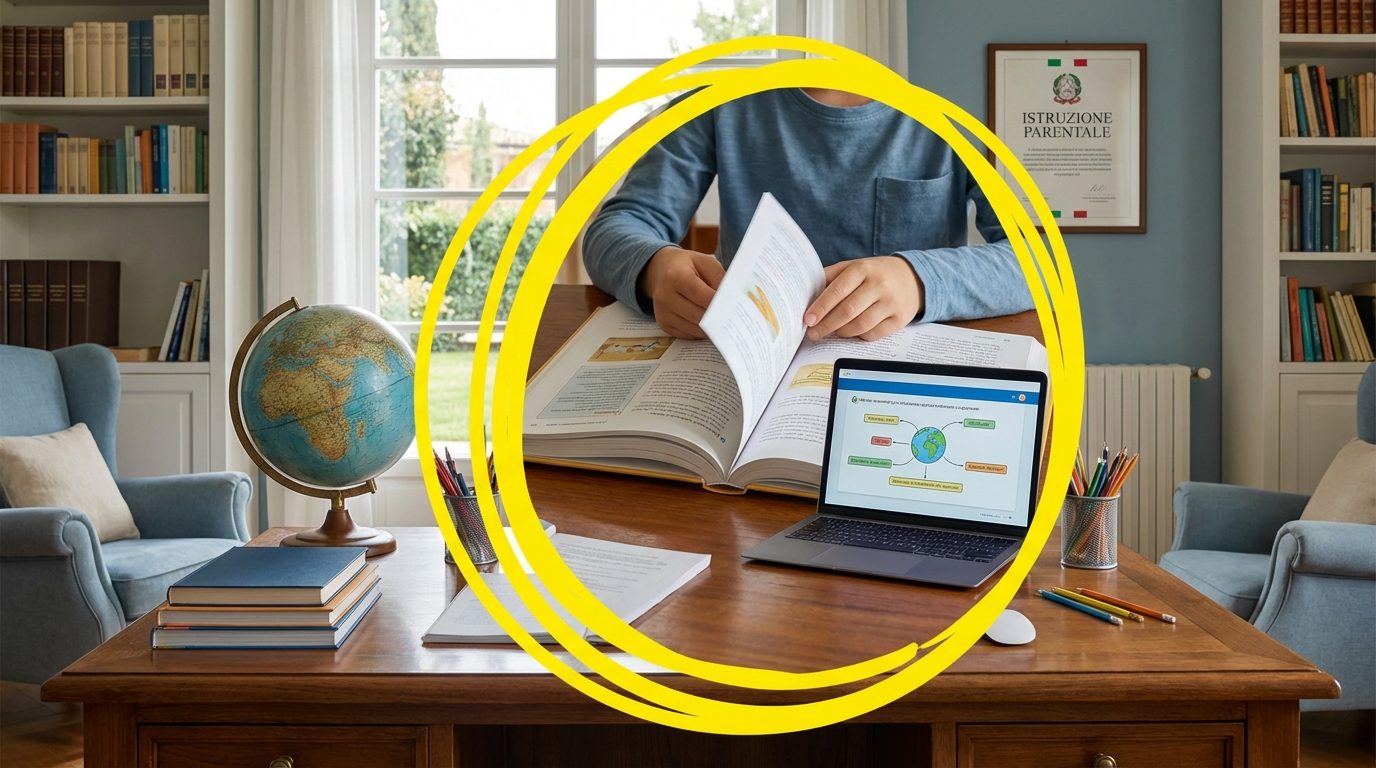
The story of the “forest family” has reopened the debate onhomeschooling – parental education carried out from home – after three children were removed from the parents with whom they lived in a house in the woods in Palmoli, Abruzzo.
Without going into too much detail about this complex case – to which the regulations on parental responsibility and on the loss of parental authority also apply -, it must be said that in our country school is compulsory until the age of 16. And, in fact, in the order issued by the court, it is specified that the three children did not attend school.
But, therefore, it’s legal in our country educate your children from home without sending them to school? Actually yes, in Italian legislation there is “an alternative to attending school” when the family chooses to directly provide for the education of its children. Clearly, this possibility is linked to the compliance with some specific criteriafrom the annual declaration to be delivered to the school director up to the student’s suitability exam.
How parental education works in Italy
As specified by the Ministry of Education and Merit, in Italy theparental educationalso known as “family school” or “homeschooling”, represents a recognized alternative to the traditional classroom education path. In particular, this option is regulated by article 2 of Legislative Decree 62/2017, which recognizes the family’s ability to choose to directly provide for the upbringing and education of their children. However, the implementation of parental education is constrained to procedures and requirements very specific.
First of all, the family that decides to make use of parental education is required to communicate this decision every year to the head teacher of nearest state school to your residence. This communication must be submitted within the established deadlines, but the crucial aspect is that the family must show to own the technical and economic capabilities necessary to independently provide teaching. The school director will then have the duty to verify the correctness of what has been declared by the parents and will be obliged to supervise the fulfillment of the minor’s educational obligation.
The second pillar of homeschooling issuitability examwhich every student must undergo annually in order to access the next class. This exam is taken – directly in a state or private school – as external candidate and serves precisely to verify that the student has actually acquired the skills relating to his/her level of study. In the event that the pupil does not pass the suitability exam, or if the family does not submit all the necessary documentation, the school director will have to activate the procedures forimmediate registration of the pupil at a school.
In other words, if the requirements established by law are not respected, the student will be forced to physically attend school, therefore having to give up parental education from home.
In the specific case of Palmoli’s family, the Ministry of Education specified in a note that the compulsory schooling of the three minors had been respected, after receiving confirmation from the competent school director.
Data on homeschooling in Italy
According to official data released by the Ministry of Education, parental education has also increased in Italy over the last few years, especially following the Covid-19 pandemic. Specifically, if in the school year 2018/2019 students educated at home by their parents were approximately 5.126already in 2020/2021 this number had reached i 15,361.
At the moment, the record appears to have been reached for the school year 2024/2025when the Ministry recorded approx 16,000 male and female students educated from home, compared to a total of 7,073,587 students returned to school. In short, although growing, it is an extremely small share, equal to 0.23% of the total students.
For this year the quota stops at 10,600, but school leaders have until the end of the year to communicate the final number of homeschooling students.
Looking abroad instead, among the most advanced countries from this point of view are the United States: according to official data released by the National Center for Education Statistics (NCES), in the 2022/2023 school year approximately 3.4% of students – from kindergarten to the last year of high school – resorted tohomeschooling.
The difference between homeschooling and unschooling
Homeschooling, however, should not be confused with what is called “unschooling”: in the first case, students are taught at home by their parents, who are required to follow a specific program depending on their school level, often using textbooks similar to school ones and dedicating a specific time of the day to studying, with a view to preparing the student for the final exam we were talking about above.
Unschooling, on the other hand, is a term coined by the educator John Holt to indicate a sort of “self-guided learning”. In practice, therefore, it consists of an instructional practice in which students have a strong decision-making autonomy as regards school activity, which is not structured in fixed programs or pre-set lessons, but largely depends on individual interests and the surrounding environment.
