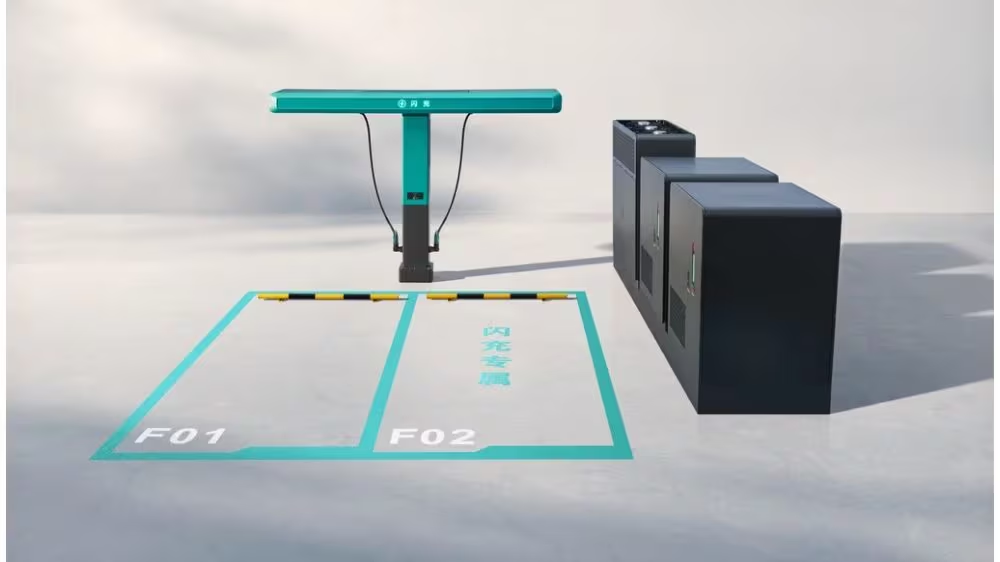
TO Bologna an infrastructure has just been created that could change our relationship with the electric car. The group BYD inaugurated in the Emilian capital the first Flash Charging station in Italy: a pioneering plant capable of deliver up to 1,500 kWor 1.5 MW, of power.
In this in-depth analysis we will see how this system is able to drastically reduce parking times, bringing the battery from 10% to 70% in just five minutes and reaching 97% charge in just nine minutes. We will then analyze the technological heart of these performances: the new one Blade Battery 2.0a lithium iron phosphate (LFP) battery optimized at a molecular level to reduce heat production and accelerate the movement of ions, without compromising safety and longevity. Let’s get started.
The power of the Flash Charging station in Bologna
Let’s start from the most relevant aspect of the news: the BYD Flash Charging station in Bologna, the first of its kind in Italy, is capable of deliver 1,500 kW of power. Under normal conditions, it takes five minutes to go from 10% to 70% charge. Also to extreme temperatures of -30°Cconditions in which the chemical reactions of traditional batteries slow down drastically, the system takes just 12 minutes to recharge from 20% to 97%.
To understand how it is possible to accumulate so much energy in times comparable to a petrol refueling, we need to look at the technology that equips the first vehicles compatible with this system, such as the shooting brake Denza Z9GT and the minivan Denza D9 Super Hybrid DM-i. The secret lies in Blade Battery 2.0.
In six years of research, BYD engineers have managed to overcome a classic physical constraint: that by which ultra-fast charging normally penalizes the energy density, i.e. the amount of energy that can be stored at the same volume. The result is a system that increases energy density by 5% And reduces degradation of capacity in the long term by 2.5%.
All this is made possible by the proprietary system FlashPassbuilt on three pillars. The cathode It has particles with a denser structure, which allows for faster ion release. THE’electrolyte it has been optimized with the support of artificial intelligence, to make it more fluid and conductive. THE’anode instead it adopts a 360-degree three-dimensional structure, capable of accommodating lithium ions at record speeds. Acting together, these solutions lower the internal resistance of the cell, limiting heat production to the source.
Added to this is an ultra-thin high-density layer called SIX (Solid Electrolyte Interphase): a protective film that forms between the electrode and the electrolyte and which integrates a dynamic self-repair capacity. On the safety front, the battery has passed extreme tests: drilling with nails during fast charging e simultaneous short circuit of multiple cells at temperatures above 700°C, without generating flames or smoke.
The approach used in the first Italian ultra-rapid station for electric cars
However, a legitimate question remains: how do you withdraw 1.5 MW without overloading the local electricity grid? The Bologna station adopts a hybrid and intelligent approach: it connects to the ordinary network with only 100 kW connection and integrates a photovoltaic system on the roof 400 kW. The energy produced is accumulated in two storage units with a total capacity of 400 kWh, which absorb current slowly and release it at very high power when a vehicle is connected.
Also the column design has been rethought: the suspended structure a T shape It keeps cables and connectors off the ground, preventing them from getting dirty or wet, while a pulley system on a track makes inserting the plug easier, making it convenient for anyone.
The expansion plan in Europe
Bologna is only the first piece of a puzzle that BYD will complete over the next few months/years. The group has allocated 2 billion euros to build an ultra-fast charging network across the continent, with the aim of install 300 stations in Italy and over 3,000 in Europe by 2027an ambitious plan that aims to fill the current infrastructure deficit in the high-power charging sector.
