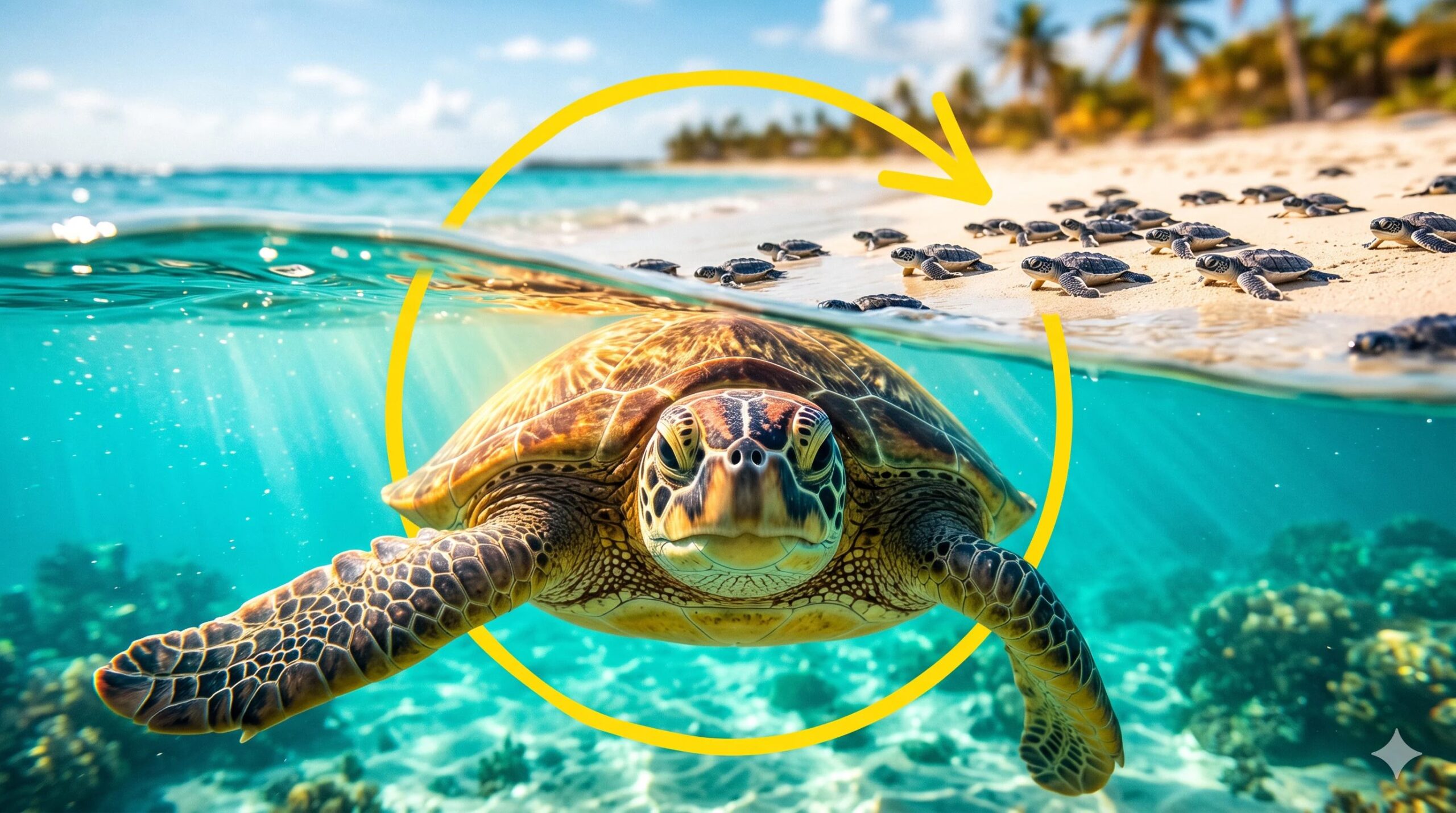
It is mid-June and on some of the warmest beaches of the Mediterranean, the Gulf of Mexico and the tropical coasts of the whole world the same ritual is repeated every year: the adult female sea turtles they emerge from the ocean at night, drag themselves across the sand with their front flippers until they find the right spot and they lay their eggs. It’s not just any beach: it is the same one in which they themselves were bornyears before, as small of a few centimeters. Despite having traveled thousands of kilometers of open sea, they manage to find their birth beach with great precision thanks to a biological mechanism based on the perception of the Earth’s magnetic field, known as geomagnetic imprinting. A behavior reminiscent of that of migratory birds returning to their nest. This behavior has been documented in over thirty years of research Kenneth Lohmann and his team at the University of North Carolina, with experimental evidence published from the early 2000s on Nature.
The seven species of sea turtles: size, habitat and diet
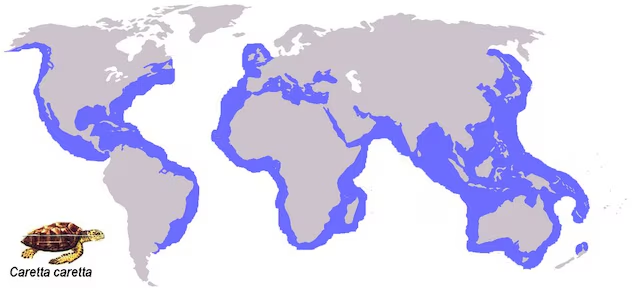
Sea turtles are marine reptiles divided into seven species, distributed in all the oceans of the planet except Arctic and Antarctic waters. Most are classified as threatened (Vulnerableeo Endangered) or in danger (Critically Endangered) from the IUCN Red List. The most widespread species in the Mediterranean is the loggerhead turtle or caretta (Caretta caretta), up to 115 cm long and weighing up to 180 kg, omnivorous, which feeds on molluscs, crustaceans and jellyfish.
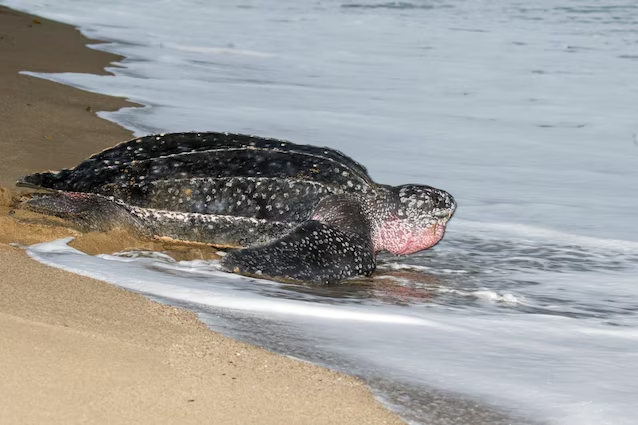
There green turtle (Chelonia mydas), with dimensions of up to 150 cm and 315 kg, is predominantly herbivorous as an adult and feeds on seagrass and algae. The largest of all is the leatherback turtle (Dermochelys coriacea): can exceed 180 cm and 700kg and feeds almost exclusively on jellyfish.
The group is completed hawksbill turtle (Eretmochelys imbricataspecialized in feeding on sponges in coral reefs), the olivaceous turtle (Lepidochelys olivacea), the Kemp’s tortoise (Lepidochelys kempiithe smallest, about 70 cm) and the flat turtle (Natator depressusendemic to Australia). As an evolutionary group, sea turtles have been present in our oceans for at least 100 million years, having lived through the extinction of the dinosaurs, continental drift and numerous reversals of the Earth’s magnetic field.
Sea turtle migrations: routes and distances travelled
Sea turtles spend almost their entire lives in the open ocean, moving between areas of diet and those of nesting in reproductive cycles that repeat every two to five years. The routes can be very extensive: North Atlantic loggerhead turtles travel thousands of kilometers between Florida beaches and feeding grounds in the Azores, while a leatherback turtle tracked via satellite telemetry traveled over 20,000 km from Indonesia to the Oregon coast in a single journey, one of the longest migrations ever documented in a reptile. The technology of satellite telemetrywhich involves fixing small transmitters to the carapace, has made it possible since the 1990s to reconstruct these routes with increasing precision, revealing that females tend to return to the same nesting beaches at each reproductive cycle thanks to thegeomagnetic imprinting.
How sea turtles find their birthplace: geomagnetic imprinting
The mechanism underlying the Christmas homing (the ability to return to the native shore) has been reconstructed thanks to decades of research, largely guided by the biologist Kenneth Lohmann and his team. It all begins in the very first moments of the turtle’s life: when the little one emerges from the sand and dives into the sea, its nervous system indelibly records the magnetic signature of that specific beach. This “signature” is an invisible coordinate given by the unique combination of two physical parameters: theinclination angle of the Earth’s magnetic field lines and its intensity. As an adult, the turtle will use these stored coordinates as the final destination of its long ocean journey.
Surprising experiments demonstrated this incredible ability. In a study published in Nature in 2004, researchers introduced green turtles (Chelonia mydas) in a water arena surrounded by special electromagnetic coilscapable of simulating the magnetic field of any place on the planet. By activating the field corresponding to an area located 340 km further north than their actual position, the turtles systematically began to swim southwards, correcting their route to “return home”. According to research by Brothers and Lohmann on Current Biology in 2015, analyzing 19 years of nesting data in Florida and superimposing them with variations in the Earth’s magnetic field, the nests moved geographically in correspondence with the field lines: the turtles they do not return to a geographically defined shore, but to a magnetic signaturefollowing it even when it moves a few kilometers over the years.
As for the biological mechanism, turtles and migratory animals in general seem to perceive the magnetic field in two ways: through photosensitive molecules which react chemically to light, therefore “seeing” the earth’s magnetic field, or through the presence, in their body, of small crystals of the mineral magnetite (Fe₃OR₄) – called magnetoreceptors – which physically rotate, aligning themselves with the field, allowing the animal to “feel” it. To understand which of the two governs the turtles’ positional map, Goforth and Lohmann’s team conditioned young loggerheads by exposing them to two distinct magnetic fields, each corresponding to the signature of a real geographic location, providing food only in the presence of one of the two. As documented in the study published on Nature in February 2025, the turtles learned to recognize the correct coordinates, i.e. those associated with food, performing a real “food dance” (which you can see in the video below). It is thought that this ability to learn and recognize specific feeding areas may explain how they return to the same nesting site, even after large migrations.
The same study showed that oscillating radio frequency magnetic fields disturb the directional compass but not the positional map, indicating that the two systems rely on distinct mechanisms. The second study, published in Journal of Experimental Biology in November 2025, he then used the same dance as an indicator: by exposing the turtles to a short magnetic pulse capable of temporarily deactivating the magnetite (without altering the photosensitive system) the dance was drastically reduced, confirming that the positional map is mainly governed by magnetite.
Artificial lights and metal cages put sea turtle signals at risk
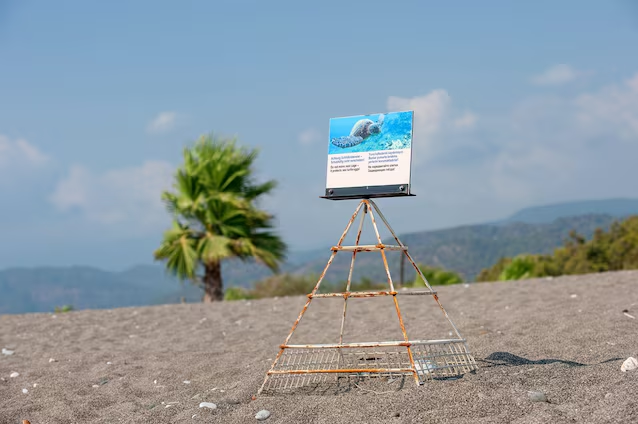
Understanding this navigation system challenges some established conservation practices. In guardianship programs it is common move the eggs from nests at risk in metal cages within protected areas. These steel structures, as reported by research published in Biological Conservationcan distort the local magnetic field. If newborns register an altered magnetic signature at those times, they may not be able to return to the correct position as adults. For this reason, the most up-to-date conservation organizations are progressively switching to structures made of non-ferromagnetic materials.
Added to this is the problem oflight pollution. As soon as they are born, turtles orient themselves towards the brightest point on the horizonwhich on a natural beach corresponds to the reflection of the moon and stars on the water. On urbanized coasts, with hotels, roads and streetlights behind, this signal is easily overwhelmed by artificial sourcesthe. According to data from NOAA and the Florida Fish and Wildlife Conservation Commission, thousands of hatchlings are disoriented every year in Florida alone. As confirmed by a systematic review on Biological Conservation in 2025, disorientation from artificial lighting is now the main cause of mortality in the nest-sea stretch on urbanized coasts, ahead of natural predation.
