
It’s the beginning of March and a few days ago the very long journey that will take you there began common swallow (Hirundo rustica) to migrate from Africa to Europe, a journey beyond 10,000km and lasting approximately 2 months. Thanks to their excellent navigation skills and orientation based on the perception of the Earth’s magnetic field, these birds not only do not lose their way, but are able to return in the same nesting sites as in previous yearsoften in exactly the same nest. Monogamous birds, they will lay a clutch of around 4-5 eggs and then undertake their return journey towards the end of September. This migration, which has been going on with precision for millions of years, is for many the symbol ofarrival of springeven if this regularity is jeopardized by the climate changes of recent years.
The characteristics of the common swallow
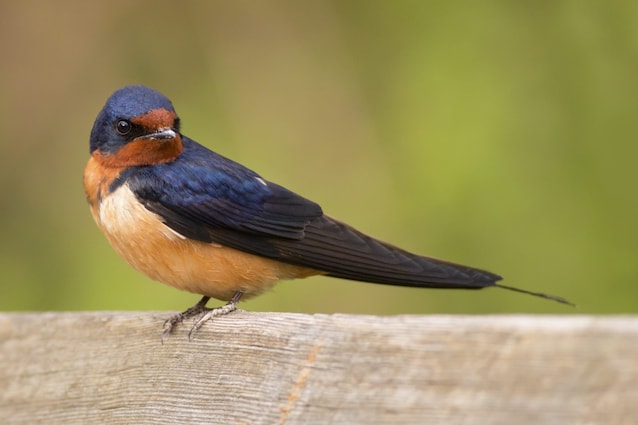
The common swallow (Hirundo rustica) is a summer breeding migratory bird species present throughout the Italian peninsula, including Sicily and Sardinia. The swallow, weighing between 16 and 20 grams, has an unmistakable livery with its back dark blue and the belly is light, tending towards whitish of different shades between males and females. The distinctive feature on the muzzle is the color spot brick red which covers both the forehead and the throat, separated from the chest by a thin dark band. It has long, black and pointed wings, perfect for flying at speeds close to 70-80 km/h. The tail is long and forked. This bifurcation is even more pronounced and evident in male specimens, the only ones to sing – females only produce contact calls and alarm cries. They are birds that nest both in rural environments and in urban centres.
The swallow migration: the long journey from Africa to Europe
During the winter months the common swallows they winter in Africareaching as far as South Africa depending on the population. This behavior is repeated in numerous other swallow species (about 90 are known) that live in other parts of the world, and that choose to stay and nest in the Southern Hemisphere during the period from September to March, which in that hemisphere corresponds to the summer months. With the change in temperature and the reduction of food resources, swallow populations move together in flocks of tens of thousands of individuals.
The journey to Europe begins towards the end of February-beginning of March and the swallows they arrive at their destination at the beginning of Aprildepending on the population and the route. For example, most of the swallows that stay in northern western Italy, as revealed by an Italian study in Movement Ecology, depart from western central Africa and then pass through Algeria and cross the Mediterranean Sea. Populations stationed in other areas of Europe will have different departure and arrival points.
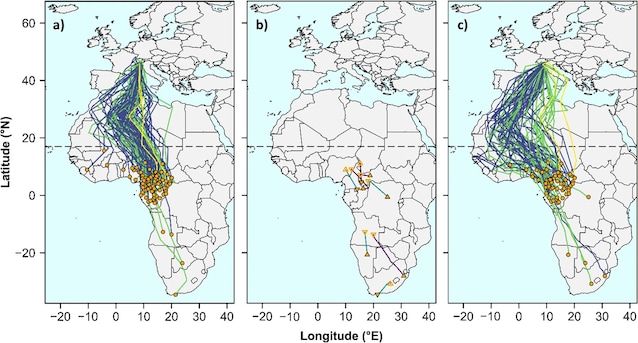
Swallow migration is a matter very tiring – these animals must constantly feed on flying insects to sustain themselves and are forced to make refueling stops. Corticosteroid level measurements in swallows show high levels of stress during the migratory period, stress that can negatively influence the success of the brood.
How do swallows return to the same nest and why
Swallows are birds of habit and with excellent geographical memory, who tend to return to the same nest year after year and stop in the same places along the way. In this, they are helped by their ability toi perceive the earth’s magnetic fieldthanks to the presence in the beak and ears of magnetitean iron oxide that reacts to magnetic field variations, and to the presence in the retina of cryptochrome 4 molecules, a magnetosensitive protein that allows swallows to “see” their inclination with respect to the magnetic field and which is present in many migratory birds. Combined with observing the position of celestial bodies and other landmarks along the route, the magnetoreception ensures that the swallows are able to find their way back and their old nest from year to year with great precision.
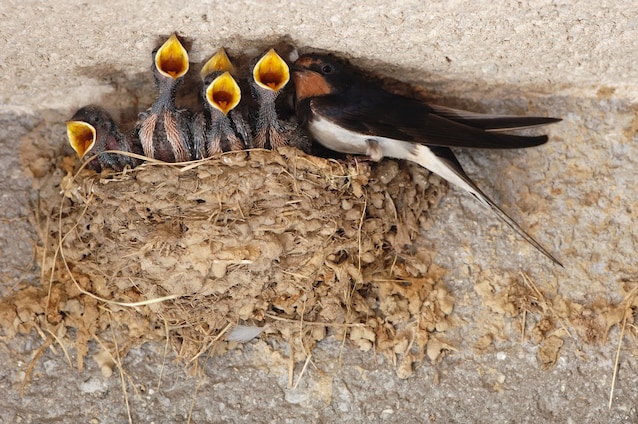
About 40% of barn swallows return to‘exact previous nestreinforcing it with mud and straw. Using the same nest is convenient: saves construction days, crucial time that could be dedicated to mating, brooding and caring for the young. In some cases, old nests are abandoned in favor of other ones nearby, for example if they are too damaged infested from parasites (ticks and fleas) or if the previous year’s litter was unsuccessful. The male arrives a week before the female to grab the best places, start cleaning the nest, and start singing to attract partners. Once the couple is established, this lasts almost for life: swallows are monogamous birds and can raise two broods in the same breeding season.
The care of swallow chicks it is the duty of both the male and the femalewho feed them until they are able to fly and undertake the return migration themselves. Luckily for their parents, the baby swallows have evolved a system that makes it easier to clean the nest: like many nestlings they produce waste in a sort of mucous and compact fecal bag, which adult swallows can easily catch with their beak and carry out of the nest like a dirty diaper.
How climate change is affecting swallow migrations
The proverbial regularity of the swallow’s migration is based on constancy of seasonal rhythmsi, a constancy that is now in danger due to climate change. For some years now, due to the increase in global temperatures, swallows are in fact starting to anticipate their arrival to Europe for a few days, and to leave later, a trend found in many other migratory birds. This extended stay impacts the limited food resources available, and with fewer insects to eat due to environmental degradation, swallows are suffering a progressive decline in population. The excessive heat is also greatly reducing the migration route, because the birds no longer need to travel all the way to Africa to find a warm environment in the months between September and March. This has led to some populations, in recent years, a even winter in Portugal instead of going below the Equator.
