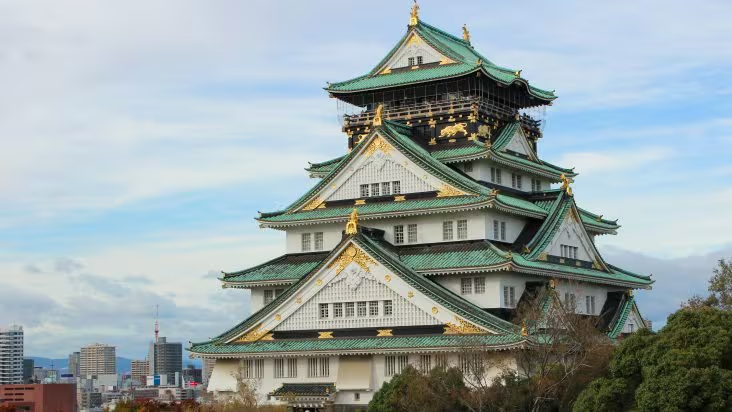
Built by Toyotomi Hideyoshi, Osaka Castle combines feudal art and modern engineering. The 1931 reinforced concrete tower, placed on powerful anti-seismic dry stone walls, resists earthquakes and bears witness to key passages in Japanese history.
The complex of Osaka Castlein Japan, was built on a park of 1.06 square kilometersdominated by the main tower with a height of 58 meters. The large stone walls exceed the 20 meters high and wind their way 12 kilometersintegrating megaliths such as the Tako-ishi da stone 108 tons. To defend the fortress we find the external moat with a width of up to 90 meters and deep 6 meters it historically contained enormous volumes of water. The reconstruction of the tower of 1931made of reinforced concrete with a cost at the time of 1.5 million yenguarantees its resistance to earthquakes, which are very frequent in the area.
Osaka Castle in Japan: architectural description
Osaka Castle represents the perfect synthesis between the Japanese feudal building art (Ishigaki) and the seismic engineering of 20th century. The foundations and external bastions adopt the masonry technique Uchikomi-hagia typically Japanese method, which consists of dry installation in which the granite boulders are rough-hewn on the edges to fit together perfectly without the use of mortar. This solution allows the walls to dissipate seismic energy through micro-movements between the blocks and to guarantee the natural drainage of rainwater, avoiding and therefore avoiding peaks of hydrostatic pressure in the rear embankment. The geometric configuration of the bastions presents twisted arch slopes, and were created with an exponential curvature which makes the wall almost vertical in the upper part, eliminating the possibility of climbing by enemies.
The central building develops with an architecture Azuchi-Momoyama apparent of 5 external levels, but hides 8 internal floors. While the aesthetics respect the traditional wooden carpentry with complex cantilevered structures to support the eaves and hipped roofs covered with golden tiles and copper covers, the current load-bearing structure is a work of iron-concrete civil engineering. The reinforced concrete cage, integrated in 1931, supports the load of the internal floors and isolates the tower from the bending stresses induced by winds and seismic oscillations, coupling the visual lightness of the historic carpentry with the high ductility of the modern structures.
The history of the Japanese castle
The history of Osaka Castle has been characterized, over the centuries, by continuous phases of destruction and reconstruction which certainly reflect what were the crucial passages in the history of Japan. Originally built in 1583 at the behest of Toyotomi Hideyoshi on the foundations of the fortified temple of Ishiyama Hongan-ji, the castle was to serve as the nerve center of a unified Japan and manifesto of unassailable power.
However, following the famous Siege of Osaka (1614-1615), the forces of the shogunate Tokugawa they destroyed the Toyotomi fortress, covering the original structures with meters of soil to build a new, totally redesigned castle on top. In the 1665the main tower was struck by lightning, causing a devastating fire that destroyed it completely, leaving the fortress without its Tenshu for nearly three centuries. During the Meiji period, the area was converted into a military complex and arsenal.
In the 1931thanks to an impressive fundraiser promoted by the citizens of Osaka, the tower was rebuilt using reinforced concrete. Although the bombings of the Second World War damaged the surrounding area and the arsenal, the main tower survived and was the subject of radical restoration activities, including 1995 and 1997which modernized the interiors with elevators resistant to seismic stress and complex structural monitoring systems, transforming it into the historical-engineering icon that dominates the contemporary city. The structure has been transformed into the “Osaka Castle Museum”, hosting a large collection of artefacts dedicated to Toyotomi Hideyoshi, the Sengoku era and the history of the fortress, presented to the public through rotating displays.
