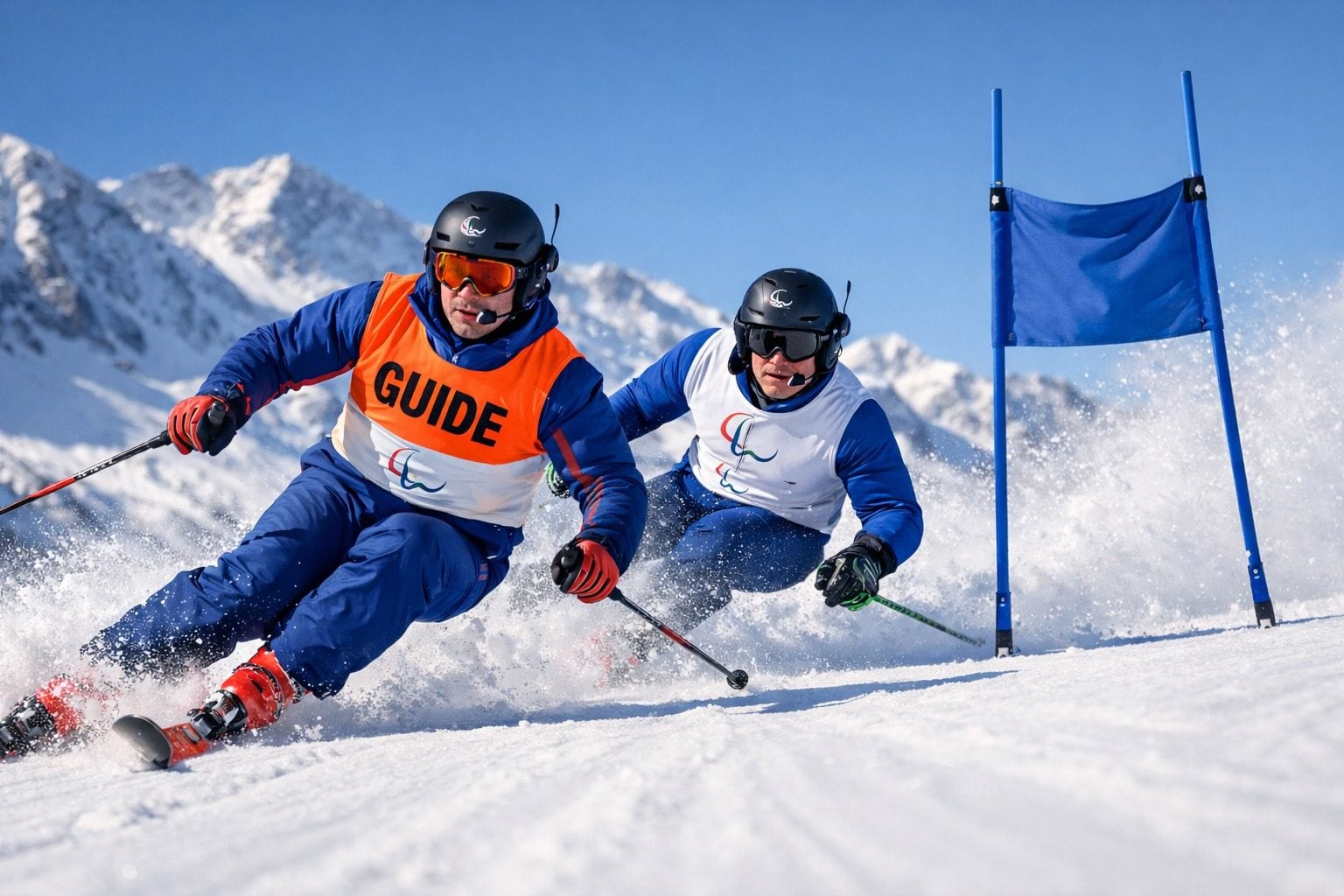
Skiing along a snow-covered slope to beyond 100 km/h without seeing – or seeing very little – it seems impossible. Yet, in the paralympic alpine skiingit’s normal. How do these athletes a orient yourself? Who decides when to turn, brake or “let go” of the skis? And above all: how important is trust in the person in front of them? At the Milan-Cortina Paralympics taking place this week, Italy already has 4 medals in this discipline. Chiara Mazzel with the guide Nicola Cotti Cottini he won a gold in the Super G and a silver in the downhill while Giacomo Bertagnolli took home a silver in the Super G and a bronze in the downhill led by Andrea Ravelli.
In this article we will see how skiing works for visually impaired athletesfrom the crucial role of the guide to the communication systems in the race, up to the categories of visual impairment and some curiosity which tell us how technical this sport is.
How are visually impaired skiers classified?
In the Paralympic world not all visually impaired athletes they see the same way. For this there is an official classification, used in international alpine skiing competitions organized by International Paralympic Committee.
Visually impaired athletes fall under three main categories:
- B1: total blindness or minimal perception of light, without the ability to recognize shapes.
- B2: very limited residual vision, with a narrow field of vision (< 5°).
- B3: milder vision loss, but still insufficient to ski safely without help.
All these athletes compete Togetherbut with a coefficient system which makes the results comparable. In practice, the final time is adjusted based on the visual category, so as to compensate for the different degree of disability.
The guide: the eyes of the athlete
A mandatory element for all categories is the use of a guide. The guide is an expert skier who precedes the visually impaired athlete along the slope, tracing the ideal line and describing the slope in real time. The relationship between athlete and guide is extremely technical and built over years of training. It is not enough to be a good skier: you must have a guide perfect reaction times and impeccable communication skills.
During the descent, the guide communicates through short voice commandstransmitted via a intercom system in the helmet. The instructions are not complete sentences, but personal keywords that the athlete learns to interpret automatically.
Typical examples are:
- “Left” / “Right”: announce the direction of the next curveallowing the athlete to prepare the set-up.
- “Hop”: Report a quick change of direction between one curve and another, used especially on steeper or more technical sections.
- “Stronger”: is used to request one sharper curveincreasing the angle of the skis on the ground.
- “Easy left” / “Easy right”: they report gentle curveswith a large radius.
- “Here”: means maintain the current trajectorywithout changing direction.
- “Stop”: command for one controlled stopgiven in advance.
These indications are not only used to tell you where to go, but also how to plan your skiing. For a blind athlete, in fact, keeping the skis “flat” is a problem: A ski that slides straight towards the maximum slope provides very little information to the body.
However, when the ski is placed on an edge and draws a curve, the athlete receives clear signals through the legs and torso: pressure, vibrations, acceleration. It is fundamental feedback to understand speed and attitude. For this reason, in skiing for the blind, they are often preferred more rounded and continuous trajectorieswhich help you maintain control and “feel” the track even without seeing it.
Everything happens in fractions of a second. The guide speaks in advance, the athlete reacts with a slight physiological delay, and the timing must be perfect. A command given half a second too late can mean missing a door or falling.
Trust and sharing
One of the most impressive aspects of skiing for the visually impaired is the speed. In fast disciplines such as downhill, athletes can exceed 100 km/h. This makes a key point even more evident for the athlete: total trust in the guide.
Even the distance is critical: too close and there is a risk of collision, too far away and the guide is no longer able to provide useful information to the athlete. Generally, a space smaller than two doors is maintained, which varies according to the discipline. To make the couple easily identifiable on the track, the guide always wears a high visibility vest, a fundamental aid for athletes who retain minimal residual vision (B2 and B3).
Finally, a little known fact is that if the guide falls or jumps a door, the athlete is automatically disqualifiedeven if he did everything correctly. This reinforces the idea that the race is a true test of the couple, where one’s mistake falls on both. Likewise, success is also fully shared: in case of victory, both the athlete and the guide get on the podium and they both receive the medal.
