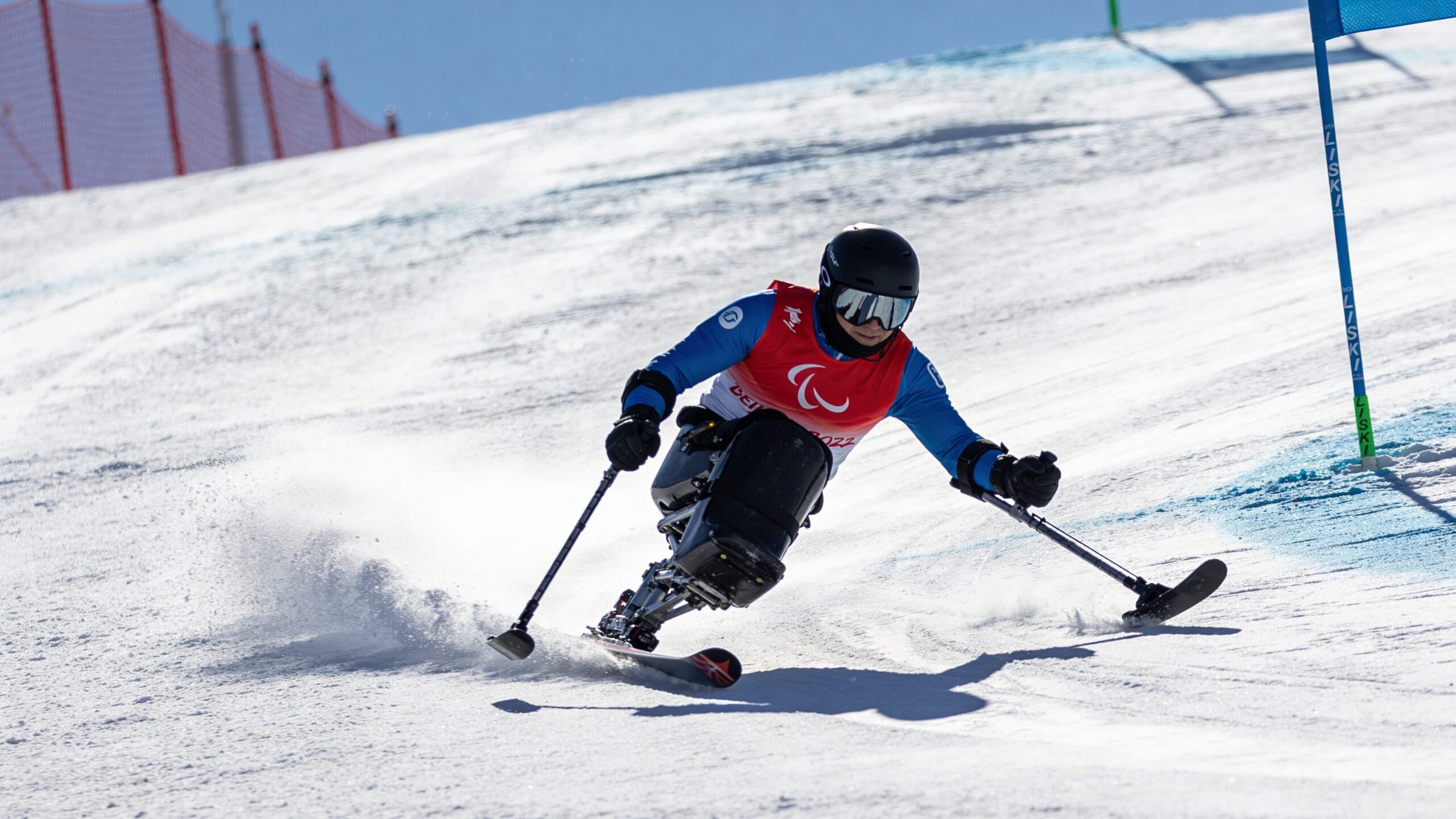
The alpine skiing it is the main mountain sport. But what happens when an athlete can’t use his legs? This is where the monoskiwhich allows people with amputations or paralysis of the lower limbs to practice alpine skiing and compete in the Paralympics. At first glance it seems like a simple sled mounted on a ski, but in reality it is the result of decades of technical evolution and biomechanical studies. How do athletes turn, brake and maintain balance on a single ski? And what are those crutch-like things they use on the track for? Let’s discover the technology and curiosities of one of the most fascinating tools in Paralympic sport.
What is monoski: features of operation
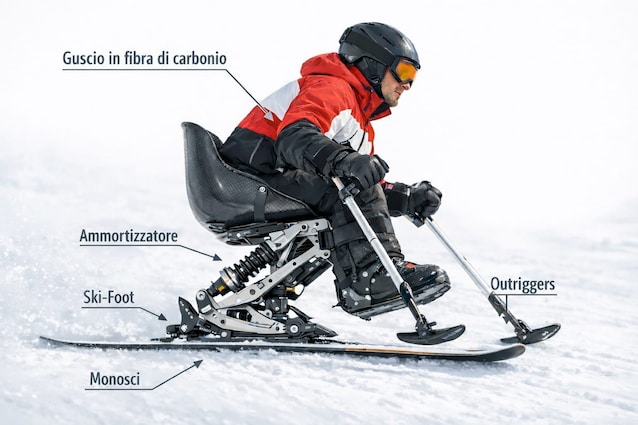
The monoski, one of the main variations of sit-skiis a tool designed to allow people with lower limb disabilities to ski sitting down. The principle is simple: one ergonomic seat it is fixed on a metal frame connected to a single traditional alpine ski. In this way the athlete slides on the snow like any other skier, but controls the movement by moving the torso and arms instead of the legs.
The structure of the monoski is made up of some key elements. The first is the seat shelltailor-made for the athlete in carbon fiber o Kevlar to guarantee rigidity: every slight movement of the torso must in fact transfer instantly to the ski without dispersion. Under the seat there is a shock absorberwhich replaces the work of the knees and ankles in traditional skiing, absorbing the irregularities of the terrain and keeping the ski in contact with the snow.
The monoski also uses a system called ski-footsort of “metallic artificial foot” which exactly replicates the attachment of a ski boot. This not only allows the use of standard alpine skis, but guarantees that the binding releases in the event of a violent fall, protecting the athlete’s back from dangerous twists.
How they control direction: the role of outriggers
But how do you control direction? Athletes use two particular tools called outriggerthat is, small crutches equipped with mini-ski at the end. These tools are essential to stabilize when cornering and to push yourself in departures.
When cornering, the inside one is almost used like a compass. The athlete points it slightly at the snow and rotates around it to close the trajectory, while the external one remains raised, ready to intervene to correct the balance. When they are not needed, for example on straights, they are raised off the ground to minimize friction.
The adjustment of these tools is a critical factor for safety: if the outriggers are too long, the skier cannot lean enough into turns because the tool contacts the snow too soon, leveraging and risking lifting the main ski. On the contrary, if they are too short, the athlete does not have enough support to handle wider and faster turns.
The result is a surprisingly effective system. Sitting skiers can cope practically any type of trackfrom fast descents to technical slaloms, just like standing skiers.
Monoski technology and biomechanics
One of the most relevant aspects of monoskiing is the much lower center of gravity compared to that of a standing skier. By sitting a few centimeters from the ski, the athlete achieves surprising stability even at high speeds (above 100 km/h), but must manage lateral balance with great precision. Each shift of the torso immediately changes the load distribution on the ski, influencing the trajectory of the turn.
Precisely for this reason the core strength — the abdominal, lumbar and dorsal muscles — is fundamental. In seated skiers these muscles do most of the work that is done by the legs in traditional skiing. During a descent the torso moves continuously to control vibrations, maintain balance and modulate the pressure on the ski.
In recent years monoskiing has become increasingly technological. Modern models use ultra-light carbon structures, adjustable suspensions and components customized for each athlete, a bit like what happens in Formula 1. In many cases the device is custom-designed: the seat is modeled on the skier’s body and the suspension stiffness is adjusted based on the driving style. Technical innovations that increase the price of competition monoskis among the 8,000 and 15,000 euros.
Athletes in the sitting category compete in same disciplines as traditional alpine skiing: downhill, super-giant, giant slalom and special slalom. To ensure balanced races, skiers are divided into different functional classes, identified with acronyms such as LW10, LW11 and LW12, based on the level of trunk control and residual mobility. The times obtained in the race are then corrected with a system of coefficients that takes into account the different functional capabilities.
