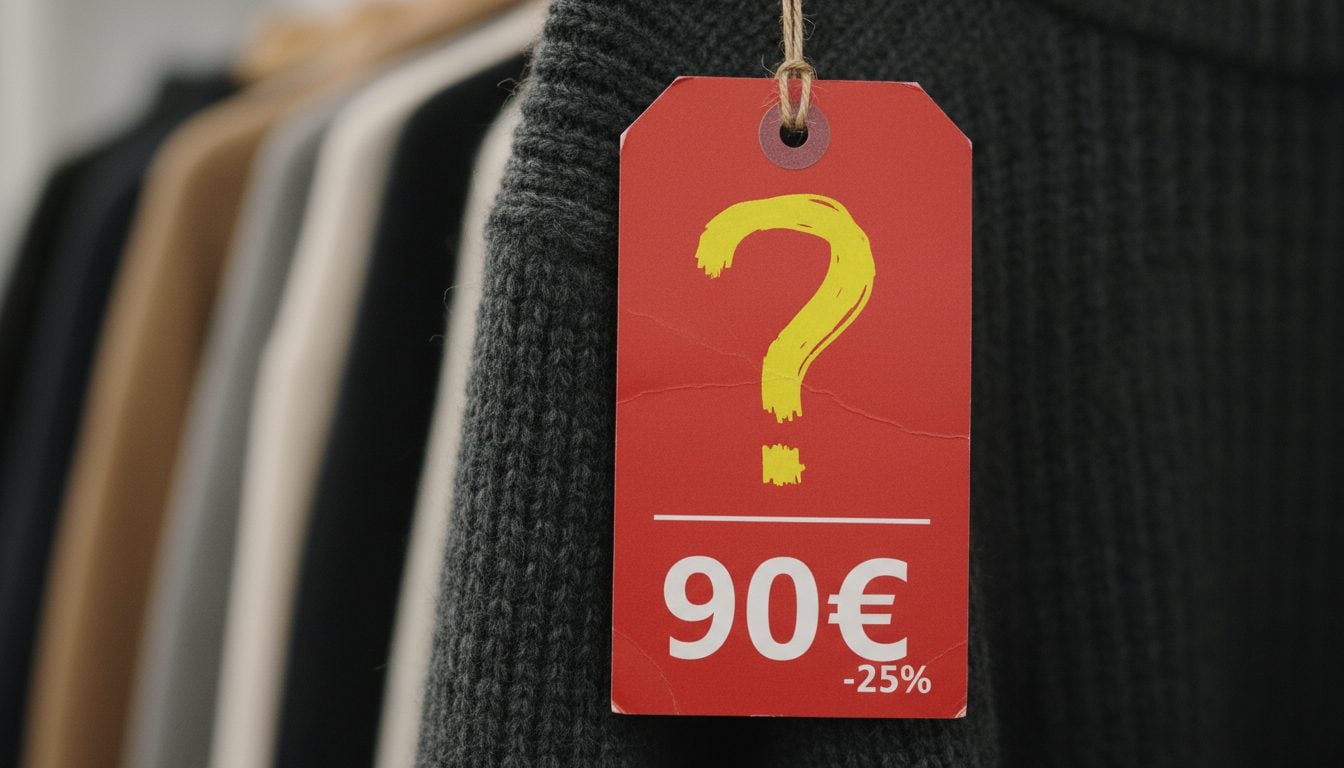
When there are i sales sometimes we find only the discount percentage and the discounted price displayed but, to evaluate whether to proceed with the purchase or not, it can be useful also know the original price. Let’s see how it is calculated and why many people get this calculation wrong.
From a regulatory point of view, in Europe, iThe seller should always indicate both the discounted and original prices (which should be the lowest price of the last 30 days) and, if the discount percentage is also indicated, this should be calculated correctly, without errors. However, this is not always the case and it may happen that not all the relevant information is exposed, for example if we are not in Europe, or if we are carrying out an informal sale, or if the seller has made some mistakes.
If only the original price and the discount percentage are provided to us, it is easy to determine the discounted price, simply calculate the discount and subtract it from the total. To calculate the discount we divide the total by 100 and multiply the result by the discount percentage. For example, to determine the discounted price of a 20% discounted sweater that originally cost 90 euros, we calculate (90:100)*2=18 and subtract it from the original price, obtaining the discounted price 90-18=72.
This is a type of calculation that most people are familiar with, but when we are faced with a discounted price and percentage and want to go back to the original price, things get slightly more complicated.
Let’s see it with an example. Suppose we want to purchase a product that, after being discounted by 25%is on sale at cost of €90how do we calculate the original price? The trick to being able to do the calculation is to focus not on the discount percentage, but on the remaining percentage: when a price is discounted by 25% it means that a part is removed from the original price, corresponding to its 25% and what remainsthe discounted price, it’s 75% i.e. 100% – 25% = 75%. In our example, the €90 discounted price corresponds to 75% of the original price, so to calculate the original price simply divide by 75 and multiply by 100: that is 90 : 75 = 1.2 and 1.2 × 100 = €120. We can summarize this calculation with an easy to remember formula:
original price = (discounted price):(100-percentage discount)×100
or alternatively, depending on how it is easier for each person to memorize,
original price = (discounted price)×100:(100-percentage discount)
In the formula we have highlighted the “100 – discount percentage” part in bold because a common mistake is to make this calculation using, instead of the highlighted part, the discount percentage without subtracting it from 100, thus thinking of calculating the discount amount. If we applied this incorrect procedure to our example, the discount would be as much as 90: 25 × 100 = €360, and by adding it to the discounted price we would find an original price of 360 + 90 = €450. This would be a price that is decidedly too high and we can verify it as follows: if we discount €450 by 25% we obtain a discounted price corresponding to €337.5, much more than the €90 we started with.
