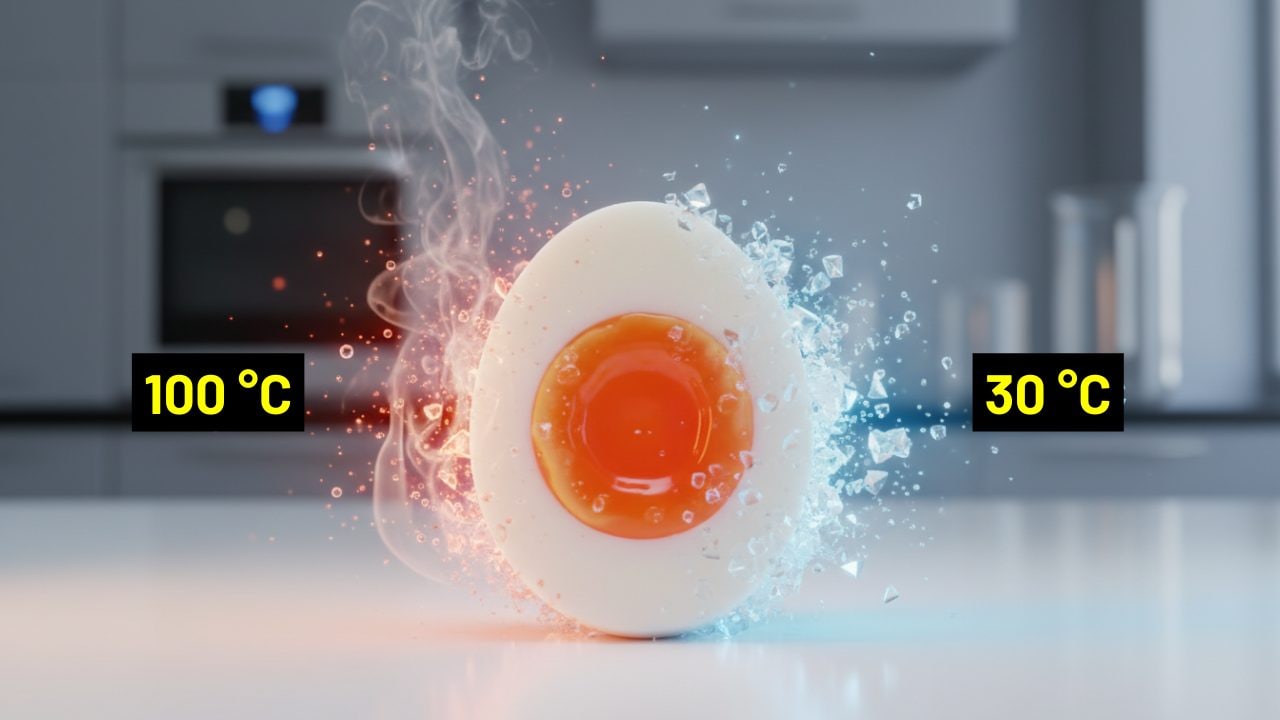
Here’s how to cook a “perfect” egg in a scientific way: put the egg with the shell in a pan with boiling water (100 °C) for 2 minutes then move it into a bowl with water 30°C for another 2 minutes and repeat the cycle eight times for a total of 32 minutes. This procedure is called periodic cooking and was created by Italian researchers from the CNR of Pozzuoli and the Federico II University of Naples to overcome cooking problems due to the biphasic nature of the egg. The egg white (85°C) and the yolk (65°C) require different cooking temperatures, making it difficult to obtain a balanced consistency of the parts without overcooking or undercooking one of the two. The study, published in the journal Nature, Engineering Communications, demonstrated that it is possible to cook egg white and yolk at two different temperatures without separating themusing specific conditions. To optimally cook an egg while maintaining its nutritional values and organoleptic characteristics, the authors Pellegrino Musto, Ernesto Di Maio and Emilia Di Lorenzo used software to study materials capable of simulating the recipe.
Traditional cooking techniques, such as the classic one boiling or the modern sous vide (cooking in a “bain-marie” between 60 and 70 degrees °C for at least an hour), often force chefs and cooking enthusiasts to make a compromise: either the yolk is cooked well or the egg white is cooked well. This happens due to the different chemical composition of the egg: thealbumen requires a temperature of 85°C to correctly denature its proteins (in particular ovotransferrin) and solidify while al yolk lower temperatures are “enough” (approx 65°C). Consequently, the sous vide it produces perfect yolks but egg whites with a gelatinous consistency. On the contrary, traditional boiling, by exposing the egg to a constant 100°C, tends to make the egg white rubbery before the heat reaches the heart to cook the yolk.
In the study the eggs were cooked four different ways, boiled for 12 and 6 minutes at 100 °Cin a “bain-marie” a 65°C for 1 hour and with periodic cooking which provides a total of 32 minutesdivided into 8 consecutive cycles:
- Immerse the egg with the shell in a pan with boiling water – 100 °C – for 2 minutes.
- Move the egg into a bowl with water at 30°C for 2 minutes.
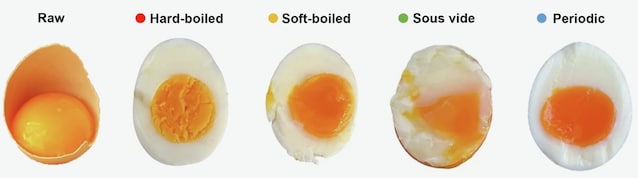
The eggs were then compared via different laboratory techniques such as spectroscopy to measure the denaturation of proteins), metabolomic analyzes to examine the nutritional profile, tests to evaluate the objective consistency of egg white and yolk and sensory analyzes to describe color and flavour. The latter have given significant differences for example between hard and periodic yolk (in softness, moisture, sweetness and umami), between “bain-marie” and periodic yolk (in shine, color, softness, humidity), between hard and periodic albumen (in brightness, color, density, moisture, softness, sweetness and umami) and between soft-boiled and periodic egg whites (in density, humidity, sweetness and flavor).
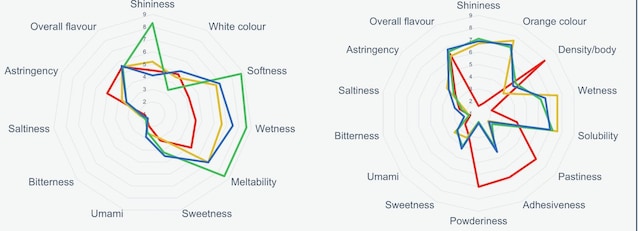
The results confirmed that periodic cooking gave an optimal result in terms of taste and nutritional values preserving the nutrients better than the other tested techniques. In addition to advantages in diet and cooking, the principle of periodic cooking has possible future applications in materials science, for example in crystallization and seasoning.
