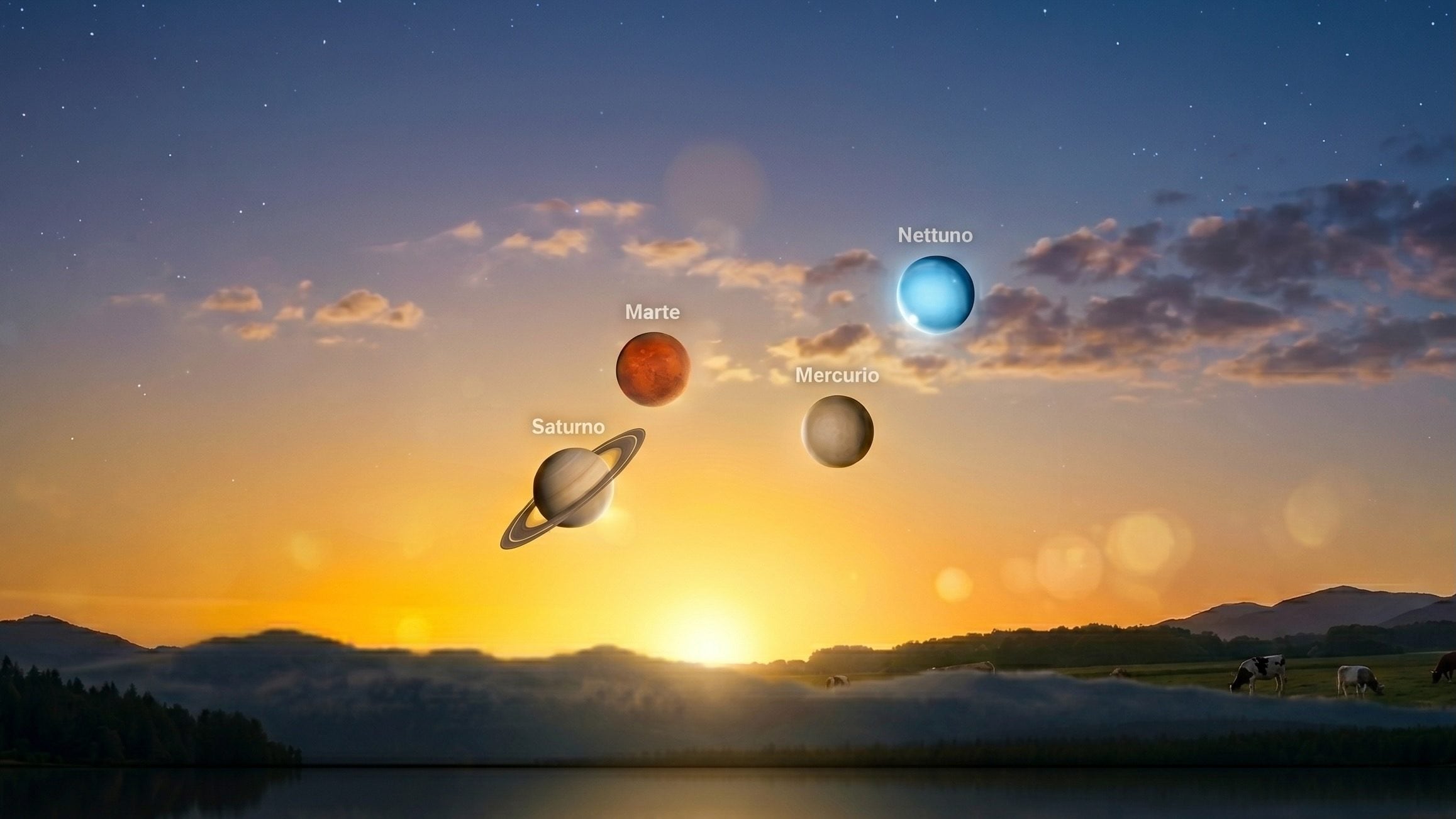
These days a new is visible planetary alignment: four planets of the Solar System (Mercury, Mars, Saturn and Neptune) appear simultaneously in the morning sky, just before sunrise. The alignment is already visible from April 16th, and will be until the 23rd, but the best days to observe the astronomical spectacle are between April 18th and 20th. Mercury, Mars and Saturn are visible to the naked eye, while for Neptune you will need good binoculars or a small telescope. This is not a perfect alignment in space (the planets will not literally be on a straight line) but they will appear to us collected in a relatively small region of the sky near theeclipticthe imaginary line on which the Sun appears to move during the year from the perspective of our planet.
To observe the alignment you have to look just above the eastern horizonin the area of the sky where the planets will rise before dawn. If you want to attempt observation, make sure you get a clear horizon to the east. Despite the dawn light, it will not be difficult to identify Saturn, Mars and Mercury with the naked eye, which will be arranged as in the image below. Neptune, visible only with the help of an instrument, can be found at the top right of Mercury, as in the cover image of this article.
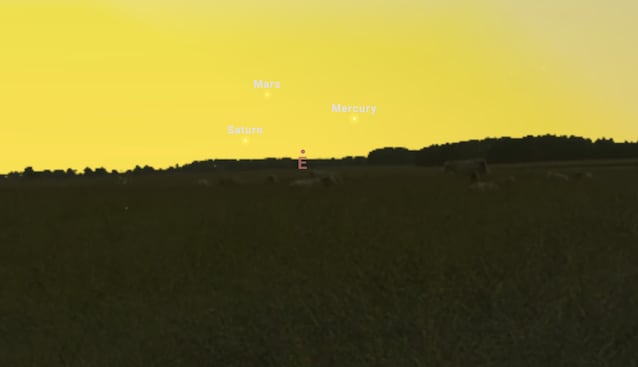
The planets are visible just before sunrise. The best time to observe the alignment is about 30 minutes before local sunrisewhose time varies by a few minutes depending on where we are in Italy. Indicatively, in Italy it dawns around 6:30, therefore the best time to observe the four planets start looking around 6:00 in the morning (a few minutes before 6:00 in Southern Italy, a few minutes later in the North). Those in the South and on the larger islands will have more favorable conditions than in the North, with the planets reaching a slightly higher maximum height above the horizon.
There main difficulty from Italy it will be there very low height above the horizon in a sky already illuminated by the glow of dawn. In addition to the lower visibility of the planets and the difficulty of finding the eastern horizon free of obstacles, other problematic factors could be phenomena such as morning mists which can prevent or ruin the observation.
