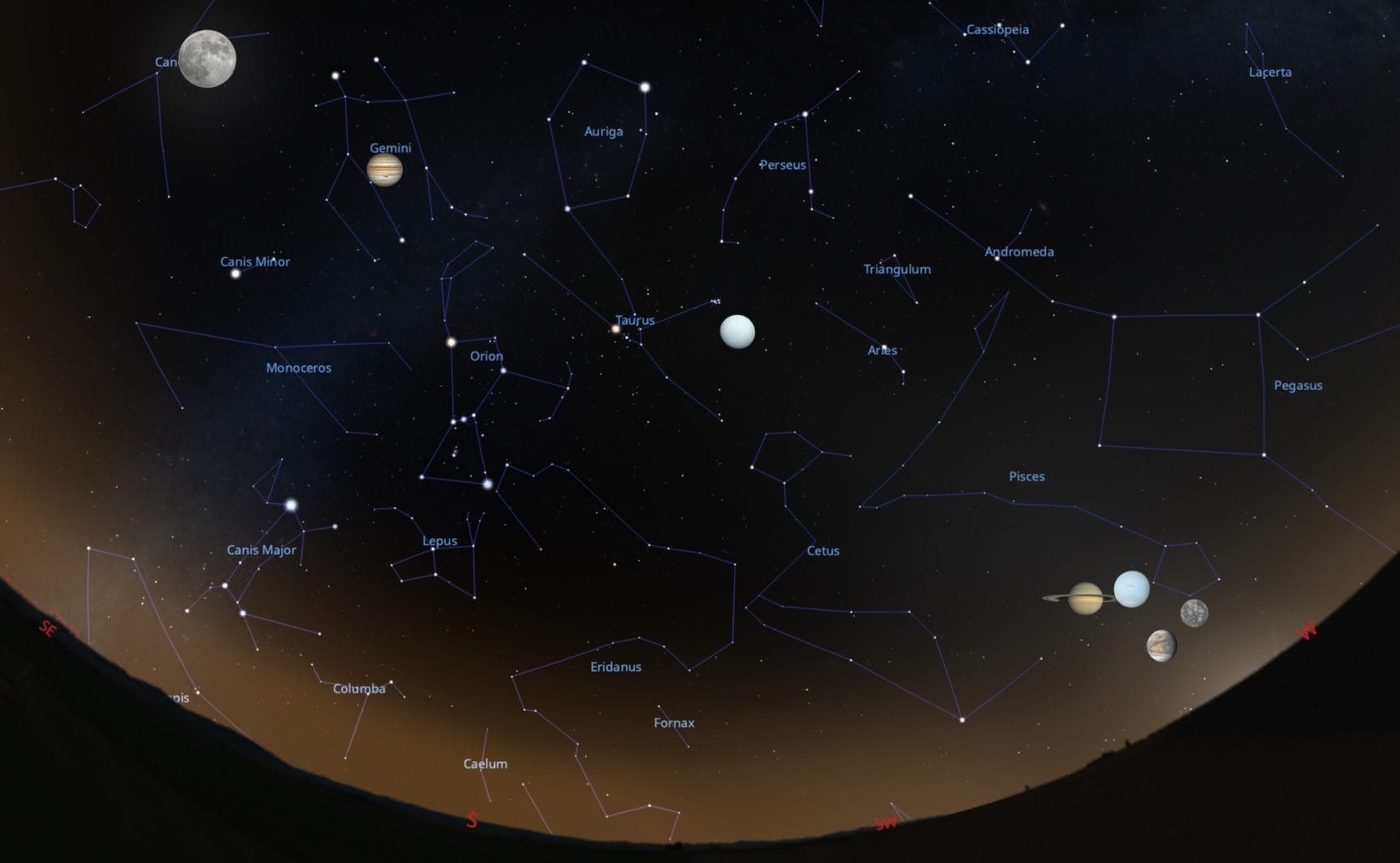
The February 28 we will have the chance to witness the first of two planetary alignments which will occur during 2026. The rare and spectacular event will see the six planets Mercury, Venus, Jupiter, Saturn, Uranus and Neptune all simultaneously visible in the sky, although only Mercury, Venus, Jupiter and Saturn will be visible to the naked eye. The astronomical show will begin at 6pm with the sunset of the Sun and the presence of Mercury and Venus, then around 6.30pm the other planets will arrive and all will be visible at the same time until around 7pm. To admire the phenomenon no binoculars or telescopes are neededjust go to one area with a clear western horizonsince four of the six planets will be quite low on thewestern horizon. Recall that the term planetary alignment is somewhat improper since the six planets they will not be aligned in a straight line in space, but they will be simply all visible in the sky at the same time. The next alignment 2026 is instead scheduled for Auguststraddling the period of the total solar eclipse in Europe.
The six planets Mercury, Venus, Jupiter, Saturn, Uranus and Neptune were simultaneously visible in the sky after sunset throughout the second half of February. But then why is reference made to the date of February 28? Simply the 28th represents the day on which Venus and Mercurythe two planets closest to the Sun (both physically and angularly), remain the same amount of time above the western horizon after sunset. Before the 28th, Venus was lower on the horizon than Mercury, setting earlier; after the 28th, however, the opposite situation occurs with Mercury setting before Venus.
On February 28, the Sun will set at 5.59pm to the coordinates of Rome. Venusthe brightest star in the night sky after the Moon, will be almost immediately visible at a height of approximately 10 degrees on thewest/southwest horizon. To be able to see Mercury and Saturn it will be necessary wait at least half an hourenough to decrease the brightness of the sky. Mercury will be visibleinitially to the naked eye, a few degrees to the right of Venusabout five on the western horizon. We recommend using binoculars for this planet. Also Saturn it will start to be visible about half an hour after sunsetat a height of 12 degrees on thewest/southwest horizon just above Venus. The last planet visible to the naked eye of this sextet, Jupiterit will be too visible almost immediately to 57 degrees in south-east directionthanks to its greater angular distance from the Sun. To its left, a 90% illuminated crescent Moon closes the picture of (non-stellar) objects visible to the naked eye during this alignment.
Uranus and Neptune Not instead they are visible to the naked eyerequiring at least a small telescope to be able to see them. Neptune will be located just to the right of Saturnalso therefore very low on the horizon, setting together with the Lord of the Rings about an hour and a half after sunset. Uranus, however, will be found halfway between Saturn and Jupiterat a height of 62 degrees on the southwest horizon half an hour after sunset, in the company of the splendid star cluster of the Pleiades, in the constellation of Taurus. We remind you that to best enjoy the celestial spectacle you will need to go to one area with a clear western horizoneven better if without light pollution.
