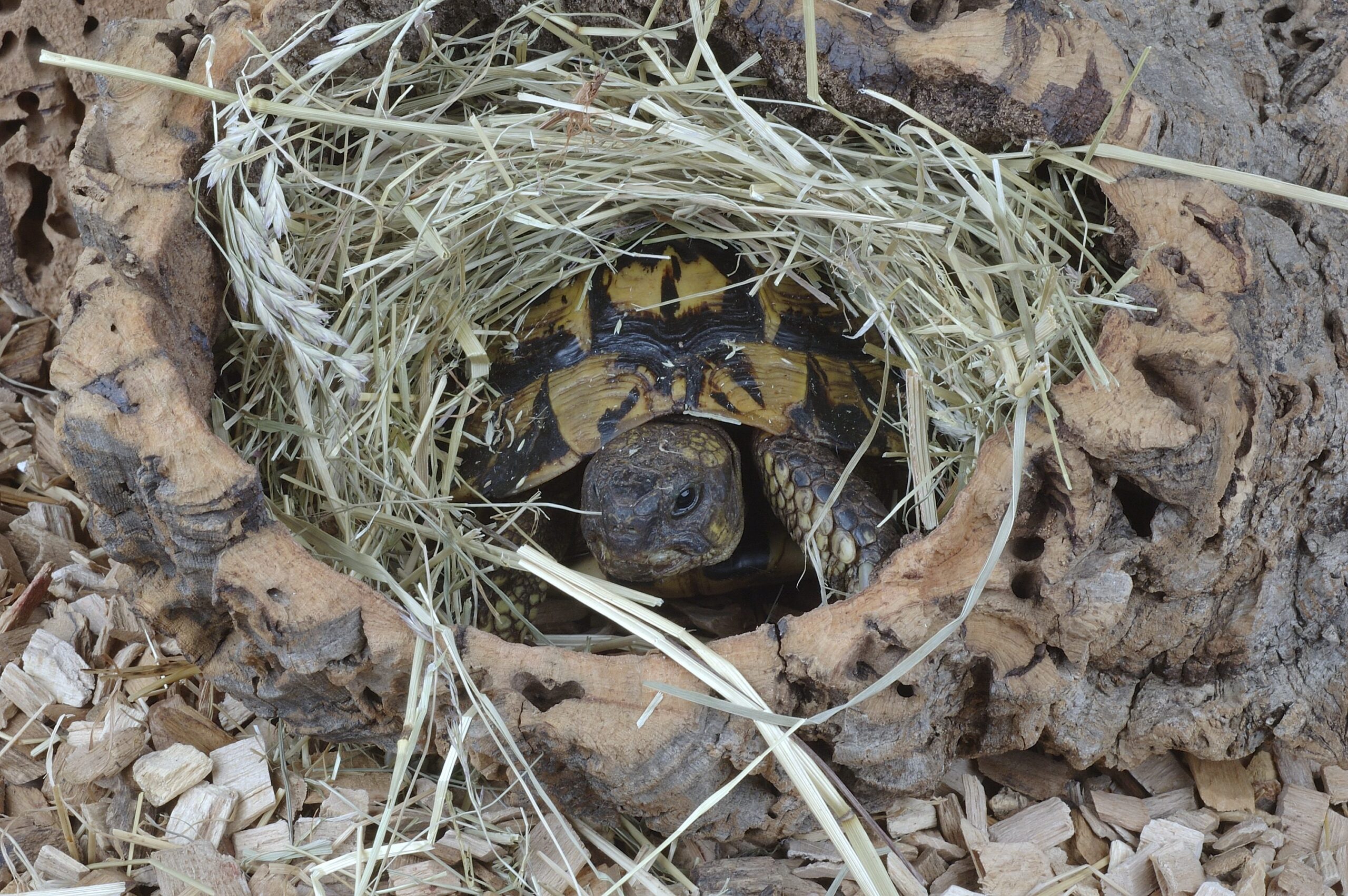
Who has one turtle in the garden, he hasn’t seen her around for some time because in the month of November she went in hibernationor almost. With the arrival of the winter season in our latitudes not only turtles, but in general all reptiles they undergo a particular form of quiescence and metabolic slowdown brumation. It is a process similar to hibernation from a functional point of view, but differs in the metabolic mechanisms involved. The term derives from the Latin “mist”, The coldest period of winter, and can be defined as a kind of hibernation softnecessary to survive the low temperatures, the few hours of sunshine and the scarcity of food. Turtles, as reptiles, are cold-blooded animals (ectotherms), incapable of thermoregulation and, therefore, with body temperature that varies according to that of the external environment, whose variations are fundamental for their survival: with temperatures below 5 °C, it is better for turtles find a sheltered placestop eating, slow down the heartbeat and vary some metabolic processes, waiting for the arrival of spring. There is no exact month in which brumation begins, but it all depends on the climatic conditions of the areaso much so that ongoing climate change is seriously threatening the regularity of many physiological mechanisms of these reptiles. To accompany your turtle in this delicate phase, it is essential contact your trusted veterinarian and create a suitable environment in your home or garden.
Which turtles go into brumation and what happens to their organism
Not all turtles go into brumationthis is an evolutionary adaptation of species that populate areas with temperate climate and with harsh wintershowever tropical and subtropical species or African ones do not brumate. Let’s take into consideration two turtles characteristic of Mediterranean environments and also present in Italy: the land tortoise (Testudo hermanni) and the pond turtle (Emys orbicularis)typical of stagnant waters.
The first is herbivorous and when temperatures begin to drop in autumn, it stops feeding and progressively empties its intestines. In about 20 days it looks for a sheltered place and buries itself in a hole of about 10-20 cm. The ideal brumation temperature is around 5 °C, which must remain almost constant in the burial site. The second is carnivorous and feeds on insects, molluscs and crustaceans. In autumn it also reduces its feeding and aggregates with other companions, in a small area with shallow waters and with the presence of aquatic vegetation to begin brumation. All during the winter slow down their metabolism by up to 95–99% and undergo, over the months, a average body mass loss of 5.32% .
Scientific research on turtles that were induced to hibernate, keeping them in controlled cooled environments, allowed the measurement of various physiological parameters. During brumation:
- the carapace cools (the armor) of the animal;
- the RNA content varies, significantly reducing the rate of protein synthesis;
- heart rate dropped to 10–20 beats per minute;
- decrease both theblood oxygenation that the quantities of molecules associated with energy consumption (for example ATP);
- the levels of corticosterone and thyroid hormones vary.

How to manage turtle hibernation at home: some suggestions
There brumation it is a delicate process and, if the temperature changes are sudden or the animal is not healthy, it can be fatal: the reptile can die from infections, excessive weight loss, tissue freezing or dehydration.
The domestic turtles they can enter brumation outdoors or indoors: the ideal condition is a fenced garden and in a sheltered positionwith well-drained soil, where our “family reptile” can dig a hole and bury itself to spend the winter. The area it must never freeze for sudden drops in temperature in the months of January and February.
In the absence of an outdoor space, it is possible to use one cellar or a refrigerated room with a stable temperature between 2 and 6 °C, humid enough to avoid dehydration of the animal, with a corner equipped with a certain quantity of substrate composed of moist earth. You can also add a double wooden box equipped with small holes for ventilation and covered with leaves. The entry of parasites or rodents must be absolutely avoided. Furthermore, if hibernation is too prolonged, the animal can die from dehydration or from exhaustion of energy reserves.
Before brumation a veterinary visit to evaluate the health conditions of our turtle and the level of emptying of the intestine, which must not retain partially digested food residues because it could cause infections. The process occurs slowly and large animals, of around 2-3 kg, also need a month of fasting to empty the bowel. The bladder should instead remain full, as a fluid reserve. Turtles that are underweight or affected by some pathology, instead of entering brumation, should be overwintered in a heated terrarium.
