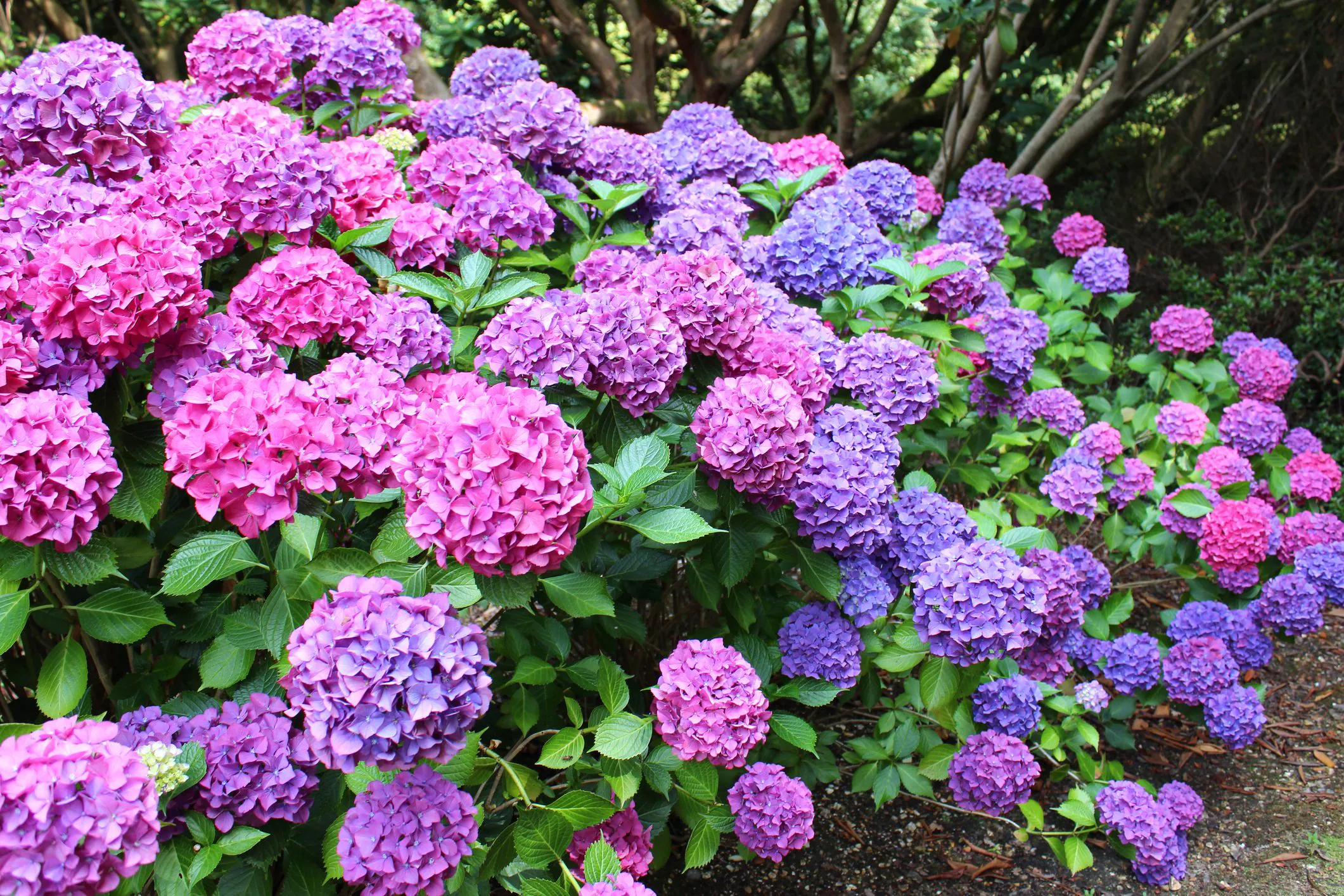
Hydrangeas are flowers of plants belonging to the genus Hydrangeamuch loved in gardens all over the world for their large and showy flowering “heads”. However, behind this familiar appearance lies a surprising plant: a very ancient genrewhose fossils date back to over 60 million years agoshortly after the disappearance of the dinosaurs, at the dawn of the age of mammals. What we mistake for petals are in reality sepalsand the famous color change from pink to blue it does not depend on the pH of the soil itselfbut by the availability of aluminum. Also, it takes weeks to see the color change, and no, it won’t work with the bouquet you have at home. Their history crosses nations and continents, passes through the samurai Japanese, nineteenth-century medicine and even today the origins of its name are not known.
A prehistoric flower
Fossils of the genus Hydrangea cover a very wide range, from Paleocene to Miocenethat is, from approximately 66 to 5 million years ago: the oldest, according to an article by the Geology Department of Western Washington University, were found in Alaska and date back to the Paleocene and Eocene. Interestingly, as described by the study in the analysis of fossils from the Chuckanut Formation (near Bellingham, United States), remains of Hydrangea were found in both the oldest and most recent layers of the formation, demonstrating the ability of the entire genus to adapt to the drastic climatic changes of the early Tertiary.
What you see… are not petals.
The round explosion that adorns many gardens, as might be guessed, is not a single flower, but ainflorescencethat is, a grouping of individual flowers with four colored “petals”. Here is the first botanical surprise: the little flowers that make up the pom pom are sterile and what’s more the petals are not real petals, but sepals. In botanical terms, sepals are modified leaflets which resemble colored petals.
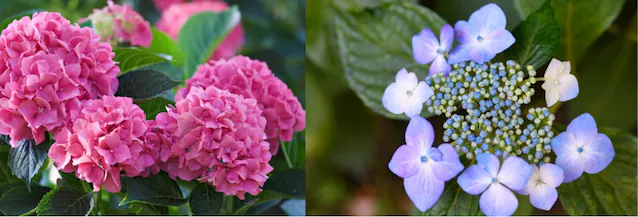
The inflorescence contains two types of flower. As Oregon State University’s botanical database describes, there are i fertile flowerssmall and non-ornamental, ei sterile flowerslarge and showy: it is the latter, with their colored sepals (from pale pink to red, fuchsia, purple or blue), that put on a show. Even the study on Chuckanut fossils describes them in the same way already millions of years ago (showy sterile “four-petaled” flowers alongside tiny fertile flowers) and hypothesizes that the sterile flowers served as recall and as a “landing strip” for pollinating insects.
Another curiosity is that often, in globose hydrangeas (those with pom-poms so to speak), the fertile flowers are almost completely hidden from sterile ones. This structure is called mophead (mop head), while fertile flowers are much more visible in hydrangeas lacecap (lace cap, with a flat structure). In the latter, the fertile flowers form a central flat disk surrounded by a crown of large sterile sepals.
The color arises from the chemistry of the soil and presence of aluminum
The most famous characteristic of the hydrangea is its ability to change color. Not only if we move it from one piece of land to another, but even the same plant can have pink flowers on the right and blue flowers on the left! Why? Some botany enthusiasts will have heard that pH has something to do with it… But it’s only a small aspect of the question.
In reality, what matters is the availability of aluminum in the soil and this depends directly on the pH. If the land is acidthe aluminum is free to move: it is absorbed by the roots and reaches the sepals, causing them to become blue. As the pH rises (becomes more basic), aluminum becomes less soluble: it precipitates as the hydroxide Al(OH)3 and is no longer absorbed by the roots. This gives rise to a range of colors ranging from the blue of acid soils, to lilac-violetto, until pink-red of basic soils.
The mechanism that makes the sepals turn blue is well explained in a 2010 study. At a molecular level, aluminum from the soil reaches the vacuoles of the sepals where it removes a hydrogen ion from the delphinidinan anthocyanidin present in hydrangea leaves and which gives it its pink-red base color. After this “theft”, delphinidin binds to the aluminum itself and, to stabilize and intensify the colour, a second pigment molecule it stacks on top of the complex, in a sort of “sandwich”, responsible for the blue color. A further study in 2018 completed the picture by identifying the third co-pigment, 5-O-caffeoylquinic acid.
There is one last subtlety: not all hydrangeas can turn blueeven with plenty of aluminum. The capacity depends on the genetically defined delphinidin content, as found by a 2023 study published in Scientia Horticlturaeand is in fact exclusive to Hydrangea macrophylla. White varieties and other species do not respond to soil.
It takes weeks to change color
Let’s dispel a myth: the color change is not instantaneous and it doesn’t happen with the bouquet you just placed in your favorite vase. Color is formed as the flower developsbecause the aluminum must be absorbed by rootsaccumulated and transported to the growing sepals, a process of weeks, not days. A potted cut flower has no roots, so it cannot absorb aluminum.
A study from 2025 proves this well: the best blue color is obtained by applying aluminum sulphate continuously, for approximately two weeks after trimming until flowering, and the longer the aluminum supply lasts during development, the more complete the transition from pink to blue is. This is why there are no quick pot “tricks”: the color is decided on the living and growing plant, over a period of weeks.
Between samurai, poisons and mysteries: the curious story of the hydrangea
In Japan the hydrangea, called ajisaihas very ancient roots: two poems on native species already appear in Man’yōshūthe oldest Japanese poetic collection, a sign that the plant it grew spontaneously on the archipelago over a thousand years ago. Today it is the symbol par excellence of the rainy season, but for centuries it was not loved at all.
The reason is curious and concerns precisely the botany we talked about. As a horticultural expert explains, the four sepals recalled the number fourin Japanese shihomophone of the word “death”: an unfortunate association that caused the plant to be avoided. Furthermore, its continuous changing color was read as a sign of disloyaltyand for this reason the samurai, for whom loyalty to the lord was everything, avoided it. Popularity came only later and in a roundabout way: at the end of the Edo period, the doctor Philipp Franz von Siebold brought several wild hydrangeas to Europe, where they sparked a fashion for the “Eastern rose” and then returned to Japan, in the Meiji era, renamed “Western” hydrangeas.
In addition to its troubled cultural path, this species hides a double soul. In the United States in the 19th century, hydrangea entered complementary medicine in the form of tablets, elixirs and extracts for diuretic use and some of these medicines are still preserved in the Smithsonian’s National Museum of American History. Be careful, though: the same plant that heals can also do harm. A phytochemical study isolated from the leaves of Hydrangea macrophylla two new ones cyanogenic glycosides and in fact, in traditional Chinese medicine the plant is considered toxic. In other words, it is a plant to be admired in the garden, not to be put on your plate.
Even its etymology is an enigma. The botanical name Hydrangea comes from Greek hydro– (water) e angeîon (vase, container), a reference to cup shape of seed capsules, similar to an ancient water jug. According to the foundation Plants & Flowersit was coined in 1739 by the botanist Jan Frederik Gronovius. The common name hydrangea, however, is of origin French and his birth remains shrouded in mystery. It was the naturalist Philibert Commerson who introduced it in 1771, but it is not known for certain what inspired it. There are three hypotheses: that he wanted to pay homage to a woman dear to him, his lover, or a well-known astronomer with whom he was in close contact; that the name alludes to Hortense de Nassaudaughter of the Prince of Nassau met during a botanical expedition. The least romantic option is that it comes from Latin hortus (“garden”), since Commerson found the plant in the garden of the King of Mauritius.
Sources:
Mustoe, George. (2002). Hydrangea fossils from the early Tertiary Chuckanut Formation. Washington Geology. Oregon State University – Hydrangea macrophylla Schreiber HD, Swink AM, Godsey TD (2010), The chemical mechanism for Al³⁺ complexing with delphinidin, Journal of Inorganic Biochemistry Ito T, Oyama Ki, Yoshida K. Direct Observation of Hydrangea Blue-Complex Composed of 3-O-Glucosyldelphinidin, Al3+ and 5-O-Acylquinic Acid by ESI-Mass Spectrometry. Molecules. 2018 Yuan, Suxia & Qi, Hui & Yang, Suoning & Chu, Zhiyun & Zhang, Gaitian & Chun, Liu. (2023). Role of delphinidin-3-glucoside in the sepal blue color change among Hydrangea macrophylla cultivars. Scientia Horticulturae. Wang Y, Liang Z, Liu C, Fan Y, Yuan S. Effects of Aluminum Concentration and Application Period on Sepal Bluing and Growth of Hydrangea macrophylla. Horticulture. 2025 Yang CJ, Wang ZB, Zhu DL, Yu Y, Lei YT, Liu Y. Two new cyanogenic glucosides from the leaves of Hydrangea macrophylla. Molecules. 2012 How the hydrangea got its name, Plants & Flowers Foundation Netherlands Blooming and Booming: Japan’s Hydrangeas Enjoy Surge in Popularity Smithsonian’s National Museum of American History Selected hydrangea histories
